
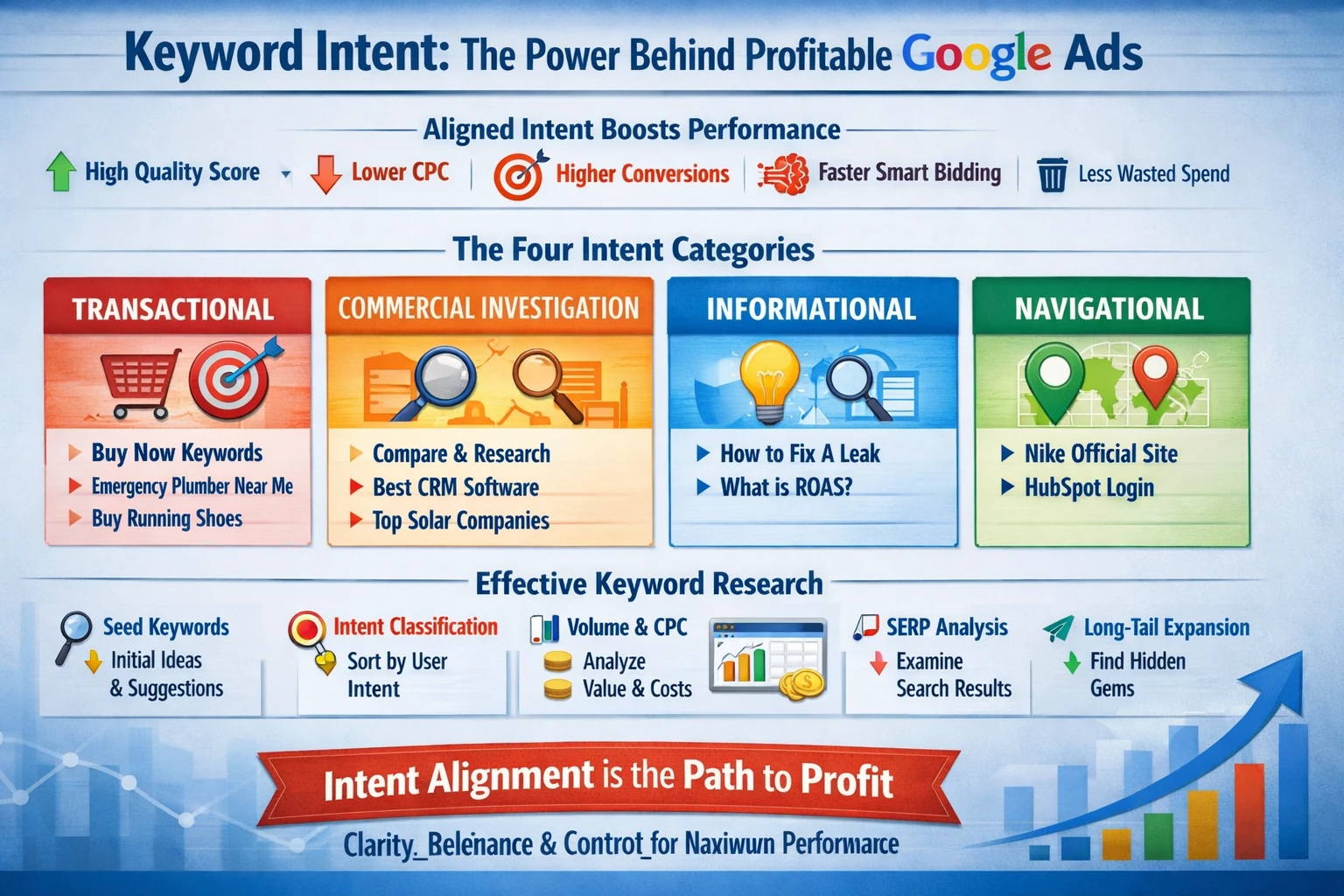
Understanding keyword intent is one of the most decisive factors in Google Ads profitability. Two advertisers can target the same keyword list, yet one pays half the CPC and generates triple the conversions simply because their keyword strategy aligns with user intent. This pillar breaks down how intent works, how to classify it, and how to build a research workflow that consistently uncovers high‑value opportunities.
How Intent Shapes Performance
Every search query carries a psychological signal about what the user wants. Google’s auction system rewards advertisers who match that intent with relevant ads and landing pages. When intent is aligned:
- Quality Score increases
- CPC decreases
- Conversion rate rises
- Smart Bidding learns faster
- Wasted spend drops
When intent is mismatched, Google interprets your ads as low‑relevance, and performance collapses.
The Four Intent Categories
All keywords fall into one of four intent buckets. Treating them as interchangeable is a common beginner mistake.
- Transactional intent — The user is ready to buy, hire, or take action. Examples: “emergency plumber near me”, “buy running shoes online”, “hire PPC agency”. These are the highest‑value keywords and should receive the highest bids and cleanest structure.
- Commercial investigation — The user is comparing options or researching before buying. Examples: “best CRM for small business”, “top solar companies”, “PPC agency reviews”. These keywords convert well but require strong landing pages and trust signals.
- Informational intent — The user wants to learn, not buy. Examples: “how to fix leaking pipe”, “what is ROAS”, “how Google Ads works”. These are useful for remarketing and audience building but rarely convert directly.
- Navigational intent — The user is searching for a specific brand or website. Examples: “HubSpot login”, “Nike shoes official site”. These are valuable for brand protection and competitor conquesting.
Segmenting keywords by intent ensures each campaign and ad group speaks directly to the user’s mindset.
Match Types and Intent Control
Match types determine how tightly your ads match user queries.
- Exact match is ideal for transactional intent because it protects precision.
- Phrase match works well for commercial investigation where variations matter.
- Broad match can be powerful when paired with strong conversion data and audience signals, but it must be monitored closely.
Using broad match on informational intent without negatives is one of the fastest ways to burn budget.
Keyword Research Workflow
A professional keyword research workflow includes:
- Seed keyword extraction from client interviews, competitor sites, and search suggestions.
- Intent classification to group keywords by psychological stage.
- Volume and CPC analysis to prioritize high‑value opportunities.
- SERP inspection to understand what Google believes the intent is.
- Negative keyword mapping to eliminate irrelevant traffic.
- Long‑tail expansion to capture cheaper, high‑intent queries.
This workflow ensures you build campaigns around profitable intent rather than random keyword lists.
Using Competitor Intent to Your Advantage
Competitor research reveals:
- Gaps in their keyword coverage
- High‑intent keywords they ignore
- Weak landing pages you can outperform
- Branded terms you can conquest
Competitor intent analysis often uncovers hidden opportunities that generic keyword tools miss.
The Strategic Takeaway
Keyword intent is the compass that guides your entire Google Ads strategy. When you align keywords, ads, and landing pages with the user’s intent, you create a system that is cheaper to run, easier to optimize, and far more profitable.