
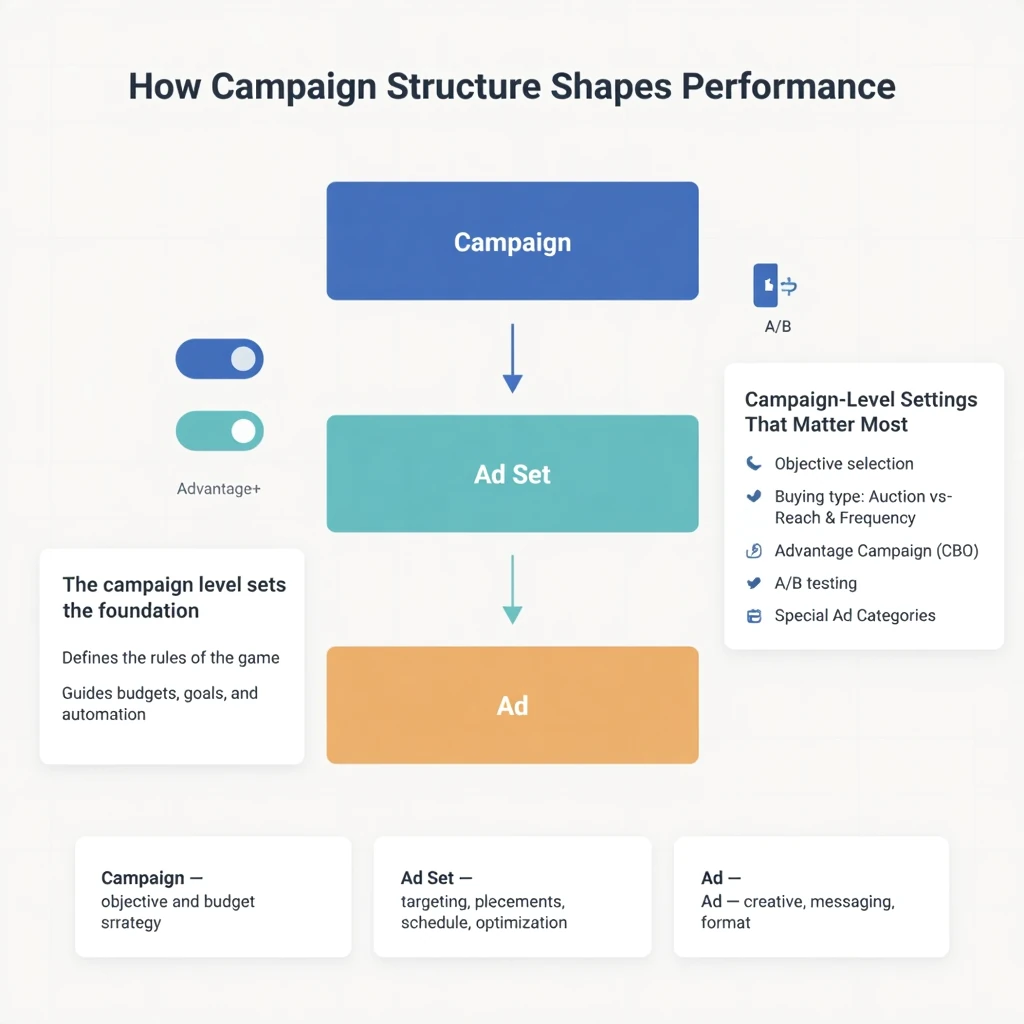
Meta Ads Manager is built on a three-tier architecture—Campaign → Ad Set → Ad—and the campaign level sets the foundation. The decisions made here determine how the algorithm interprets your goals, how budgets flow, and how automation behaves. Even though the campaign level has fewer settings than the ad set or ad level, it is strategically the most important layer because it defines the “rules of the game” for everything that follows.
How Campaign Structure Shapes Performance
The campaign level controls the overarching strategy:
- What the algorithm is optimizing for
- Whether budgets are controlled centrally or at the ad set level
- Whether automation (Advantage+) is allowed to take over
- How experiments and A/B tests are configured
A well‑structured campaign creates clarity for the algorithm. A poorly structured one forces Meta to guess, which leads to unstable delivery, inconsistent costs, and difficulty scaling.
Campaign Architecture: The Three‑Tier System
Meta’s structure is intentionally simple:
- Campaign — defines the objective and budget strategy
- Ad Set — defines targeting, placements, schedule, and optimization events
- Ad — defines creative, messaging, and format
This hierarchy ensures that each layer has a specific job. When advertisers mix responsibilities—such as testing audiences at the campaign level or mixing funnel stages in one campaign—performance degrades quickly.
Campaign-Level Settings That Matter Most
Several settings at the campaign level have outsized impact on performance:
- Objective selection — determines the optimization goal
- Buying type — Auction vs. Reach & Frequency
- Advantage Campaign Budget (CBO) — centralizes budget allocation
- A/B testing — isolates variables for clean learning
- Special Ad Categories — applies restrictions for housing, credit, employment
Each of these settings influences how Meta distributes impressions and how aggressively it pursues your desired outcome.
Advantage Campaign Budget (CBO)
CBO allows Meta to allocate budget dynamically across ad sets. It is especially powerful when:
- You have multiple audiences of varying sizes
- You want the algorithm to find the most efficient pockets of performance
- You are scaling a proven structure
However, CBO requires stable ad sets. If audiences overlap heavily or if ad sets are under‑developed, CBO can starve certain segments and distort learning.
Buying Type: Auction vs. Reach & Frequency
Most advertisers use Auction, which optimizes for performance and cost efficiency. Reach & Frequency is useful for:
- Predictable delivery
- Brand campaigns
- Large audiences
- Fixed CPM planning
Choosing the wrong buying type can lead to wasted budget or misaligned expectations.
A/B Testing at the Campaign Level
Meta’s built‑in testing framework allows advertisers to isolate variables such as:
- Creative
- Audience
- Placements
- Optimization events
- Budget strategies
Running structured experiments prevents guesswork and accelerates learning. The key is to test one variable at a time and allow enough time for the algorithm to stabilize.
Strategic Takeaway
Campaign-level structure is the blueprint for everything that happens inside Meta Ads Manager. When objectives, budgets, and buying types are aligned with your funnel and data maturity, the algorithm performs more efficiently and scales more predictably. Strong campaigns are built on clarity, simplicity, and clean separation of responsibilities across the three tiers.