
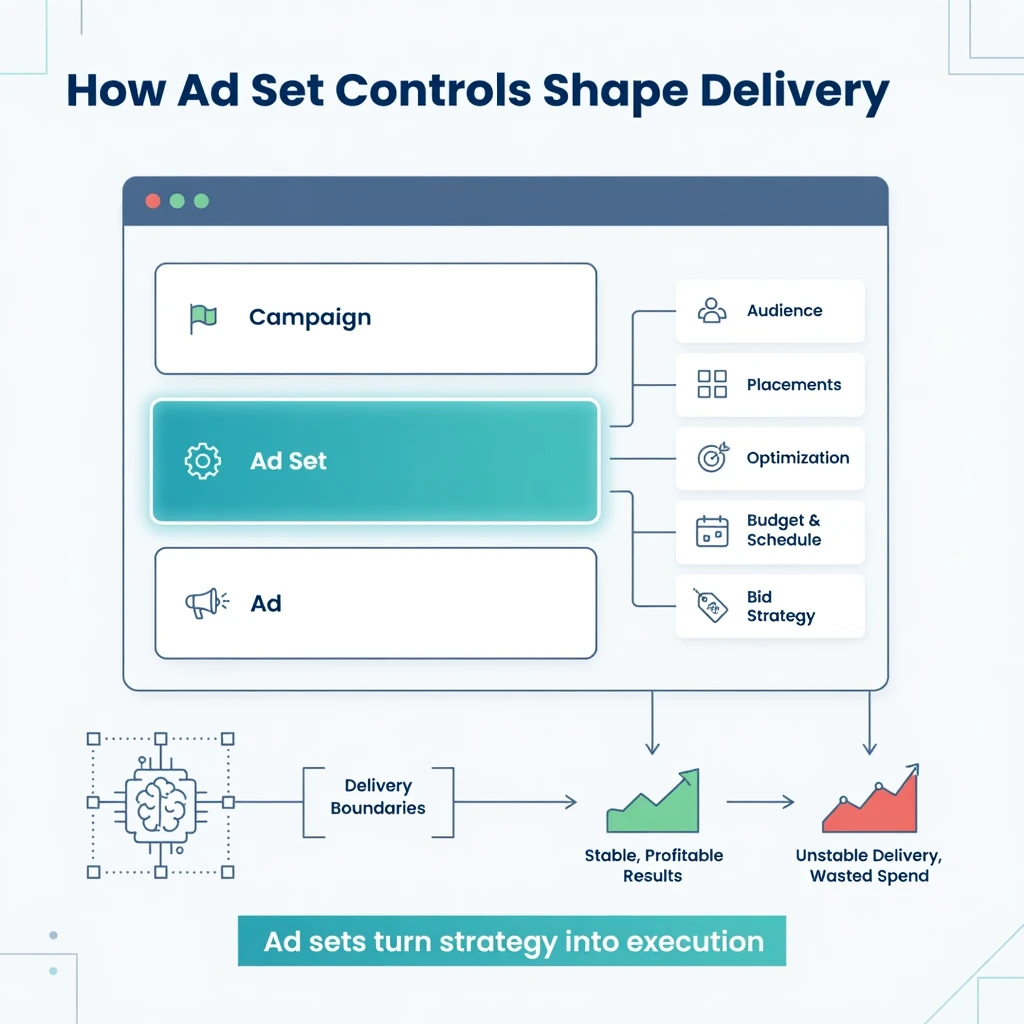
Ad sets are the operational engine of Meta Ads Manager. While campaigns define the goal, ad sets determine how the algorithm pursues that goal. This layer controls targeting, placements, optimization events, scheduling, and budget distribution. Strong ad set configuration ensures the algorithm has the right constraints, signals, and environment to deliver profitable results. Weak configuration leads to unstable delivery, inconsistent costs, and wasted spend.
How Ad Set Controls Shape Delivery
Meta’s algorithm makes millions of micro‑decisions during delivery. The ad set settings act as the boundaries for those decisions. They determine:
- Who is eligible to see your ads
- Where your ads can appear
- When your ads run
- What event does the algorithm optimize for
- How aggressively it bids
- How budget flows across audiences
Because of this, the ad set is where most performance issues originate—and where most performance breakthroughs occur.
Audience Controls
Audience selection defines the pool of people Meta can target. The key components include:
- Saved audiences (interests, behaviors, demographics)
- Custom audiences (warm traffic, engagers, customers)
- Lookalike audiences (predictive modeling)
- Advantage+ audience expansion
The most effective ad sets use broad or lightly‑defined audiences, allowing the algorithm to explore. Overly narrow targeting restricts learning and increases CPMs. Clean exclusions—such as removing purchasers from prospecting—are essential for efficiency.
Placement Controls
Placements determine where ads appear across Meta’s ecosystem:
- Facebook Feed
- Instagram Feed
- Reels
- Stories
- Messenger
- Audience Network
Meta strongly favors Advantage+ Placements, which allow the algorithm to distribute impressions where performance is strongest. Manual placement selection is useful only when:
- Creative is format‑specific
- Brand safety requires strict control
- Testing a new placement in isolation
In most cases, broader placement access improves efficiency and scale.
Optimization & Delivery Settings
This is one of the most important sections of the ad set. It tells Meta what action to optimize for. Options include:
- Conversions (purchases, leads, add‑to‑cart, etc.)
- Landing page views
- Link clicks
- Impressions
- Reach
- ThruPlay (video)
Choosing the wrong optimization event is one of the most common causes of poor performance. For example, optimizing for link clicks attracts clickers—not buyers. Optimizing for purchases attracts people most likely to convert, even if CPM is higher.
Budget & Schedule Controls
If you’re not using CBO, budgets are set at the ad set level. Key considerations include:
- Daily vs. lifetime budgets
- Minimum learning volume
- Avoiding frequent budget changes
- Ensuring enough data for stable optimization
Scheduling allows you to run ads continuously or during specific hours. Most advertisers benefit from continuous delivery unless data clearly shows time‑based inefficiencies.
Bid Strategy Controls
Bid strategies influence how aggressively Meta competes in the auction:
- Lowest cost
- Cost cap
- Bid cap
- ROAS goal
Lowest cost is the most stable for learning. Cost caps and bid caps require strong historical data and consistent conversion volume.
Strategic Takeaway
Ad sets are where strategy becomes execution. When targeting, placements, optimization events, and bidding are aligned, the algorithm performs predictably and efficiently. Clean structure at the ad set level reduces volatility, accelerates learning, and creates the conditions for scalable growth.