
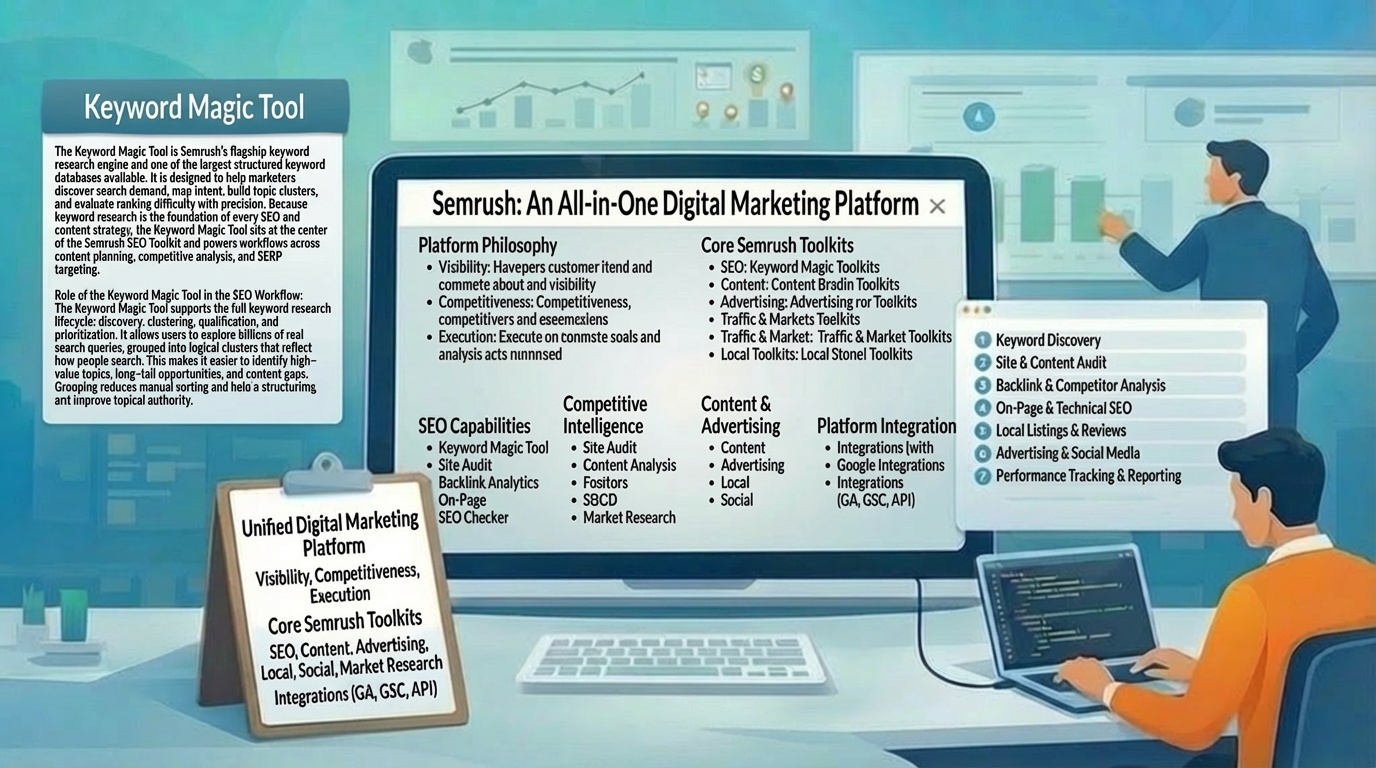
The Keyword Magic Tool is Semrush’s flagship keyword research engine and one of the largest structured keyword databases available. It is designed to help marketers discover search demand, map intent, build topic clusters, and evaluate ranking difficulty with precision. Because keyword research is the foundation of every SEO and content strategy, the Keyword Magic Tool sits at the center of the Semrush SEO Toolkit and powers workflows across content planning, competitive analysis, and SERP targeting.
Role of the Keyword Magic Tool in the SEO Workflow
The Keyword Magic Tool supports the full keyword research lifecycle: discovery, clustering, qualification, and prioritization. It allows users to explore billions of real search queries, grouped into logical clusters that reflect how people search. This makes it easier to identify high‑value topics, long‑tail opportunities, and content gaps. The tool also integrates with Keyword Manager, Position Tracking, and the SEO Writing Assistant, creating a seamless research‑to‑execution pipeline.
Keyword Database & Search Intent Classification
Semrush organizes keywords into topic‑based clusters and automatically assigns search intent categories such as informational, navigational, commercial, and transactional. This helps marketers understand what users expect when they search and ensures content aligns with SERP expectations. Intent classification is especially important for prioritizing keywords that match your business goals—whether you’re targeting awareness, consideration, or conversion.
The database includes broad match, phrase match, exact match, and related keyword variations, giving users multiple angles for discovering opportunities.
Core Metrics: Volume, KD%, CPC, and Competitive Density
Each keyword includes several metrics that guide decision‑making:
- Search Volume — Average monthly searches, indicating demand.
- Keyword Difficulty (KD%) — A percentage score estimating how hard it is to rank organically.
- CPC — Cost‑per‑click estimates for paid search.
- Competitive Density — How competitive the keyword is in paid advertising.
- SERP Features — Indicators such as featured snippets, local packs, or video results.
These metrics help marketers balance opportunity with feasibility and choose keywords that align with their authority and resources.
Keyword Grouping & Topic Clustering
One of the Keyword Magic Tool’s strengths is its automatic grouping system. Keywords are organized into clusters and subgroups based on semantic relationships. This supports:
- Topic cluster creation
- Content hub planning
- Internal linking strategies
- Editorial calendar development
Grouping reduces manual sorting and helps teams build structured content ecosystems that improve topical authority.
Filters & Advanced Research Capabilities
The tool includes filters for:
- Word count
- Intent
- Volume range
- KD% range
- SERP features
- Questions
- Competitive density
These filters allow users to refine large keyword sets into actionable lists. The “Questions” filter is especially useful for identifying long‑tail opportunities and FAQ‑style content that captures conversational search.
Integration With Other Semrush Tools
Keywords can be sent directly to Keyword Manager for deeper analysis, saved into lists, or exported into Position Tracking for monitoring. They can also be used to generate SEO briefs in the Content Marketing Toolkit or optimized using the SEO Writing Assistant. This integration ensures keyword research flows naturally into content creation and performance tracking.
Strategic Use Cases
The Keyword Magic Tool supports multiple workflows:
- Building topic clusters for SEO
- Identifying long‑tail opportunities
- Planning blog content and landing pages
- Discovering competitor keyword gaps
- Supporting PPC keyword planning
- Creating SERP‑aligned content strategies
Its versatility makes it essential for both SEO specialists and content teams.