
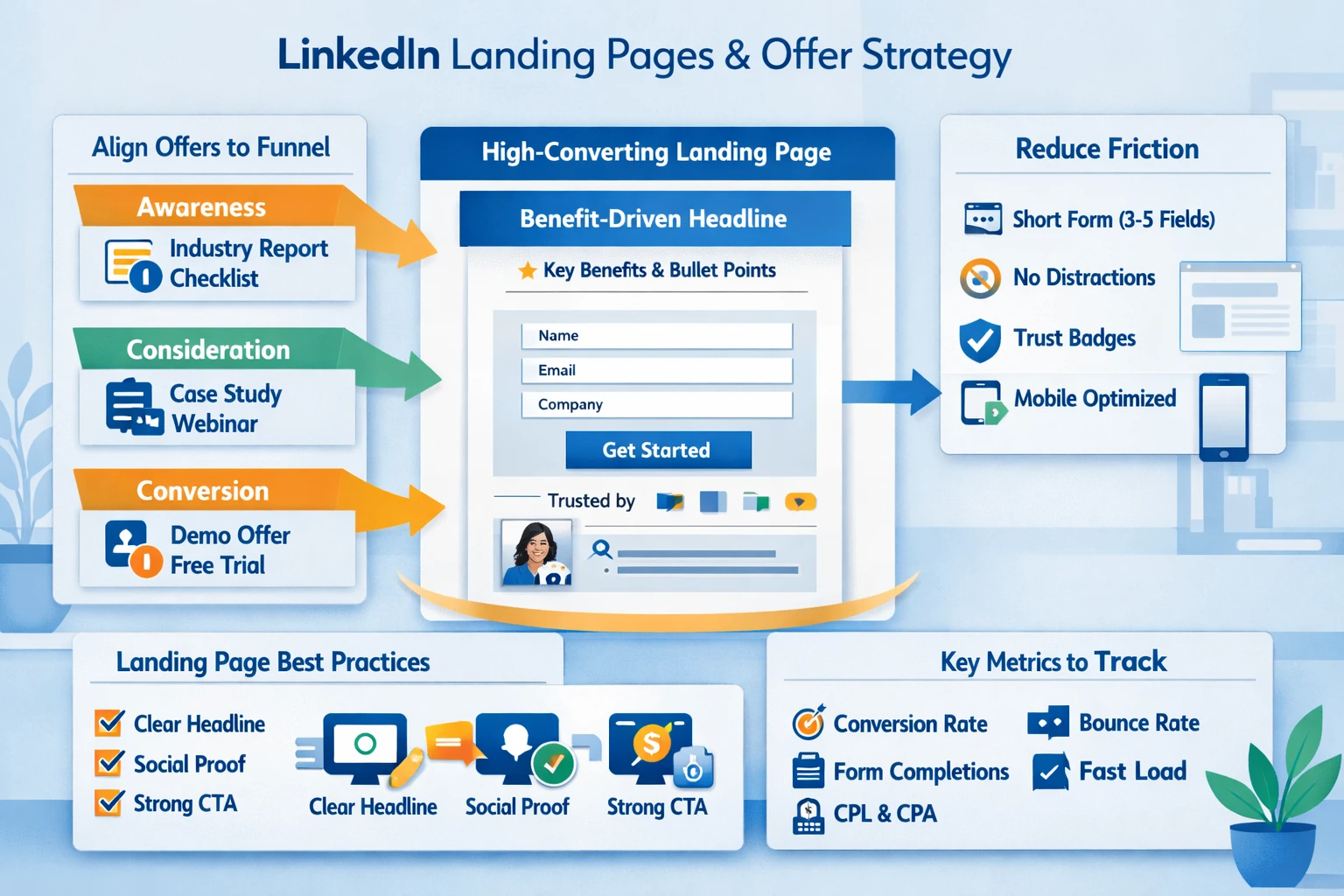
Landing pages and offer strategy determine whether your LinkedIn traffic turns into qualified leads. Because LinkedIn clicks are expensive and the audience is highly professional, your landing pages must deliver clarity, authority, and frictionless conversion. This pillar explains how to structure landing pages for B2B intent, how to align offers with funnel stages, how to reduce drop‑off, and how to ensure your conversion experience matches LinkedIn’s premium audience expectations.
Why Landing Pages Matter More on LinkedIn
LinkedIn users click with purpose. They expect:
- Clear value
- Professional presentation
- Fast loading
- Minimal friction
- Direct alignment with the ad they clicked
Any disconnect between the ad and the landing page increases bounce rate and CPL. Because CPCs are higher on LinkedIn, even small inefficiencies become expensive. Strong landing pages protect your budget and improve lead quality.
Matching Offers to Funnel Stage
Your offer must match the user’s intent. LinkedIn’s professional audience responds best to value‑driven, insight‑rich offers.
- Top of Funnel (Awareness)
- Industry reports
- Benchmark studies
- Frameworks
- Checklists
- Playbooks
- Document previews
- Middle of Funnel (Consideration)
- Case studies
- Webinars
- Comparison guides
- ROI calculators
- Product explainers
- Bottom of Funnel (Conversion)
- Demo requests
- Consultations
- Free trials
- Pricing pages
- Assessment calls
Misaligned offers—like pushing demos to cold audiences—drive up CPL and reduce lead quality.
Structuring High‑Converting Landing Pages
Effective LinkedIn landing pages follow a predictable structure:
- A clear, benefit‑driven headline
- A concise sub‑headline explaining the value
- A short paragraph or bullet list of what the user will get
- A simple form with minimal fields
- Social proof (logos, testimonials, stats)
- A strong CTA button
- Mobile‑optimized layout
- Fast loading speed
LinkedIn users prefer clarity over creativity. The page should feel like a continuation of the ad, not a new experience.
Reducing Friction to Increase Conversions
Friction kills B2B conversions. Reduce it by:
- Keeping forms short (3–5 fields)
- Using multi‑step forms for qualification
- Removing unnecessary navigation links
- Using trust badges or compliance statements
- Ensuring mobile responsiveness
- Avoiding long paragraphs or dense text
If you need deeper qualification, ask those questions after the initial conversion.
When to Use Lead Gen Forms Instead of Landing Pages
Lead Gen Forms outperform landing pages when:
- You need volume
- You’re promoting gated content
- You want to reduce friction
- Your landing page is not optimized
- You’re targeting mobile users
Landing pages are better when:
- You need custom qualification
- You want to educate before conversion
- You need multi‑step funnels
- You want to track deeper on‑site behavior
A hybrid strategy—Lead Gen Forms for TOF/MOF and landing pages for BOF—often performs best.
Optimizing Offers for Lead Quality
Lead quality depends on both the offer and the audience. Improve quality by:
- Aligning offers with seniority and job function
- Using industry‑specific landing pages
- Adding 1–2 qualification fields
- Using case studies for high‑intent audiences
- Offering value that speaks to business outcomes
High‑value offers attract high‑value leads.
Measuring Landing Page Performance
Key metrics include:
- Conversion rate
- Bounce rate
- Time on page
- Scroll depth
- Form completion rate
- CPL and CPA
- Lead quality (CRM feedback)
LinkedIn’s Insight Tag helps track post‑click behavior and optimize accordingly.