
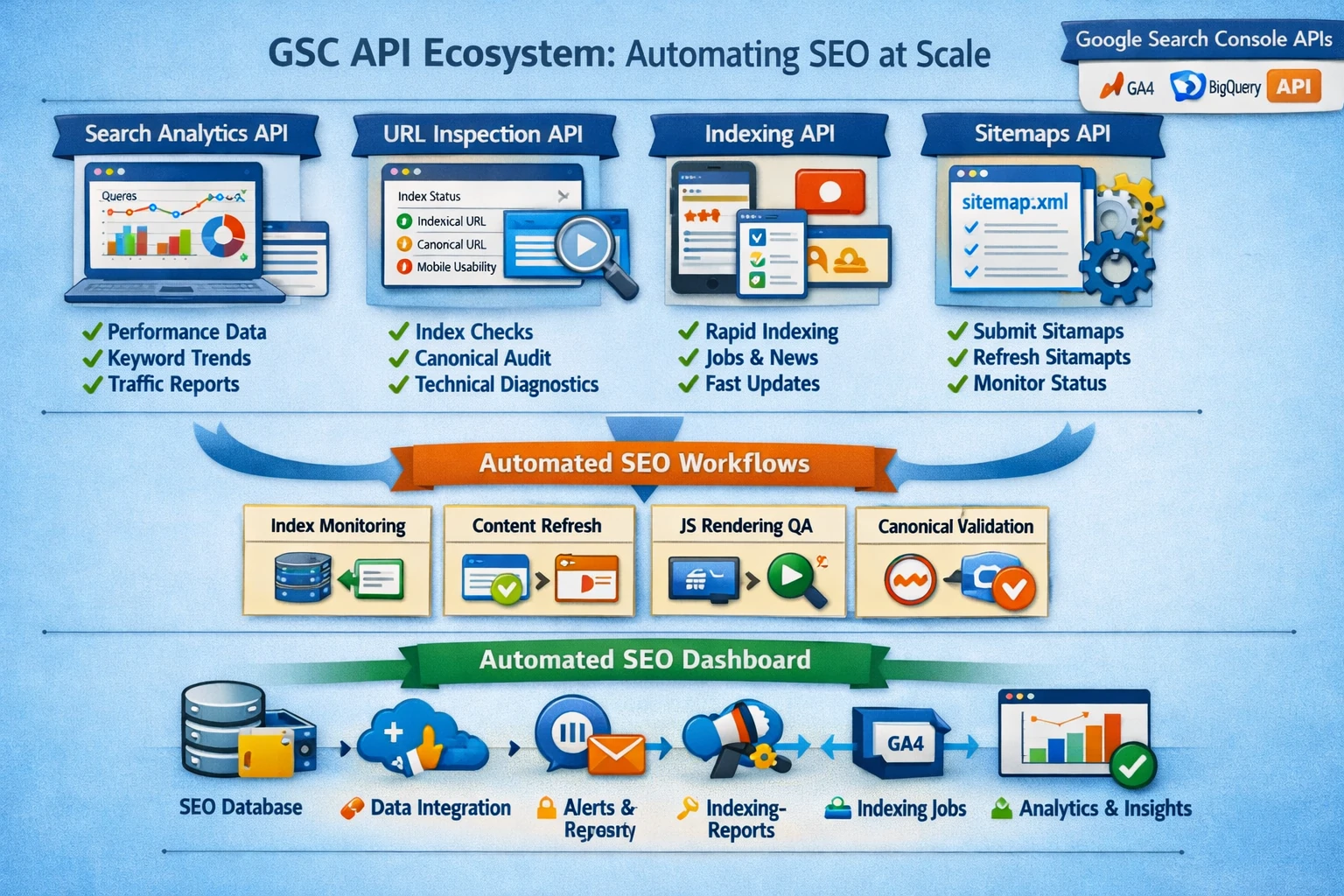
Google Search Console’s API ecosystem turns GSC from a reporting dashboard into a programmable, automated SEO infrastructure. When combined with the Indexing API, URL Inspection API, and automated workflows, you gain the ability to monitor indexing, detect issues, trigger re‑crawls, and integrate GSC data into your analytics and content systems. This pillar explains how each API works, what it can and cannot do, and how to architect automation that scales across large sites, multi‑site networks, and enterprise SEO operations.
GSC API Ecosystem Overview
Google provides several APIs that interact with Search Console data:
- Search Analytics API — programmatic access to queries, pages, CTR, impressions, and positions.
- Sitemaps API — submit, delete, and monitor sitemaps.
- URL Inspection API — retrieve indexing status, canonical selection, and crawl information for specific URLs.
- Indexing API — request rapid indexing for eligible content types (jobs, livestreams, and some news).
- Webmasters API (legacy) — property management and verification.
These APIs allow you to automate reporting, indexing workflows, and large‑scale diagnostics.
Search Analytics API: Programmatic Performance Data
The Search Analytics API mirrors the Performance report in GSC, allowing you to extract:
- Queries
- Pages
- Countries
- Devices
- Search types
- CTR, impressions, clicks, position
- Date ranges up to 16 months
This enables:
- Automated dashboards
- SEO forecasting models
- Keyword clustering
- Content decay detection
- Competitor gap analysis (via query patterns)
- Daily or hourly monitoring pipelines
For large sites, this API becomes the backbone of SEO analytics.
URL Inspection API: Deep Technical Diagnostics
The URL Inspection API exposes the same data you see in the URL Inspection tool:
- Indexing status
- Canonical chosen by Google
- User‑declared canonical
- Last crawl date
- Mobile usability
- Page availability
- Robots.txt status
- Structured data detection
- Rendering information
This API is essential for:
- Monitoring indexing health at scale
- Detecting canonical mismatches
- Validating JavaScript rendering
- Identifying crawl anomalies
- Automating QA for new deployments
It allows you to build automated alerts when pages fall out of the index.
Indexing API: Rapid Indexing for Eligible Content
The Indexing API is limited to:
- Job posting pages
- Livestream pages
- Some news content (case‑by‑case)
For eligible content types, it enables:
- Instant indexing
- Rapid de‑indexing
- Faster updates for time‑sensitive pages
Although not available for general content, it is extremely powerful for publishers and job platforms.
Sitemaps API: Automated Discovery & Refresh
The Sitemaps API allows you to:
- Submit new sitemaps
- Refresh existing sitemaps
- Remove outdated sitemaps
- Retrieve sitemap status
This is useful for:
- Large ecommerce catalogs
- Multi‑language sites
- Automated content pipelines
- Continuous deployment systems
It ensures Google always has the freshest URL inventory.
Automation Workflows for Scalable SEO
When combined, these APIs enable enterprise‑grade automation:
- Automated Indexing Health Monitoring
- Pull URLs from your CMS
- Check indexing status via URL Inspection API
- Flag URLs that are “Crawled – currently not indexed”
- Trigger alerts for sudden drops in indexed pages
This prevents unnoticed indexing decay.
- Content Decay & Opportunity Detection
- Use Search Analytics API to track declining impressions
- Identify pages losing rankings
- Trigger content refresh workflows
- Re‑submit updated URLs via Sitemaps API
This keeps evergreen content competitive.
- JavaScript Rendering QA
- Automatically test rendered HTML via URL Inspection API
- Detect missing content or hydration failures
- Flag rendering regressions after deployments
Critical for React, Vue, Angular, and Next.js sites.
- Large‑Scale Canonical Validation
- Compare user‑declared vs. Google‑selected canonicals
- Detect canonical drift across templates
- Identify duplicate clusters
This prevents ranking dilution.
- Automated Sitemap Regeneration
- Regenerate sitemaps on content updates
- Submit via Sitemaps API
- Validate discovery via GSC
Ensures Google always sees the correct URL set.
Enterprise SEO Architecture Using GSC APIs
A scalable system typically includes:
- A central SEO database
- Daily ingestion of Search Analytics API data
- Scheduled URL Inspection API checks
- Automated sitemap generation
- Indexing API triggers for eligible content
- Alerting for indexing failures, crawl anomalies, or ranking drops
- Integration with GA4, BigQuery, and server logs
This creates a unified, automated SEO intelligence platform.
Why This Pillar Matters
APIs and automation determine:
- How quickly you detect indexing issues
- How efficiently you manage large sites
- How resilient your SEO is to algorithm changes
- How fast new content becomes visible
- How well your site scales as it grows
GSC APIs transform SEO from reactive troubleshooting into proactive, automated operations.