
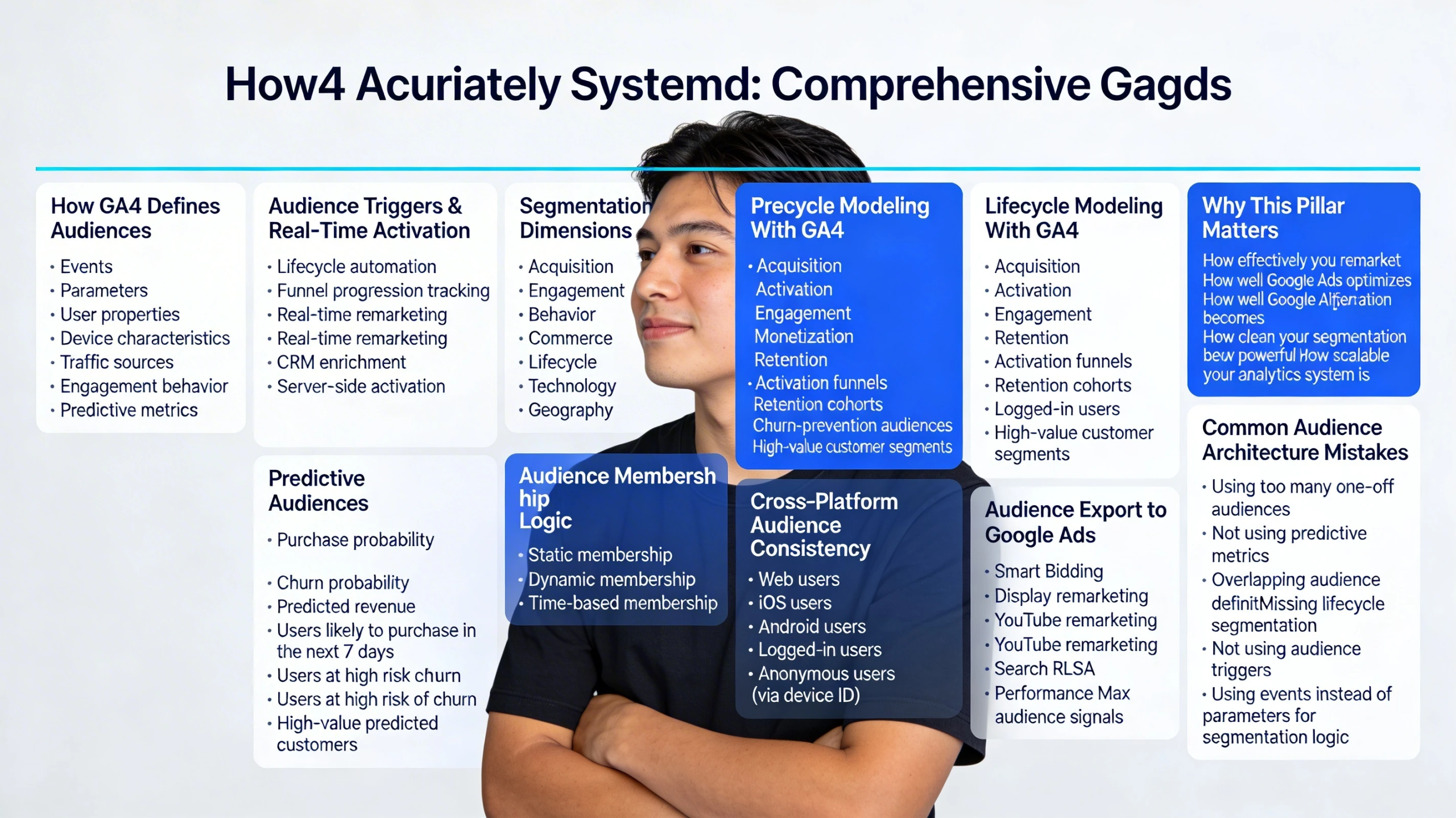
GA4’s audience system is one of the most powerful components of the entire platform. Unlike Universal Analytics, GA4’s audiences are event‑driven, real‑time, cross‑platform, and deeply integrated with Google Ads. This pillar explains how audiences work, how to architect segmentation that scales, and how to model lifecycle stages using GA4’s event and parameter system.
How GA4 Defines Audiences
Audiences in GA4 are dynamic groups of users who meet specific conditions based on:
- Events
- Parameters
- User properties
- Device characteristics
- Traffic sources
- Engagement behavior
- Predictive metrics
GA4 evaluates audience membership continuously, allowing real‑time activation in Google Ads and downstream automation.
Audience Triggers & Real‑Time Activation
GA4 introduces audience triggers, which fire an event the moment a user qualifies for an audience. This enables:
- Lifecycle automation
- Funnel progression tracking
- Real‑time remarketing
- CRM enrichment
- Server‑side activation
Audience triggers are especially powerful for SaaS onboarding, ecommerce funnels, and multi‑step lead qualification.
Segmentation Dimensions
GA4 supports segmentation across multiple dimensions:
- Acquisition — source, medium, campaign, UTM parameters
- Engagement — session count, engagement time, scroll depth
- Behavior — events completed, pages viewed, video interactions
- Commerce — add_to_cart, begin_checkout, purchase value
- Lifecycle — new vs. returning, churn probability, purchase probability
- Technology — device, OS, browser
- Geography — country, region, city
This flexibility allows you to model any customer journey.
Predictive Audiences
GA4 includes machine‑learning‑powered predictive metrics that unlock advanced segmentation:
- Purchase probability
- Churn probability
- Predicted revenue
These enable audiences such as:
- “Users likely to purchase in the next 7 days”
- “Users at high risk of churn”
- “High‑value predicted customers”
Predictive audiences sync directly to Google Ads for automated bidding and remarketing.
Lifecycle Modeling With GA4
GA4 supports full lifecycle segmentation across:
- Acquisition — first_visit, session_start
- Activation — sign_up, tutorial_begin, generate_lead
- Engagement — engaged_session, video_complete
- Monetization — purchase, add_payment_info
- Retention — login, renew_subscription
By mapping events to lifecycle stages, you can build:
- Activation funnels
- Retention cohorts
- Churn‑prevention audiences
- High‑value customer segments
This is essential for SaaS, ecommerce, and subscription businesses.
Audience Membership Logic
GA4 supports:
- Static membership — users stay in the audience permanently
- Dynamic membership — users enter and exit based on conditions
- Time‑based membership — e.g., “users who purchased in the last 30 days”
This allows precise control over remarketing and lifecycle automation.
Cross‑Platform Audience Consistency
Because GA4 unifies app + web data, audiences can include:
- Web users
- iOS users
- Android users
- Logged‑in users
- Anonymous users (via device ID)
This creates a single, unified segmentation layer across all platforms.
Audience Export to Google Ads
GA4 audiences sync to Google Ads for:
- Smart Bidding
- Display remarketing
- YouTube remarketing
- Search RLSA
- Performance Max audience signals
This is one of the strongest integrations in the Google ecosystem.
Common Audience Architecture Mistakes
Teams often run into issues such as:
- Using too many one‑off audiences
- Not using predictive metrics
- Overlapping audience definitions
- Missing lifecycle segmentation
- Not using audience triggers
- Using events instead of parameters for segmentation logic
A clean audience system prevents fragmentation and improves activation.
Why This Pillar Matters
Your audience architecture determines:
- How effectively you remarket
- How well Google Ads optimizes
- How accurately you model lifecycle stages
- How clean your segmentation becomes
- How powerful your predictive audiences are
- How scalable your analytics system is
A strong audience framework is essential for advanced GA4 deployments.