
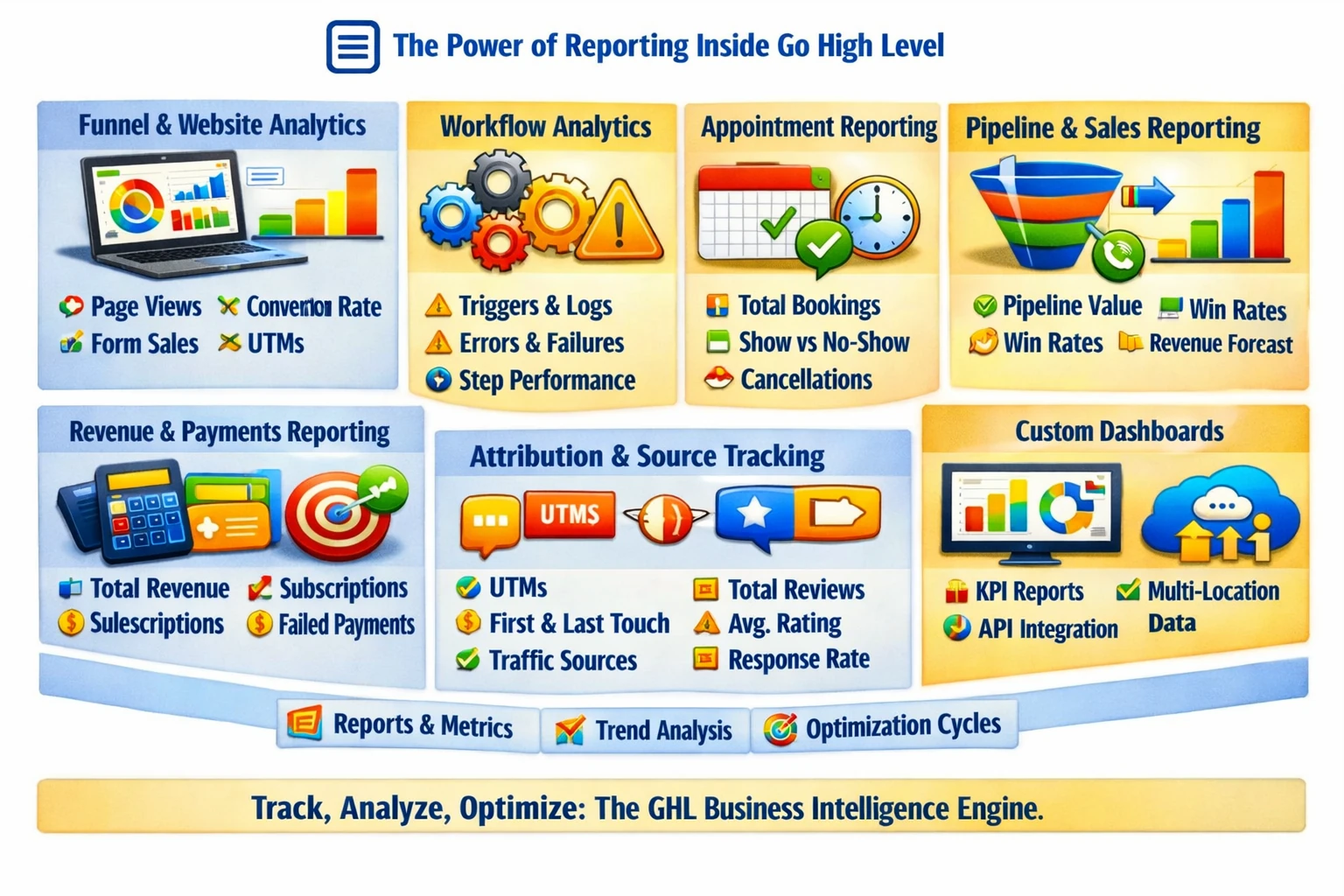
Reporting in Go High Level ties together every system you’ve built across the previous pillars—funnels, workflows, calendars, pipelines, payments, and messaging—into a unified analytics layer. Strong reporting architecture is what turns GHL from an automation tool into a true business intelligence platform. This pillar explains how GHL tracks performance, how to interpret the data, and how to build optimization cycles that scale across multiple sub‑accounts.
Core Reporting Areas Inside GHL
GHL provides several reporting modules, each tied to a different part of the ecosystem:
- Funnels & Websites — page views, conversions, step‑by‑step drop‑off.
- Workflows — execution logs, errors, completion rates.
- Calendars — appointments booked, show rate, no‑show rate.
- Conversations — response time, channel breakdown, unread messages.
- Pipelines — opportunity value, stage conversion rates, win/loss ratios.
- Payments — revenue, subscriptions, invoices, failed payments.
- Reputation — review count, rating trends, response rate.
- Attribution — UTM tracking, source performance, first/last touch.
Each module gives a different lens on performance, and together they form a complete operational dashboard.
Funnel & Website Analytics
GHL tracks:
- Page views
- Unique visitors
- Conversion rate per step
- Form submissions
- Calendar bookings
- Order form purchases
- UTM performance
This allows you to identify:
- Drop‑off points
- High‑performing traffic sources
- Funnel steps that need optimization
- A/B test winners
Because funnels integrate with workflows, you can also track downstream outcomes like show rate and revenue.
Workflow Reporting & Debugging
Workflow analytics include:
- Trigger counts
- Execution logs
- Errors and failures
- Branch performance
- Time delays
- Conversion through each step
This helps you identify:
- Broken automations
- Duplicate triggers
- Messaging bottlenecks
- Overlapping workflows
- Opportunities for consolidation
A clean workflow reporting system is essential for scaling automation safely.
Calendar & Appointment Reporting
Calendar analytics track:
- Total appointments
- Show rate
- No‑show rate
- Reschedules
- Cancellations
- User‑specific performance
These metrics directly influence:
- Sales forecasting
- Lead quality
- Team performance
- No‑show reduction strategies
Appointment data is one of the strongest indicators of funnel health.
Pipeline & Sales Reporting
Pipeline reporting shows:
- Total pipeline value
- Stage‑to‑stage conversion rates
- Win/loss ratios
- Sales velocity
- Revenue forecasting
- User performance
This is the core of sales optimization inside GHL.
Payments & Revenue Reporting
Payment analytics include:
- Total revenue
- Subscription MRR/ARR
- Failed payments
- Refunds
- Product performance
- Upsell/downsell conversion
This is essential for:
- SaaS mode
- Membership programs
- Coaching offers
- Service billing
Revenue reporting ties directly into automation through failed‑payment workflows and renewal reminders.
Attribution & Source Tracking
GHL captures:
- UTM parameters
- First‑touch attribution
- Last‑touch attribution
- Source/medium/campaign
- Funnel‑level attribution
- Appointment source attribution
This allows you to identify:
- Which channels produce the best leads
- Which campaigns generate the highest revenue
- Where to allocate budget
- Which sources produce no‑shows or low‑quality leads
Attribution is the backbone of optimization.
Reputation & Review Reporting
Reputation analytics track:
- Total reviews
- Average rating
- Review growth
- Response rate
- Sentiment patterns
This influences local SEO and conversion rates.
Building Optimization Cycles
A strong optimization cycle includes:
- Weekly funnel performance review
- Weekly workflow error check
- Weekly appointment show‑rate analysis
- Weekly pipeline stage conversion review
- Monthly revenue and subscription analysis
- Monthly attribution deep dive
- Quarterly system cleanup and consolidation
This creates a predictable rhythm for improving performance.
API‑Driven Reporting & Dashboards
The GHL API allows you to:
- Pull contacts, opportunities, and pipeline data
- Pull appointment and calendar data
- Pull payment and subscription data
- Pull workflow logs
- Build external dashboards
- Aggregate multi‑location reporting
- Automate KPI monitoring
This is essential for agencies running dozens of sub‑accounts or SaaS products built on top of GHL.
Why Reporting Matters for Scaling
Reporting determines:
- Where bottlenecks exist
- Which funnels convert
- Which workflows break
- Which sources produce revenue
- Which team members perform best
- How predictable your revenue becomes
Without strong reporting, automation becomes guesswork. With it, GHL becomes a full operating system for your business.