
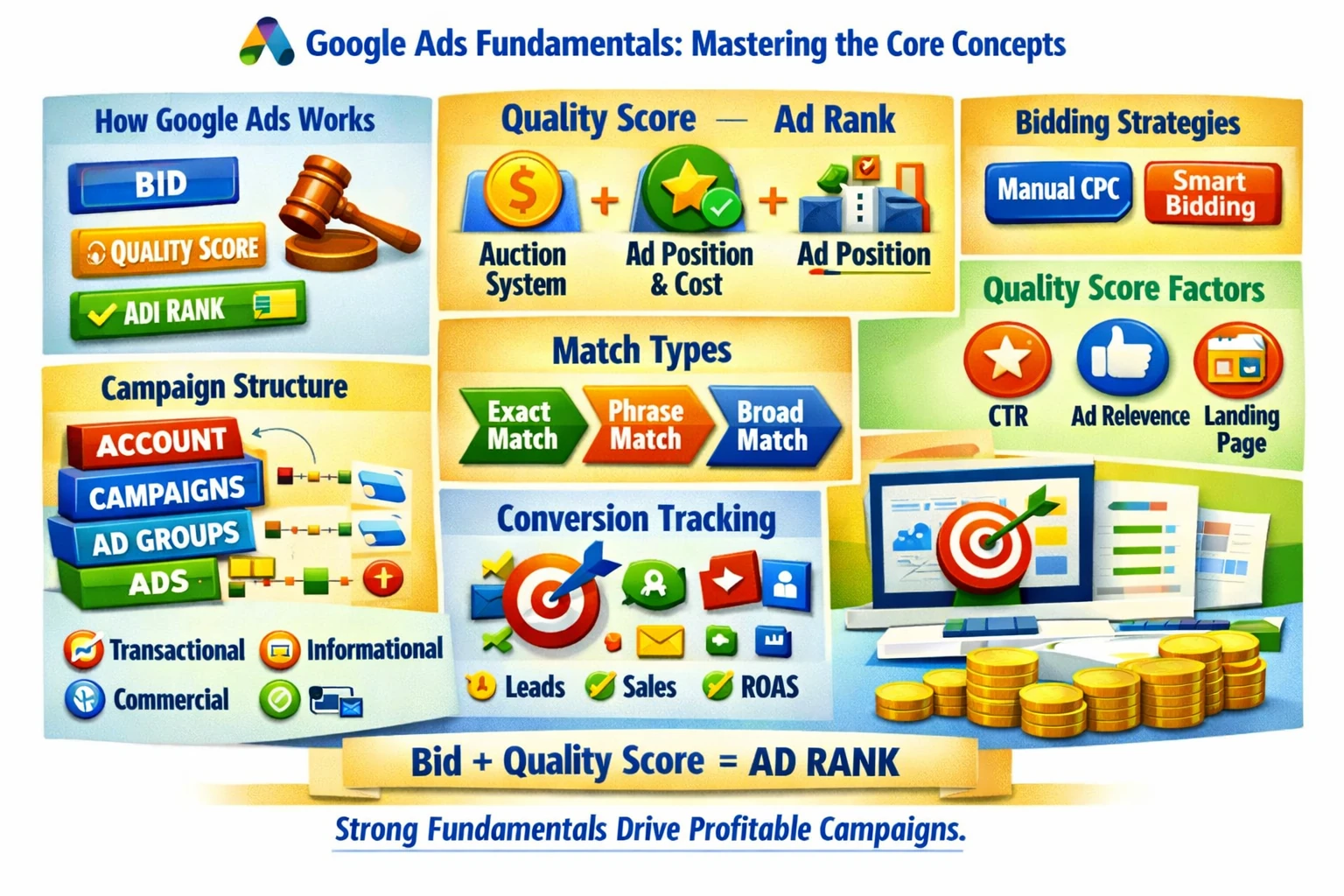
Google Ads fundamentals form the backbone of every profitable campaign. Even advanced strategies—automation, bidding algorithms, audience layering—only work when the foundational elements are solid. This pillar establishes the core concepts that govern how Google Ads decides who sees your ad, when they see it, and how much you pay.
How Google Ads Works at Its Core
Google Ads is an auction-based advertising system. Every time a user searches, Google runs a real-time auction to determine which ads appear and in what order. Three factors drive this auction:
- Bid — the maximum amount you’re willing to pay for a click or conversion.
- Quality Score — Google’s measure of your ad relevance, expected CTR, and landing page experience.
- Ad Rank — the final score that determines your position; calculated from bid × quality + other signals.
This means the highest bidder doesn’t always win. A highly relevant ad with strong Quality Score can outrank competitors while paying less per click.
Campaign Structure and Why It Matters
Google Ads is built on a hierarchy:
- Account — billing, access, and global settings.
- Campaigns — budget, bidding strategy, location, networks.
- Ad Groups — keyword themes and ad variations.
- Ads — the actual messages users see.
A clean structure improves relevance, lowers costs, and makes optimization easier. Poor structure is the #1 reason campaigns fail.
Keyword Intent as the Foundation
Keywords are not just search terms—they represent intent. Google Ads works best when keywords are grouped by intent:
- Transactional (“buy”, “hire”, “near me”)
- Commercial investigation (“best”, “top”, “reviews”)
- Informational (“how to”, “what is”)
- Navigational (brand searches)
Matching ad copy and landing pages to intent dramatically improves Quality Score and conversion rates.
Match Types and Control
Google offers three match types:
- Exact match — tight control, highest relevance.
- Phrase match — balanced reach and precision.
- Broad match — maximum reach, relies heavily on Google’s AI.
Beginners often misuse broad match and burn the budget. Professionals use it strategically with strong conversion tracking and audience signals.
The Role of Conversion Tracking
Without conversion tracking, Google’s automation is blind. Tracking enables:
- Smart Bidding
- Accurate ROAS
- Keyword-level performance
- Attribution modeling
Google recommends using enhanced conversions and first-party data to improve accuracy.
Bidding Strategies
Google offers two categories:
- Manual CPC — full control, slower learning.
- Smart Bidding — automated strategies like Maximize Conversions, Target CPA, and Target ROAS.
Smart Bidding works best when you feed it enough conversion data and maintain clean structure.
Quality Score as a Cost Lever
Quality Score directly affects CPC. Improving it reduces costs and increases ad visibility. The three components:
- Expected CTR
- Ad relevance
- Landing page experience
Small improvements compound into major savings.
Why Fundamentals Matter
Every advanced tactic—Performance Max, audience layering, automated bidding—depends on strong fundamentals. Weak structure, poor tracking, or mismatched intent will sabotage even the most sophisticated campaigns.