
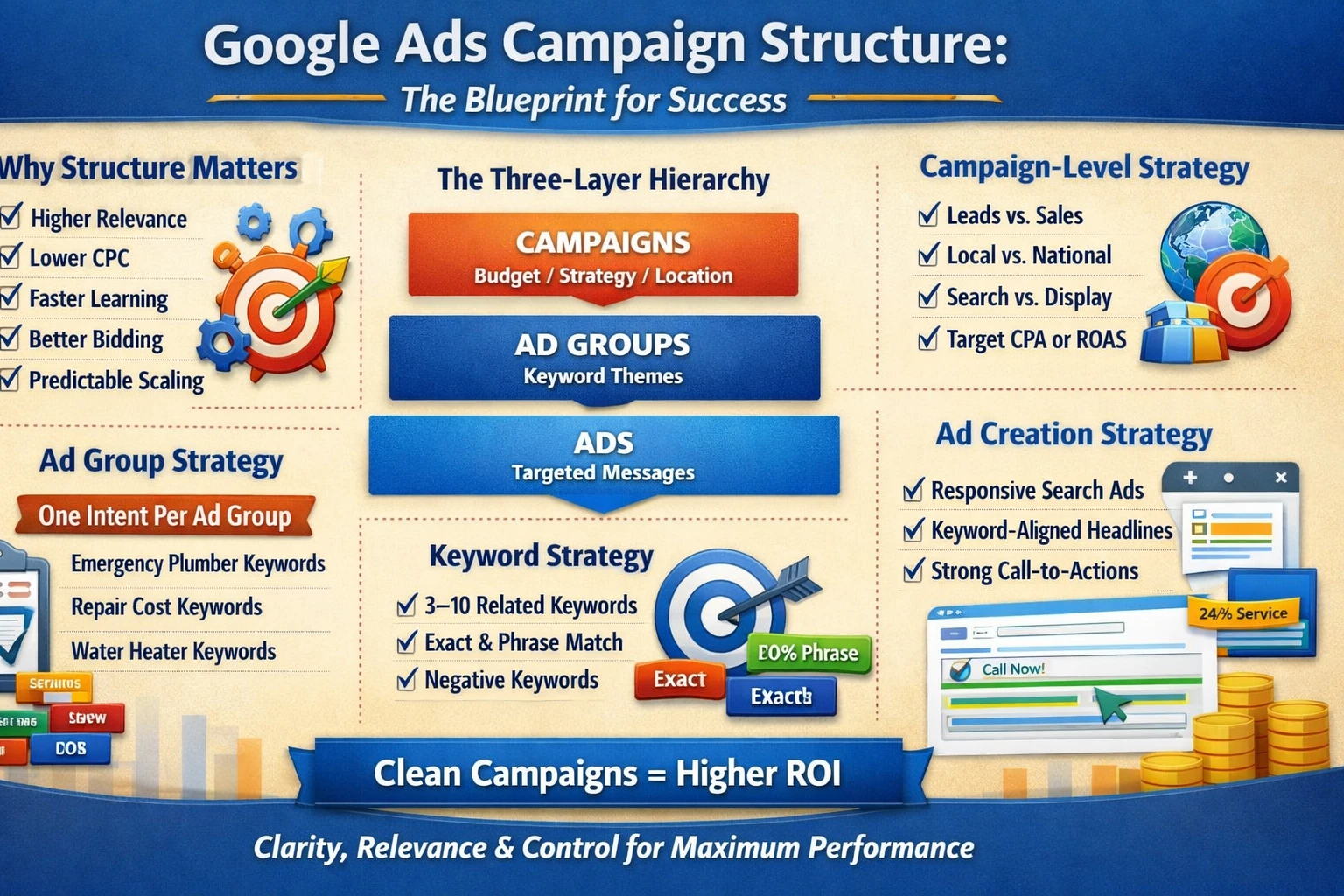
A strong campaign structure is the engine that determines how efficiently your Google Ads budget converts. Even with perfect keywords and great ad copy, a poorly structured account leaks money due to irrelevant traffic, low Quality Scores, and algorithmic confusion. This pillar breaks down how to architect campaigns the way high-performing agencies do—clean, intentional, and aligned with business goals.
Why Structure Matters
Google’s automation is powerful, but it can only optimize what it understands. A messy structure forces the algorithm to guess, mixing intents, audiences, and signals. A clean structure gives Google clear boundaries, which leads to:
- Higher relevance
- Lower CPC
- Faster learning
- Better Smart Bidding performance
- More predictable scaling
Structure is not about complexity—it’s about clarity.
The Three-Layer Hierarchy
Google Ads accounts are built on three operational layers:
- Campaigns — define budget, bidding strategy, location, networks, and overall objective.
- Ad Groups — organize keywords or audience themes.
- Ads — deliver the message aligned with the intent of each ad group.
Each layer has a specific job. Mixing responsibilities (e.g., using one campaign for multiple goals) weakens performance.
Campaign-Level Strategy
Campaigns should be separated based on strategic differences, such as:
- Objective (lead gen, sales, calls, local visits)
- Bidding strategy (Target CPA, Target ROAS, Max Conversions)
- Location (different regions have different CPCs and intent)
- Network (Search vs. Display vs. Performance Max)
- Budget allocation (high intent vs. discovery)
A common agency mistake is combining multiple intents into a single campaign. For example, mixing “buy now” keywords with “what is…” keywords forces Google to optimize toward the cheaper, low-intent clicks.
Ad Group Strategy
Ad groups should be tightly themed. The rule of thumb:
One intent per ad group.
Examples:
- “emergency plumber near me”
- “plumbing repair cost”
- “water heater installation”
Each intent gets its own ad group so the ads can speak directly to the user’s need. This improves CTR, Quality Score, and conversion rate.
Avoid “kitchen sink” ad groups with 50+ unrelated keywords. They dilute relevance and confuse Smart Bidding.
Keyword Strategy Within Ad Groups
Each ad group should contain:
- 3–10 tightly related keywords
- A mix of match types (exact + phrase; broad only when supported by strong conversion data)
- Negative keywords to protect intent
Negative keywords are essential for controlling broad match and preventing wasted spend.
Ad Strategy
Each ad group should include:
- 2–3 responsive search ads
- Unique headlines that match keyword intent
- Strong CTAs aligned with the landing page
- Ad extensions (assets) that reinforce relevance
Google rewards ads that match the user’s search language. This is why tight ad groups outperform broad ones.
Scaling Strategy
Scaling is not about raising budgets blindly. It’s about:
- Duplicating winning structures
- Segmenting high-performing intents
- Increasing budgets on proven campaigns
- Expanding match types gradually
- Layering audiences for stronger signals
A well-structured account scales smoothly because each component is predictable.
The Strategic Takeaway
A clean structure is the foundation of profitable Google Ads. It gives Google’s automation the clarity it needs to optimize efficiently, reduces wasted spend, and creates a scalable system you can grow over time.