
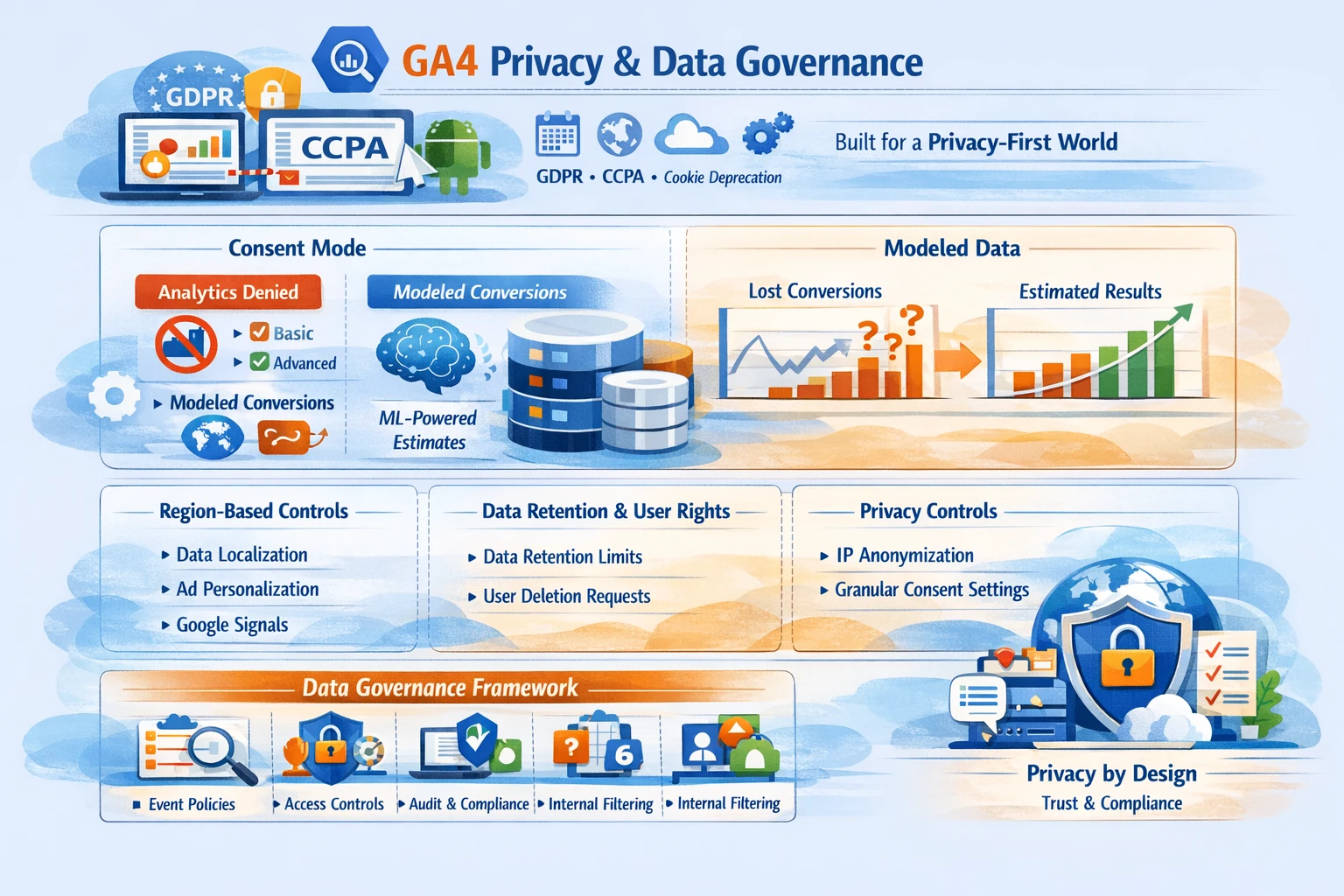
GA4 is built for a world where privacy regulations, browser restrictions, and user consent fundamentally shape how data can be collected. This pillar explains how GA4 handles consent, how modeled data fills measurement gaps, and how to architect a governance framework that keeps your analytics accurate, compliant, and future‑proof.
Privacy as a Core Design Principle
GA4 was created in response to global privacy shifts—GDPR, ePrivacy, CCPA, cookie deprecation, and platform‑level restrictions. Unlike Universal Analytics, GA4:
- Does not store IP addresses
- Uses region‑based data controls
- Supports consent‑aware data collection
- Relies on machine learning to fill gaps
- Allows granular control over signals and ads personalization
This makes GA4 inherently more privacy‑aligned and resilient to future regulation.
Consent Mode & Data Collection Behavior
Consent Mode allows GA4 to adjust its behavior based on user consent choices. When a user declines analytics or ads cookies, GA4 switches into a restricted mode:
- Analytics storage denied → no identifiers stored, limited event data
- Ads storage denied → no remarketing identifiers, limited attribution
- Modeled conversions enabled → GA4 uses machine learning to estimate lost data
Consent Mode ensures compliance while preserving measurement quality.
Two versions exist:
- Consent Mode Basic — blocks tags until consent is granted
- Consent Mode Advanced — sends cookieless pings even without consent, enabling modeling
Advanced mode is essential for accurate attribution in privacy‑restricted environments.
Modeled Conversions & Modeled Reporting
When consent is denied or identifiers are missing, GA4 uses machine learning to model:
- Conversions
- Attribution paths
- User journeys
- Traffic source contributions
Modeled data is blended with observed data to maintain reporting continuity. This is critical as third‑party cookies disappear and first‑party identifiers become limited.
Region‑Based Controls & Data Restrictions
GA4 allows granular configuration by region:
- Disable Google Signals in specific countries
- Disable ads personalization
- Disable location data
- Disable device‑level identifiers
- Adjust data retention windows
This ensures compliance with region‑specific laws without sacrificing global measurement.
Data Retention & Storage Controls
GA4 provides two retention windows:
- 2 months
- 14 months
Retention applies to event‑level data used in Explorations. BigQuery export bypasses this limit, making it essential for long‑term analysis.
User Deletion & Data Subject Requests
GA4 supports privacy rights through:
- User deletion API
- User‑level data removal
- Event‑level deletion requests
- Automated deletion workflows
This ensures compliance with GDPR’s right to erasure and CCPA’s deletion requirements.
Data Governance Framework
A strong governance system includes:
- Event taxonomy documentation
- Parameter naming standards
- Consent Mode configuration
- Data retention policies
- Access control & permissions
- BigQuery export governance
- Cross‑domain tracking rules
- Internal traffic filtering
Governance prevents data drift, fragmentation, and compliance risks.
Signals, Ads Personalization & Google Ads Integration
GA4 allows fine‑grained control over advertising signals:
- Enable or disable Google Signals
- Enable or disable ads personalization
- Restrict remarketing by region
- Control user‑level identifiers
These settings directly affect:
- Audience size
- Attribution accuracy
- Google Ads bidding
- Remarketing eligibility
A privacy‑aligned ads setup ensures both compliance and performance.
Common Privacy & Governance Pitfalls
Teams often run into issues such as:
- Incorrect Consent Mode implementation
- Missing cookieless pings
- Over‑blocking tags
- No governance for custom events
- Misconfigured region‑based controls
- No BigQuery retention strategy
- Fragmented access permissions
A disciplined governance framework prevents data loss and compliance failures.
Why This Pillar Matters
Privacy and governance determine:
- Data accuracy
- Attribution reliability
- Audience eligibility
- Compliance with global laws
- Long‑term analytics stability
- Google Ads performance
- Trust with users and regulators
A strong privacy architecture ensures GA4 remains a durable, compliant measurement system as the digital landscape continues to evolve.