
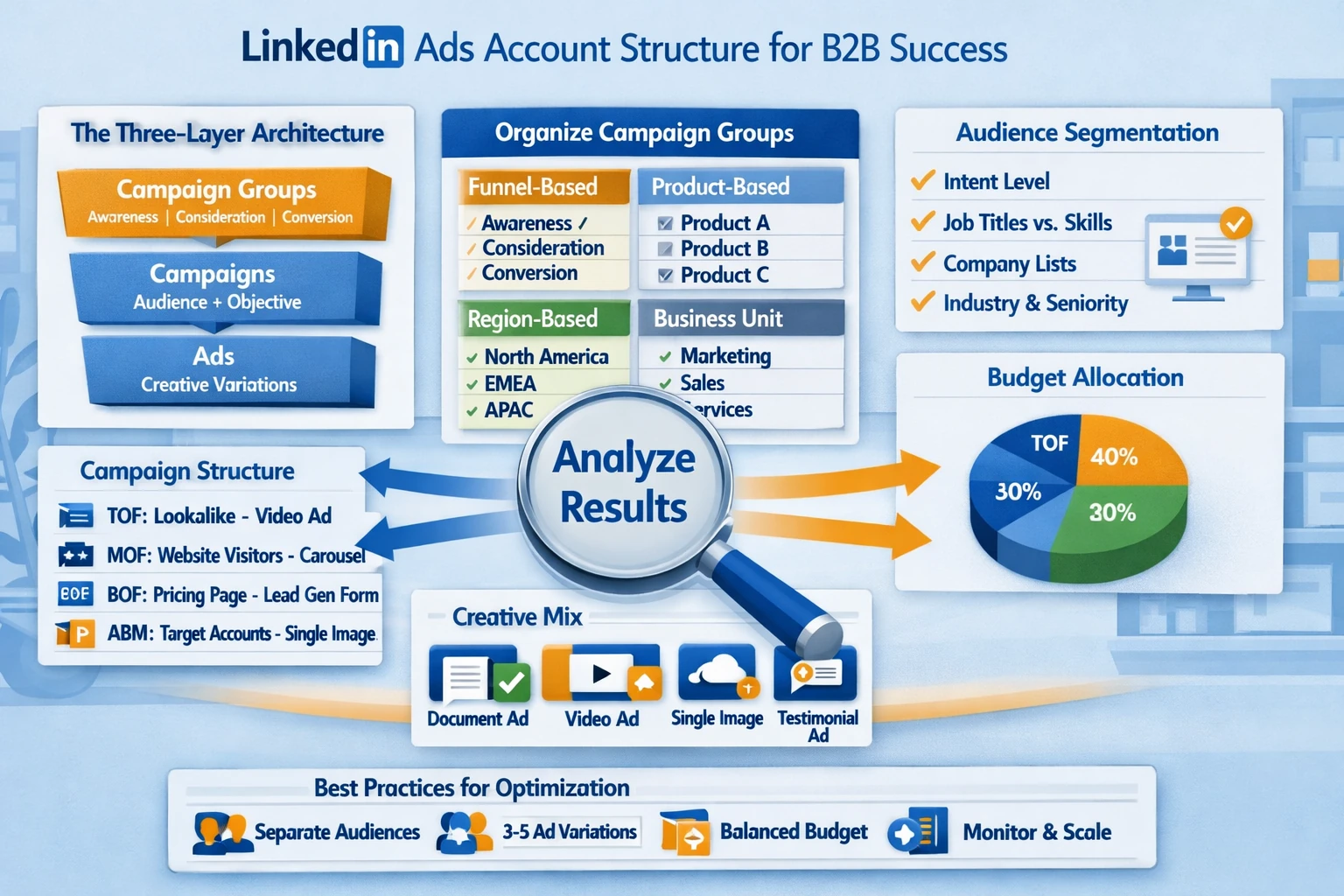
A strong LinkedIn Ads account structure creates clarity, improves optimization, and prevents wasted spend. Because LinkedIn is a premium B2B platform with higher CPCs, your architecture must be intentional, segmented, and aligned with the funnel. This pillar explains how to structure your account, organize campaigns, separate audiences, and build a scalable system that improves performance over time.
Why Account Structure Matters on LinkedIn
LinkedIn’s algorithm optimizes based on campaign‑level signals. A clean structure ensures:
- Accurate reporting
- Better budget allocation
- Faster optimization
- Clear audience segmentation
- Easier scaling
- Reduced overlap and cannibalization
Poor structure leads to mixed signals, inflated CPCs, and inconsistent lead quality.
The Three‑Layer Architecture
A well‑designed LinkedIn Ads account uses a simple, scalable hierarchy:
- Campaign Groups — organize by funnel stage, region, product, or business unit.
- Campaigns — define objective, audience, placement, and budget.
- Ads — creative variations for testing and optimization.
This structure mirrors Google Ads and Meta Ads best practices but tailored for B2B intent.
Organizing Campaign Groups
Campaign Groups act as containers. Common structures include:
- Funnel‑Based
- Awareness
- Consideration
- Conversion
- Product‑Based
- Product A
- Product B
- Product C
- Region‑Based
- North America
- EMEA
- APAC
- Business Unit‑Based
- Marketing Solutions
- Sales Solutions
- Service Solutions
Funnel‑based grouping is the most common and easiest to scale.
Campaign Structure for Optimization
Each campaign should have one audience, one objective, and one placement strategy. This prevents mixed signals and allows clean reporting.
A typical structure looks like:
- Campaign 1: TOF — Skills + Seniority — Video
- Campaign 2: TOF — Lookalike — Document Ad
- Campaign 3: MOF — Website Visitors — Carousel
- Campaign 4: BOF — Pricing Page Visitors — Lead Gen Form
- Campaign 5: ABM — Company List — Single Image
This segmentation ensures each audience receives the right message at the right stage.
Audience Segmentation Rules
LinkedIn audiences should be separated by:
- Intent level (cold, warm, hot)
- Targeting type (Job Title vs. Skills vs. Lookalike)
- Company list vs. open targeting
- Industry or vertical
- Seniority
Never mix cold and warm audiences in the same campaign. Warm audiences convert better and deserve dedicated budgets.
Creative Segmentation Rules
Each campaign should contain 3–5 ads for testing:
- 1 value‑first Document Ad
- 1 insight‑driven single image
- 1 video explainer
- 1 testimonial or proof‑based ad
LinkedIn optimizes toward the best performer, so variety accelerates learning.
Budget Allocation Framework
A balanced B2B budget distribution looks like:
- TOF: 40%
- MOF: 30%
- BOF: 20%
- ABM: 10%
TOF fuels the funnel, MOF nurtures, BOF converts, and ABM targets high‑value accounts.
Avoiding Common Structural Mistakes
- Combining too many audiences in one campaign
- Using one campaign for all funnel stages
- Mixing Lead Gen Forms and landing pages
- Running only one ad per campaign
- Not separating ABM from general prospecting
- Using Job Title targeting exclusively (too narrow, too expensive)
A clean structure reduces CPCs and improves lead quality.
Scaling Your Architecture
Scale by:
- Duplicating winning campaigns
- Expanding audiences (Skills → Job Function → Lookalike)
- Adding new creative formats
- Increasing budgets gradually
- Creating vertical‑specific campaigns
Scaling works best when each layer of the funnel is already performing well.