
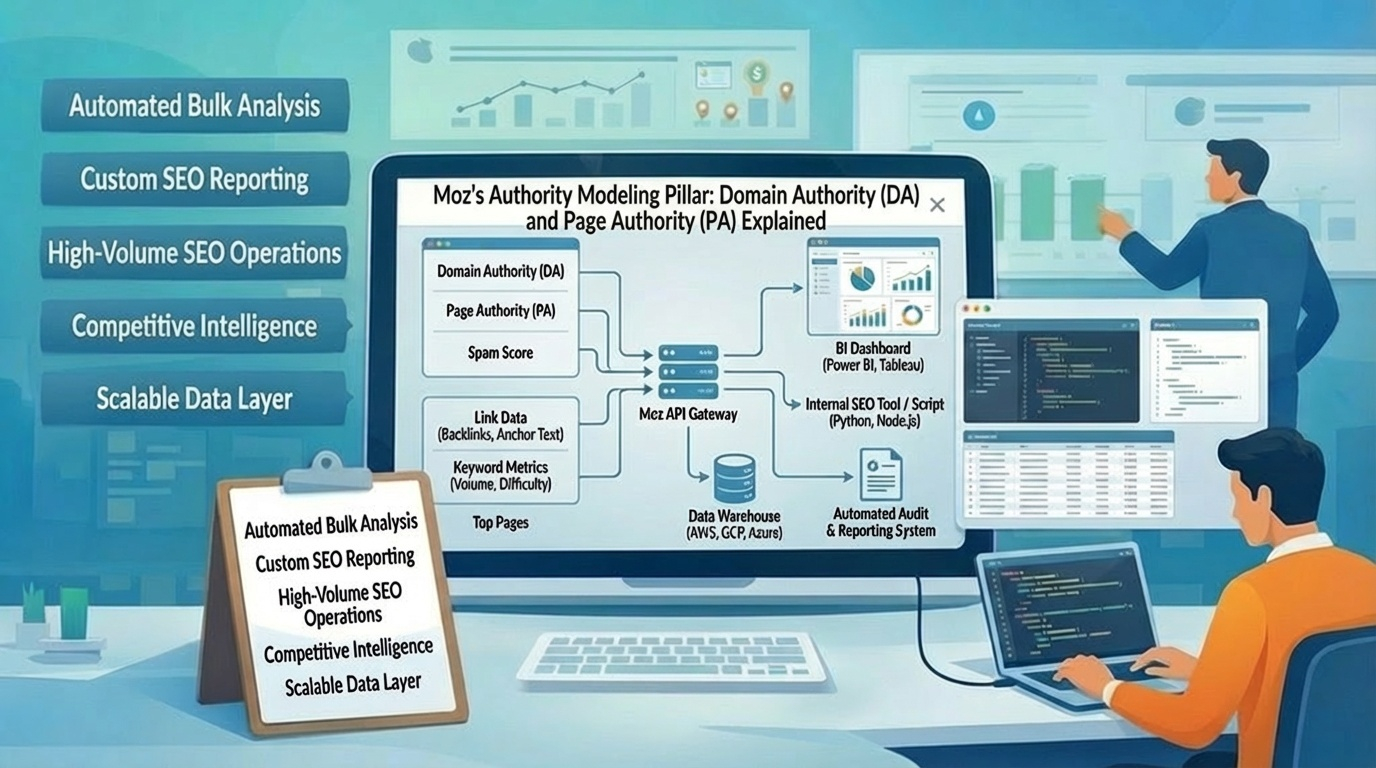
Domain Authority (DA) and Page Authority (PA) are Moz’s signature metrics for predicting ranking strength. They are machine‑learning models trained on massive link graphs to estimate how likely a domain or page is to rank in Google’s search results. Alongside DA and PA, Moz provides a suite of link metrics—linking domains, total backlinks, Spam Score, top pages, and anchor text patterns—that together form a complete authority modeling system. This pillar explains how these metrics work, how to interpret them, and how to use them to guide SEO strategy.
How DA & PA Fit Into SEO Strategy
DA and PA are not Google metrics—they are predictive models. Their purpose is to help SEOs understand relative ranking strength. DA predicts the ranking potential of an entire domain, while PA predicts the ranking potential of a specific URL. These metrics are especially useful for:
- Competitive analysis
- Link‑building prioritization
- Content opportunity assessment
- Authority benchmarking
- Prospect filtering for outreach
Because DA and PA correlate strongly with SERP performance, they serve as reliable directional indicators for SEO planning.
How Domain Authority Works
DA is calculated using a machine‑learning model that evaluates dozens of link‑based signals, including:
- Total linking domains
- Quality and authority of linking domains
- Link velocity (growth over time)
- Follow vs. nofollow distribution
- Spam indicators
- Link diversity
DA is scored on a 0–100 logarithmic scale, meaning it becomes progressively harder to increase at higher levels. A jump from DA 10 to 20 is far easier than a jump from 60 to 70.
DA is best used comparatively, not absolutely. A DA 40 site may be strong in one niche and weak in another depending on competitor strength.
How Page Authority Works
PA predicts the ranking strength of individual URLs. It is influenced by:
- Internal links
- External backlinks
- Page‑level link equity
- Canonicalization
- Redirect history
PA is especially useful for identifying:
- High‑value pages worth updating
- Pages that need internal links
- Pages with strong link equity that can support others
- Competitor pages dominating SERPs
PA helps guide content optimization and internal linking strategy.
Spam Score & Link Risk Indicators
Spam Score evaluates the likelihood that a domain exhibits link patterns similar to penalized sites. It considers signals such as:
- Low‑quality link neighborhoods
- Thin content
- Over‑optimized anchors
- Suspicious TLD patterns
- Unnatural link velocity
Spam Score helps SEOs identify risky domains, evaluate backlink quality, and avoid harmful outreach targets.
Link Metrics for Authority Modeling
Moz provides several link metrics that support deeper analysis:
- Linking domains — the strongest indicator of authority
- Total backlinks — volume of inbound links
- Top linking pages — high‑authority sources
- Anchor text distribution — relevance and naturalness
- Follow vs. nofollow — equity‑passing links
- Link growth trends — momentum over time
These metrics help SEOs understand why competitors rank and where link gaps exist.
Using DA/PA for Competitive Analysis
Authority modeling helps answer key strategic questions:
- Can we realistically rank for this keyword?
- Which competitors have stronger link profiles?
- Which pages are driving their authority?
- Where are the biggest link gaps?
- Which prospects are worth pursuing?
By comparing DA/PA and link metrics across competitors, SEOs can prioritize keywords and content opportunities with the highest likelihood of success.
Integrating Authority Metrics Into SEO Workflows
DA, PA, and link metrics work best when combined with:
- Keyword research (Keyword Explorer)
- Technical audits (Site Crawl)
- Content optimization
- Link‑building outreach
- Rank tracking
Together, they form a complete authority‑driven SEO strategy.