
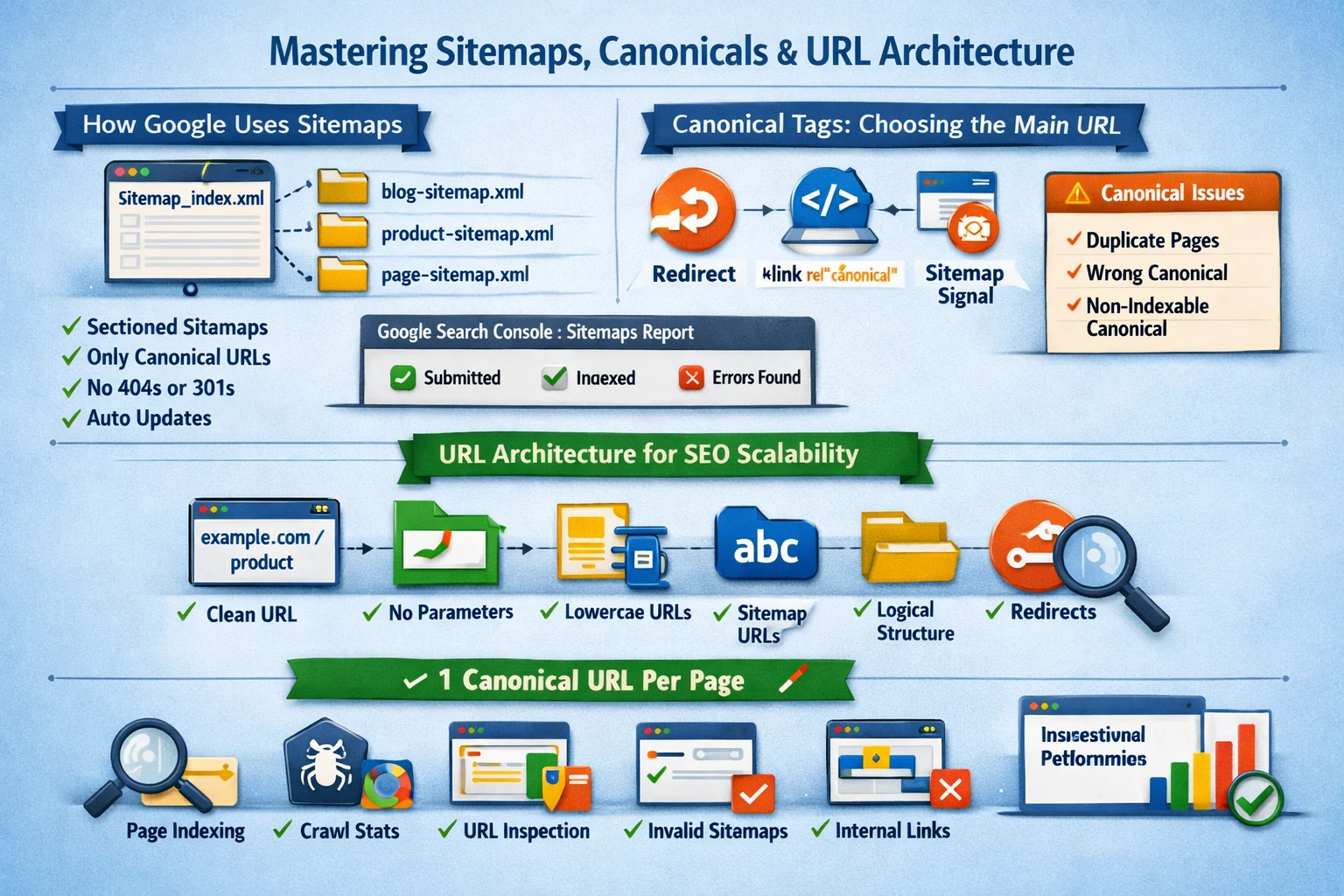
Sitemaps, canonical tags, and URL architecture form the structural backbone of technical SEO. They determine how Google discovers URLs, understands duplicates, consolidates signals, and selects the correct canonical version for indexing. Google Search Console provides direct visibility into how these signals are interpreted, making this pillar essential for maintaining a clean, indexable, and scalable site.
How Google Uses Sitemaps
Sitemaps help Google discover and prioritize URLs. They act as a hint, not a directive, but they strongly influence crawl efficiency. Google treats sitemap inclusion as a weak canonical signal, meaning it helps reinforce which URLs you prefer Google to index.
A strong sitemap strategy includes:
- A single sitemap index linking to section‑specific sitemaps
- Separate sitemaps for blog posts, products, categories, and static pages
- Only canonical URLs included
- Automatic regeneration on content updates
- No 404s, 301s, or parameterized URLs
GSC’s Sitemaps report shows submission status, last read date, and discovered URLs, helping diagnose crawl gaps or structural issues.
Canonical Tags: How Google Selects the “Main” URL
Canonical tags tell Google which version of a page is the preferred one. They are a strong signal, but not an absolute directive. Google may override your canonical if other signals conflict.
Google ranks canonicalization signals by strength:
- Redirects — strongest canonical signal
- rel=”canonical” — strong signal
- Sitemap inclusion — weak signal
- Internal linking patterns — contextual signal
- External links — authority signal
- hreflang clusters — reinforcing signal
Google’s own documentation confirms that redirects and canonical tags are the strongest ways to influence canonical selection.
Common Canonicalization Problems
GSC frequently surfaces canonical issues in the Page Indexing report:
- Duplicate without user‑selected canonical
- Alternate page with proper canonical
- Google chose a different canonical than user
- Non‑indexable canonical target
- Mixed HTTP/HTTPS versions
- Parameter URLs competing with clean URLs
These issues often arise from inconsistent signals across:
- Internal links
- Sitemaps
- Canonical tags
- hreflang clusters
- Redirect rules
Google’s glossary reinforces that only the canonical URL is indexed from a set of duplicates.
URL Architecture & SEO Scalability
A clean URL architecture improves crawlability, indexing, and canonical clarity. Strong architectures share these traits:
- One canonical URL per piece of content
- No session IDs or tracking parameters in indexable URLs
- Consistent trailing slash rules
- Lowercase URLs
- Short, descriptive paths
- Logical folder hierarchy
- Avoiding duplicate paths (e.g., /product/123 vs /products/123)
Google treats each variation—protocol, subdomain, parameters—as a separate URL unless canonicalized.
How GSC Helps Diagnose URL Architecture Issues
GSC surfaces architecture problems through:
- Page Indexing report — duplicates, canonical mismatches, blocked URLs
- Crawl Stats — excessive crawling of low‑value URLs
- URL Inspection — canonical chosen by Google vs. user
- Sitemaps report — invalid or non‑canonical URLs in sitemaps
- Links report — internal linking inconsistencies
These insights help identify structural inefficiencies that impact crawl budget and ranking.
Best Practices for a Clean Canonical & Sitemap System
A scalable system includes:
- Canonical tags on every indexable page
- Self‑referencing canonicals
- Canonicals aligned with hreflang
- Sitemaps containing only canonical URLs
- Redirects for non‑canonical variants
- Noindex for low‑value or duplicate content
- Parameter handling rules in Google Search Console (legacy) or via robots.txt
- Clear URL patterns for pagination, filters, and faceted navigation
This alignment ensures Google receives consistent signals across all systems.
Why This Pillar Matters
Sitemaps, canonicals, and URL architecture determine:
- How efficiently Google discovers your content
- Which URLs get indexed
- How duplicate content is consolidated
- How link equity flows across your site
- How scalable your SEO becomes as your site grows
A clean architecture prevents indexing waste, ranking dilution, and crawl inefficiency.