
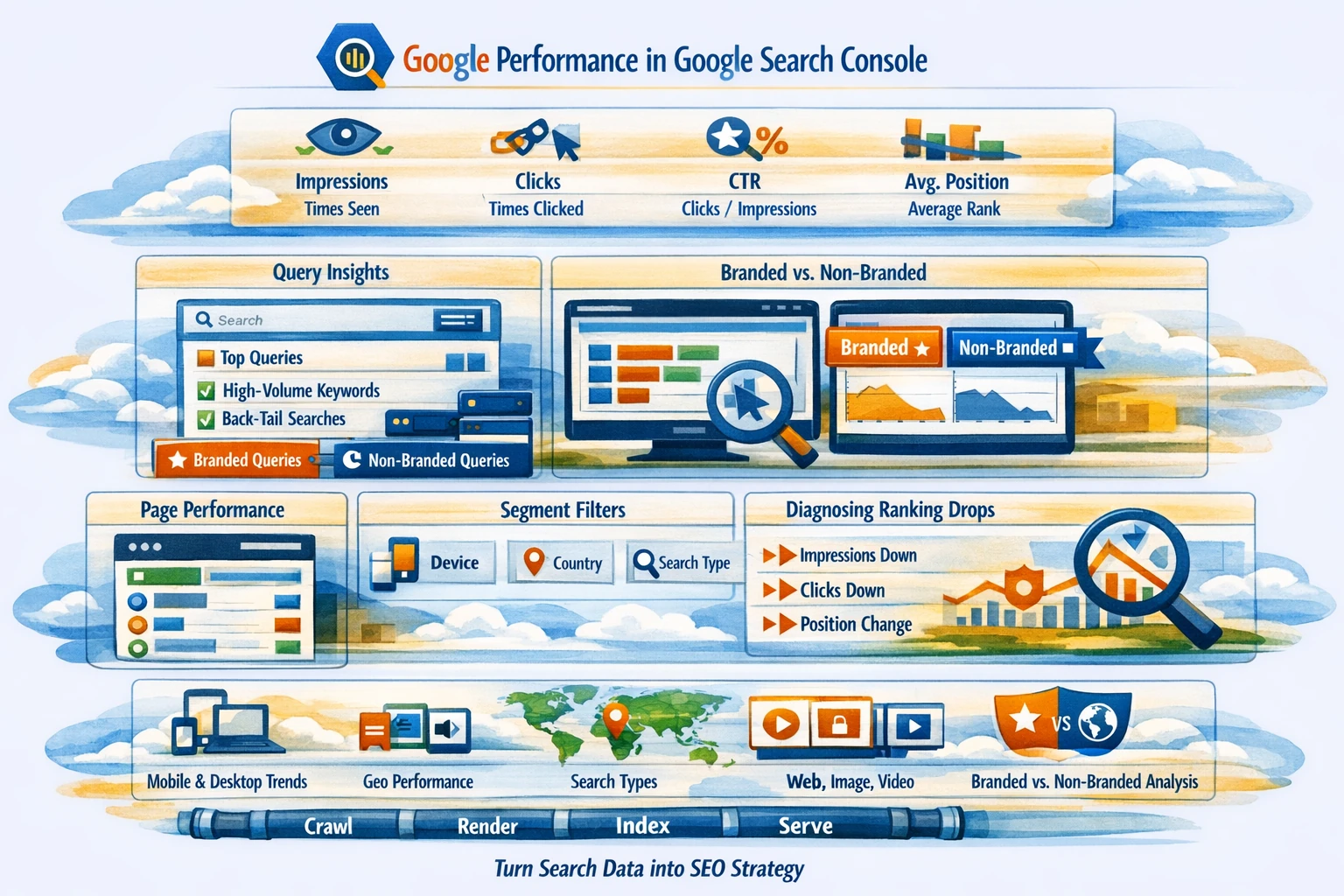
The Search Performance report is the analytical heart of Google Search Console. It reveals how users discover your site, which queries drive visibility, how pages rank, and how search behavior changes over time. This pillar explains how impressions, clicks, CTR, and average position work, how to interpret query‑level data, and how to use GSC to diagnose ranking shifts and uncover growth opportunities. It also incorporates the newest branded vs. non‑branded query segmentation now available to all eligible sites .
How Google Measures Search Performance
GSC captures four core metrics directly from Google Search:
- Impressions — how often your URL appeared in search results.
- Clicks — how often users selected your result.
- CTR — click‑through rate (clicks ÷ impressions).
- Average Position — the average ranking of your URL across impressions.
These metrics reflect actual search behavior, not estimates. They show how your content performs in real SERPs, across devices, countries, and search types.
Query‑Level Insights
The Queries tab reveals the exact search terms users typed before clicking your site. This includes:
- High‑volume keywords
- Long‑tail queries
- Question‑based searches
- Branded vs. non‑branded queries
- Seasonal or trending terms
In March 2026, Google expanded the branded queries filter to all eligible sites, allowing you to segment performance by brand vs. non‑brand directly in the UI . This eliminates the need for regex filters and makes brand strength analysis significantly easier.
Branded queries help you understand:
- How well users recall your brand
- How much traffic is navigational vs. competitive
- Whether brand demand is rising or falling
- How competitors influence your visibility
Non‑branded queries reveal your true SEO reach and content performance.
Page‑Level Performance
The Pages tab shows how individual URLs perform across all queries. This helps identify:
- High‑ranking pages with low CTR
- Pages with strong impressions but weak rankings
- Pages losing visibility over time
- Pages gaining traction after updates
Combining page‑level and query‑level data reveals which content deserves optimization, consolidation, or expansion.
Device, Country & Search Type Segmentation
GSC allows segmentation by:
- Device — mobile, desktop, tablet
- Country — geographic performance
- Search type — web, image, video, news
These filters help diagnose:
- Mobile‑specific ranking drops
- Country‑specific indexing issues
- Image or video search opportunities
- International SEO gaps
Segmented analysis often reveals patterns hidden in aggregated data.
Ranking Signals Reflected in GSC Data
While GSC does not show ranking factors directly, performance metrics reflect the impact of:
- Content relevance
- Page experience
- Internal linking
- Backlinks
- Structured data
- Freshness
- Search intent alignment
Drops in impressions or position often signal algorithmic shifts, content decay, or technical issues.
Diagnosing Ranking Drops
When rankings fall, GSC helps isolate the cause:
- Impressions drop, clicks drop → visibility loss (indexing or ranking).
- Impressions stable, clicks drop → CTR issue (title/description).
- Position drops but impressions rise → more competition or new SERP features.
- Query mix changes → algorithm update or intent shift.
Cross‑referencing with Indexing and Page Experience pillars provides deeper clarity.
Why This Pillar Matters
Search Performance determines:
- Which keywords drive traffic
- How users discover your content
- Where ranking opportunities exist
- How algorithm updates affect your site
- How brand strength evolves over time
- Which pages deserve optimization or expansion
A strong grasp of GSC performance data turns raw search behavior into actionable SEO strategy.