
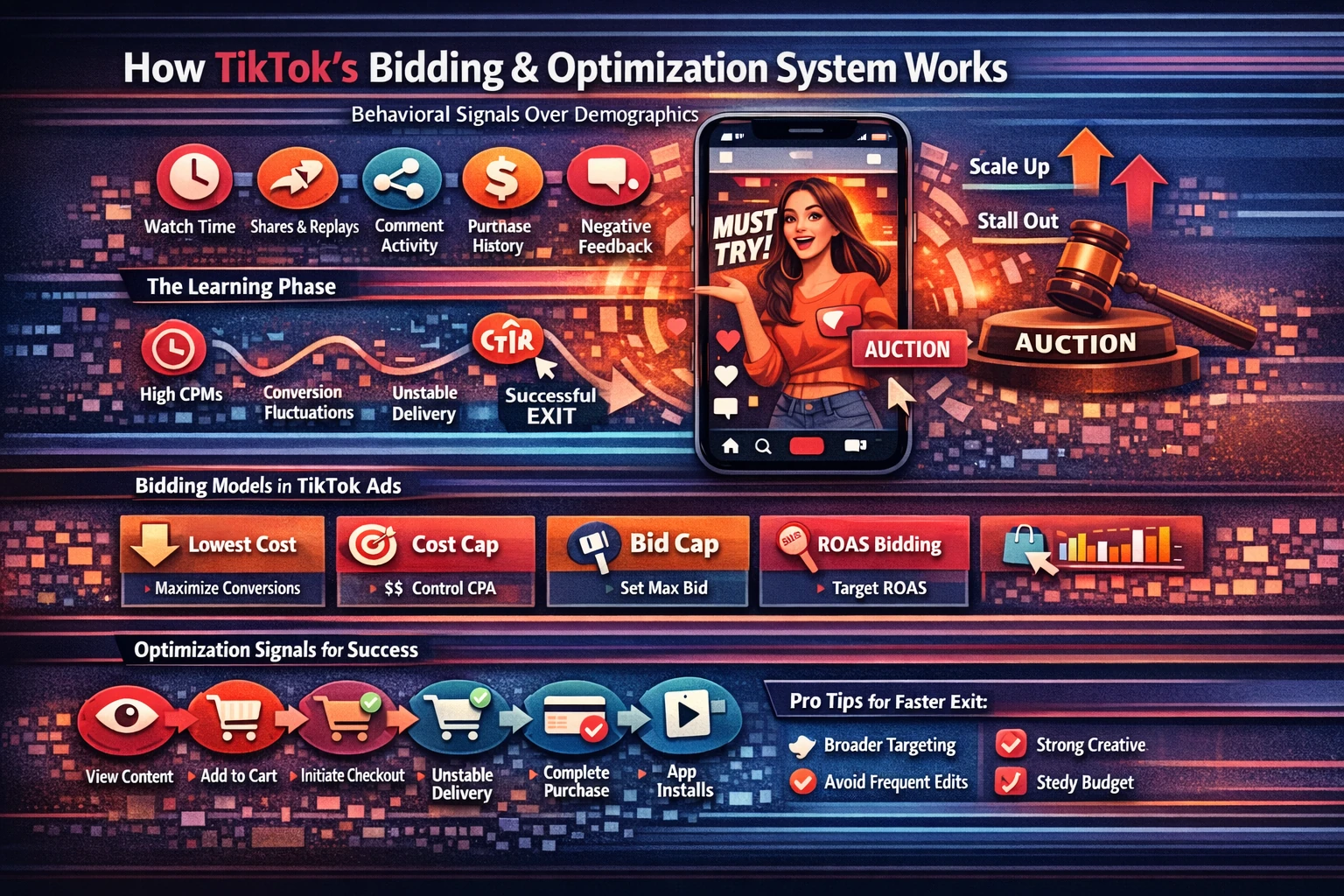
TikTok’s bidding and optimization system is designed to identify the lowest‑cost conversions by testing audiences, creatives, and placements in real time. Because TikTok is a creative‑first platform, the algorithm relies heavily on early engagement signals to determine whether an ad should scale or stall. Understanding how bidding models work, how the learning phase behaves, and how optimization signals influence delivery is essential for stable, scalable campaigns.
How TikTok’s Optimization System Works
TikTok optimizes delivery based on predicted action rates—how likely a user is to complete your desired outcome. The system evaluates:
- Watch time and completion rate
- Replays and engagement
- Click‑through rate
- Conversion probability
- Negative feedback (skips, hides, reports)
These signals help TikTok determine which users are most likely to convert and how aggressively to bid in the auction. Strong creative improves these signals, lowering costs and accelerating optimization.
Understanding the Learning Phase
Every new ad group enters a learning phase where TikTok tests different audience pockets and creative variations. During this period, performance is unstable because the system is still gathering data. The learning phase ends when TikTok has enough conversion signals to predict outcomes reliably.
Key characteristics of the learning phase:
- Higher CPMs and CPCs
- Fluctuating conversion rates
- Unstable delivery
- Sensitivity to creative performance
- Slower scaling
To exit learning efficiently, campaigns need consistent conversions and minimal disruptions.
How to Exit the Learning Phase Faster
TikTok recommends several practices to stabilize delivery:
- Use broad targeting to give the algorithm more data
- Avoid frequent edits to budgets, bids, or creatives
- Use strong, high‑retention creatives
- Consolidate ad groups instead of splitting audiences
- Maintain budgets high enough to generate daily conversions
Every reset—changing bids, budgets, or targeting—restarts learning and delays optimization.
Bidding Models in TikTok Ads Manager
TikTok offers several bidding strategies depending on your objective:
- Lowest Cost — TikTok finds the cheapest conversions; best for scale
- Cost Cap — Controls average CPA; best for stable performance
- Bid Cap — Sets a maximum bid; best for strict cost control
- ROAS Bidding (for app & e‑commerce) — Optimizes for return on ad spend
Most advertisers use Lowest Cost for initial testing and Cost Cap for scaling.
Budgeting Strategies for Stable Delivery
Budgets influence how quickly TikTok can learn and optimize. Effective budgeting includes:
- Setting budgets high enough to generate 50+ conversions per week
- Avoiding drastic budget changes (keep adjustments under 20%)
- Using daily budgets for stability
- Using lifetime budgets only for short campaigns or promotions
Underfunded campaigns struggle to exit learning and often deliver inconsistently.
Optimization Events and Their Impact
Choosing the right optimization event determines how TikTok evaluates success. Options include:
- View content
- Add to cart
- Initiate checkout
- Complete payment
- Lead submission
- App install or in‑app events
Optimizing for deeper events (like purchases) improves long‑term performance but requires more data. For new accounts, optimizing for higher‑funnel events can help build signal density before switching to purchases.
Why This Pillar Matters
Bidding and optimization determine whether your campaigns scale efficiently or burn budget without results. Mastering the learning phase, choosing the right bidding model, and maintaining stable optimization signals ensures predictable performance and long‑term profitability.