
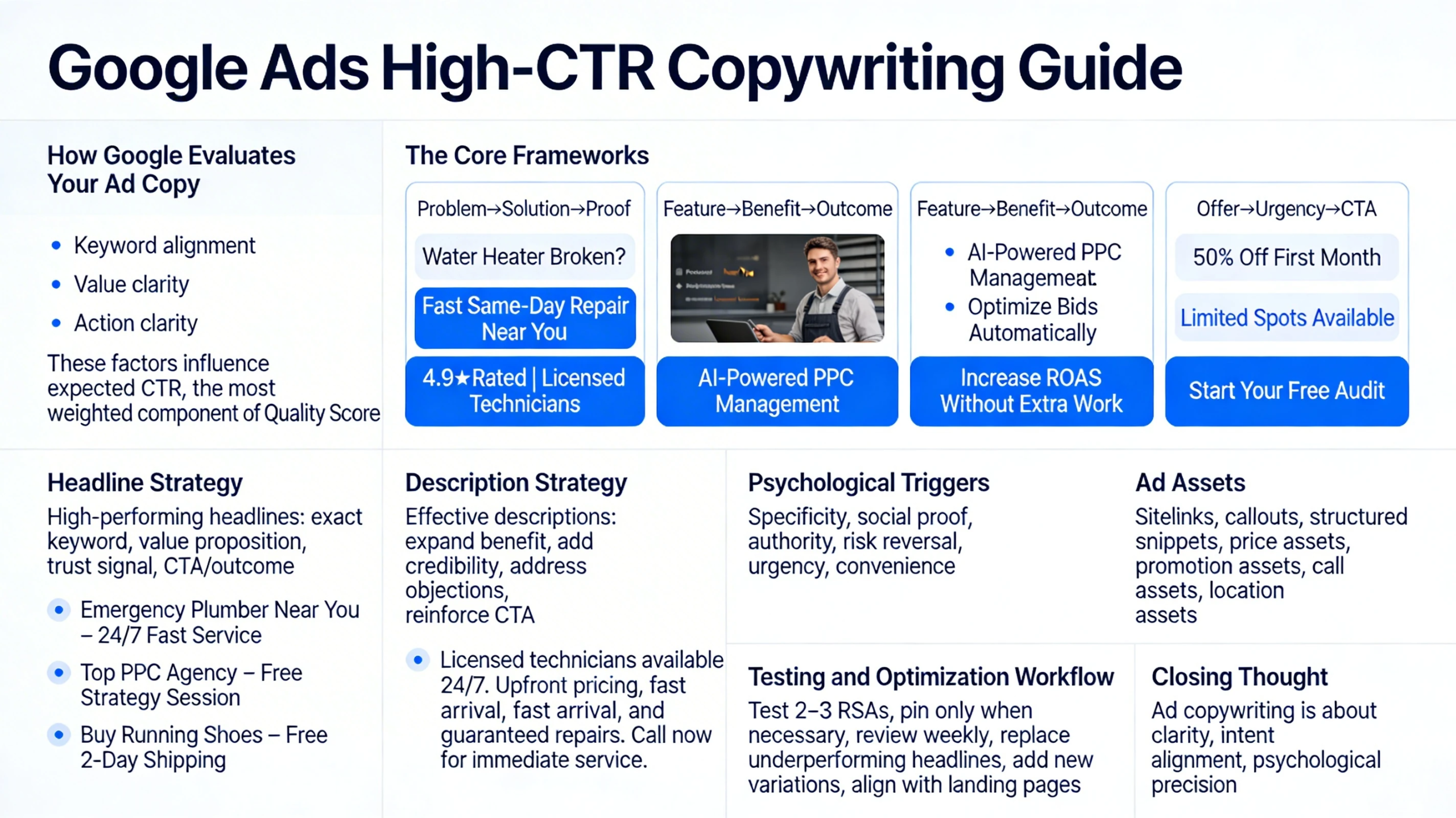
Effective ad copy is the bridge between user intent and conversion. Even with perfect targeting and strong bidding strategies, weak ad copy can collapse CTR, lower Quality Score, and starve Smart Bidding of the signals it needs. High‑performing advertisers treat ad copywriting as a strategic discipline—not a creative afterthought. This pillar breaks down the frameworks, psychological triggers, and structural rules that consistently produce high‑CTR, high‑conversion ads in Google Ads.
How Google Evaluates Your Ad Copy
Google’s system rewards ads that demonstrate relevance, clarity, and usefulness. Three elements matter most:
- Keyword alignment — Headlines must reflect the user’s search language.
- Value clarity — Users must immediately understand what makes your offer better.
- Action clarity — Strong CTAs guide users toward the next step.
These factors influence expected CTR, which is the most heavily weighted component of Quality Score.
The Core Frameworks Used by Top Advertisers
Professional copywriters rely on proven frameworks that map directly to user psychology. The most effective ones for Google Ads include:
- Problem → Solution → Proof
- Headline: “Water Heater Broken?”
- Sub‑headline: “Fast Same‑Day Repair Near You”
- Proof: “4.9★ Rated | Licensed Technicians”
- Feature → Benefit → Outcome
- Feature: “AI‑Powered PPC Management”
- Benefit: “Optimize Bids Automatically”
- Outcome: “Increase ROAS Without Extra Work”
- Offer → Urgency → CTA
- Offer: “50% Off First Month”
- Urgency: “Limited Spots Available”
- CTA: “Start Your Free Audit”
These frameworks ensure your ads speak directly to user intent while differentiating your offer.
Headline Strategy
Headlines carry the most weight in determining CTR. High‑performing headlines typically include:
- The exact keyword or close variant
- A clear value proposition
- A trust signal (ratings, awards, guarantees)
- A CTA or outcome statement
Examples:
- “Emergency Plumber Near You – 24/7 Fast Service”
- “Top PPC Agency – Free Strategy Session”
- “Buy Running Shoes – Free 2‑Day Shipping”
Google allows up to 15 headlines in RSAs, but the goal is not quantity—it’s clarity and relevance.
Description Strategy
Descriptions reinforce the promise made in the headlines. Effective descriptions:
- Expand on the benefit
- Add credibility
- Address objections
- Reinforce the CTA
Example:
“Licensed technicians available 24/7. Upfront pricing, fast arrival, and guaranteed repairs. Call now for immediate service.”
Descriptions should feel like a natural continuation of the headline, not a generic filler.
Psychological Triggers That Increase CTR
High‑performing ads often incorporate subtle psychological triggers:
- Specificity — “Save 37% Today” outperforms “Save Big”.
- Social proof — “Trusted by 12,000+ Businesses”.
- Authority — “Google Partner Certified”.
- Risk reversal — “Money‑Back Guarantee”.
- Urgency — “Limited Availability”.
- Convenience — “Book in 60 Seconds”.
These triggers reduce friction and increase user confidence.
Ad Assets (Extensions) as Copy Multipliers
Ad assets expand your ad’s footprint and improve CTR. The most impactful ones include:
- Sitelinks
- Callouts
- Structured snippets
- Price assets
- Promotion assets
- Call assets
- Location assets
Each asset reinforces relevance and increases the likelihood of a click.
Testing and Optimization Workflow
A professional ad testing process includes:
- Testing 2–3 RSAs per ad group
- Pinning only when necessary for compliance or clarity
- Reviewing asset performance weekly
- Replacing underperforming headlines
- Adding new variations based on search term insights
- Aligning ad copy with landing page messaging
This creates a continuous improvement loop that strengthens Quality Score over time.
Closing Thought
Ad copywriting is not about creativity—it’s about clarity, intent alignment, and psychological precision. When your ads speak directly to what the user wants, every metric improves.