
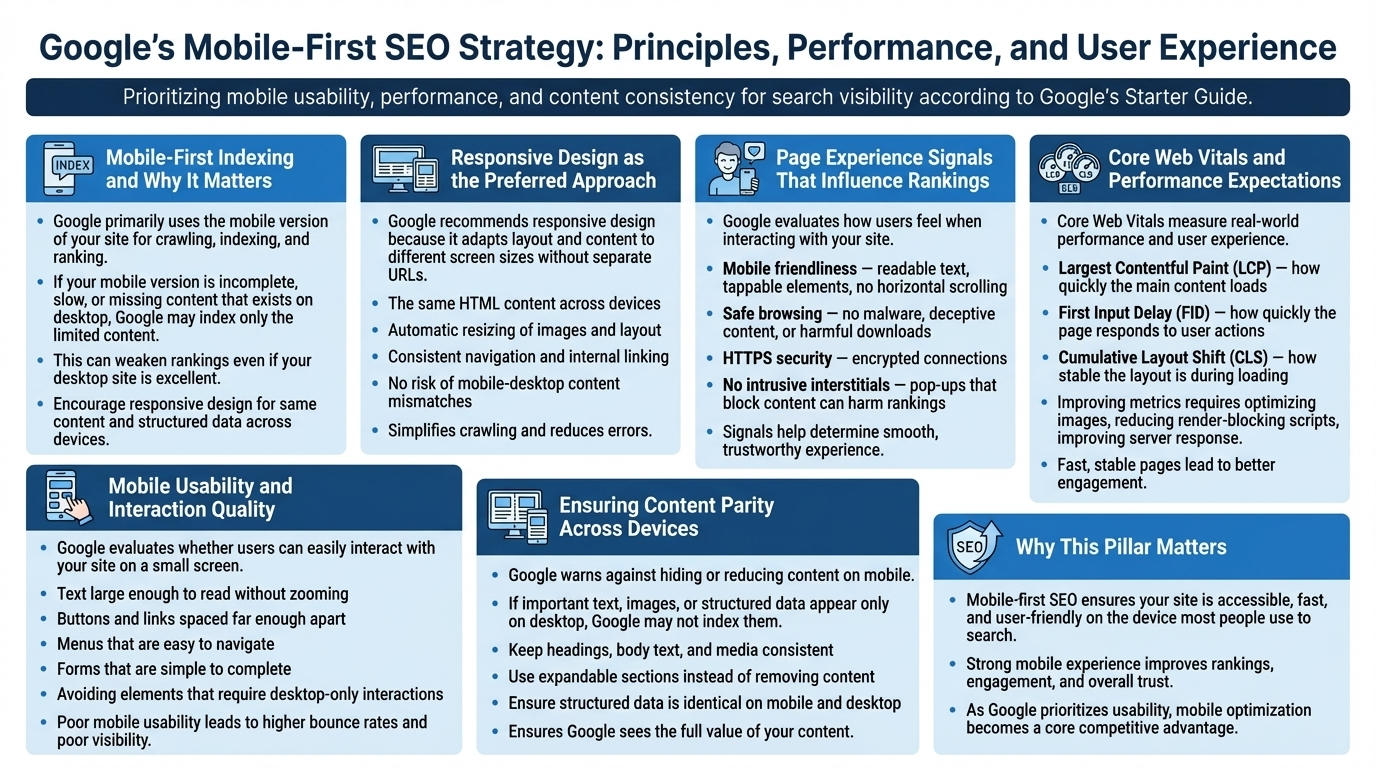
Google’s SEO Starter Guide makes one principle unmistakably clear: Google primarily uses the mobile version of your site for crawling, indexing, and ranking. This shift to mobile‑first indexing means your mobile experience is no longer a secondary consideration—it is your website as far as Google is concerned. Page experience, usability, and performance on mobile directly influence how well your content ranks.
Mobile‑First Indexing and Why It Matters
Google evaluates your site based on what mobile users see. If your mobile version is incomplete, slow, or missing content that exists on desktop, Google may index only the mobile version’s limited content. This can weaken rankings even if your desktop site is excellent. Google encourages a responsive design that serves the same content and structured data across devices, ensuring consistency and accessibility.
Responsive Design as the Preferred Approach
Google recommends responsive design because it adapts layout and content to different screen sizes without requiring separate URLs or dynamic serving. A responsive site ensures:
- The same HTML content across devices
- Automatic resizing of images and layout
- Consistent navigation and internal linking
- No risk of mobile‑desktop content mismatches
This simplifies crawling and reduces the risk of errors that can occur with m.example.com or dynamic serving setups.
Page Experience Signals That Influence Rankings
Google evaluates how users feel when interacting with your site. Page experience includes several key factors:
- Mobile friendliness — readable text, tappable elements, no horizontal scrolling
- Safe browsing — no malware, deceptive content, or harmful downloads
- HTTPS security — encrypted connections
- No intrusive interstitials — pop‑ups that block content can harm rankings
These signals help Google determine whether your site provides a smooth, trustworthy experience.
Core Web Vitals and Performance Expectations
Core Web Vitals measure real‑world performance and user experience. Google focuses on three metrics:
- Largest Contentful Paint (LCP) — how quickly the main content loads
- First Input Delay (FID) — how quickly the page responds to user actions
- Cumulative Layout Shift (CLS) — how stable the layout is during loading
Improving these metrics often requires optimizing images, reducing render‑blocking scripts, and improving server response times. Google emphasizes that fast, stable pages lead to better engagement and higher satisfaction.
Mobile Usability and Interaction Quality
Google evaluates whether users can easily interact with your site on a small screen. Key considerations include:
- Text large enough to read without zooming
- Buttons and links spaced far enough apart
- Menus that are easy to navigate
- Forms that are simple to complete
- Avoiding elements that require desktop‑only interactions
Poor mobile usability can lead to higher bounce rates, which indirectly affects visibility.
Ensuring Content Parity Across Devices
Google warns against hiding or reducing content on mobile. If important text, images, or structured data appear only on desktop, Google may not index them. To maintain parity:
- Keep headings, body text, and media consistent
- Use expandable sections instead of removing content
- Ensure structured data is identical on mobile and desktop
This ensures Google sees the full value of your content.
Why This Pillar Matters
Mobile‑first SEO ensures your site is accessible, fast, and user‑friendly on the device most people use to search. Strong mobile experience improves rankings, engagement, and overall trust. As Google continues to prioritize usability, mobile optimization becomes a core competitive advantage.