
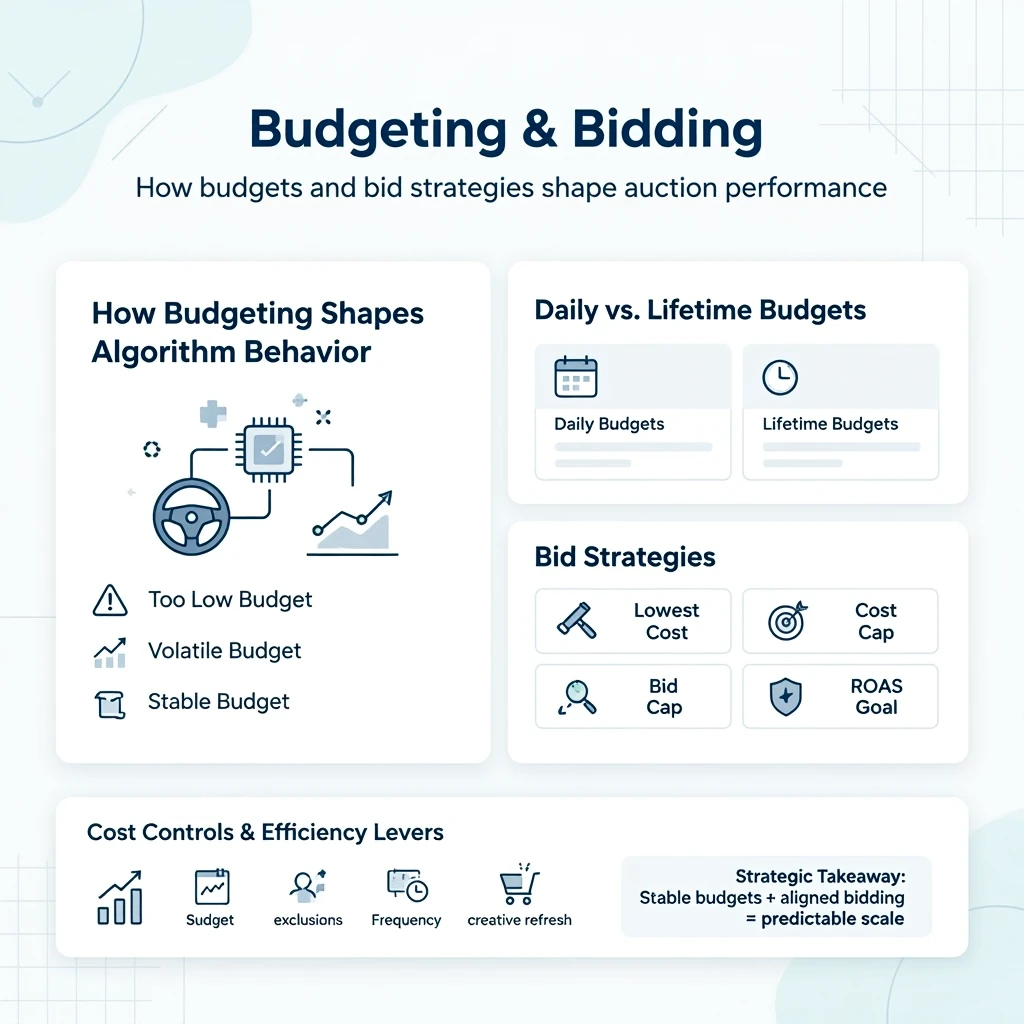
Budgeting and bidding determine how aggressively your ads compete in Meta’s auction and how efficiently the algorithm can pursue your objective. Even with strong creative and clean targeting, poor budget structure or misaligned bidding strategies can cause unstable delivery, rising CPMs, and inconsistent results. This pillar explains how Meta’s budget system works, how bidding influences auction behavior, and how to structure cost controls that support both efficiency and scale.
How Budgeting Shapes Algorithm Behavior
Budgets tell Meta how much freedom it has to explore audiences, test creativity, and gather conversion signals. When budgets are too low, the algorithm struggles to exit the learning phase. When budgets are too volatile, learning resets and performance become unpredictable. Stable budgets allow Meta to build a reliable performance pattern and optimize toward your goal with confidence.
Budgeting is not just about how much you spend—it’s about how consistently you spend it.
Daily vs. Lifetime Budgets
Daily Budgets
Daily budgets provide consistent pacing and predictable spend. They are ideal for:
- Always-on campaigns
- Testing new audiences or creative
- Maintaining stable learning
- Avoiding overspending during high-competition periods
Daily budgets work best when you want steady delivery and long-term optimization.
Lifetime Budgets
Lifetime budgets allow Meta to spend more on high-opportunity days and less on low-opportunity days. They are useful for:
- Short-term promotions
- Seasonal campaigns
- Event-based advertising
- Tight scheduling windows
Lifetime budgets give the algorithm more flexibility but require clear start and end dates.
Campaign Budget Optimization (CBO)
CBO centralizes budget at the campaign level and lets Meta allocate spend dynamically across ad sets. It is powerful when:
- You have multiple audiences of varying sizes
- You want the algorithm to find the most efficient pockets of performance
- You are scaling a proven structure
However, CBO requires:
- Clean audience separation
- Stable ad sets
- Minimal overlap
- Limited manual interference
When used correctly, CBO improves efficiency and accelerates scaling.
Bid Strategies
Bid strategies determine how Meta competes in the auction. Each strategy has different tradeoffs.
Lowest Cost
Meta spends your budget to get the most results at the lowest price. Best for:
- New campaigns
- Learning phase
- Broad audiences
- Scaling early winners
This is the most stable and forgiving strategy.
Cost Cap
You set a maximum average cost per result. Useful when:
- You have strict CPA or CPL targets
- You want predictable cost control
- You have enough conversion volume for stable learning
Cost caps require patience and consistent data.
Bid Cap
You set the maximum bid Meta can place in the auction. Best for:
- Highly competitive niches
- Advanced advertisers
- Large budgets with strict efficiency requirements
Bid caps can limit delivery if set too low.
ROAS Goal
You set a minimum return on ad spend. Ideal for:
- E-commerce
- Catalog sales
- High-volume purchase data
ROAS bidding requires strong pixel/CAPI signals and consistent purchase volume.
Cost Controls & Efficiency Levers
Strong cost control comes from disciplined management:
- Avoid frequent budget changes
- Increase budgets gradually (10–20% increments)
- Maintain stable optimization events
- Use exclusions to prevent wasted spend
- Monitor frequency to avoid fatigue
- Refresh creative before performance declines
Small, consistent adjustments outperform drastic changes.
Strategic Takeaway
Budgeting and bidding are the financial steering wheel of Meta Ads. When budgets are stable, bidding strategies align with your goals, and cost controls are applied consistently, the algorithm performs more efficiently and scales more predictably. Strong budget discipline turns Meta Ads from volatile to reliable.