
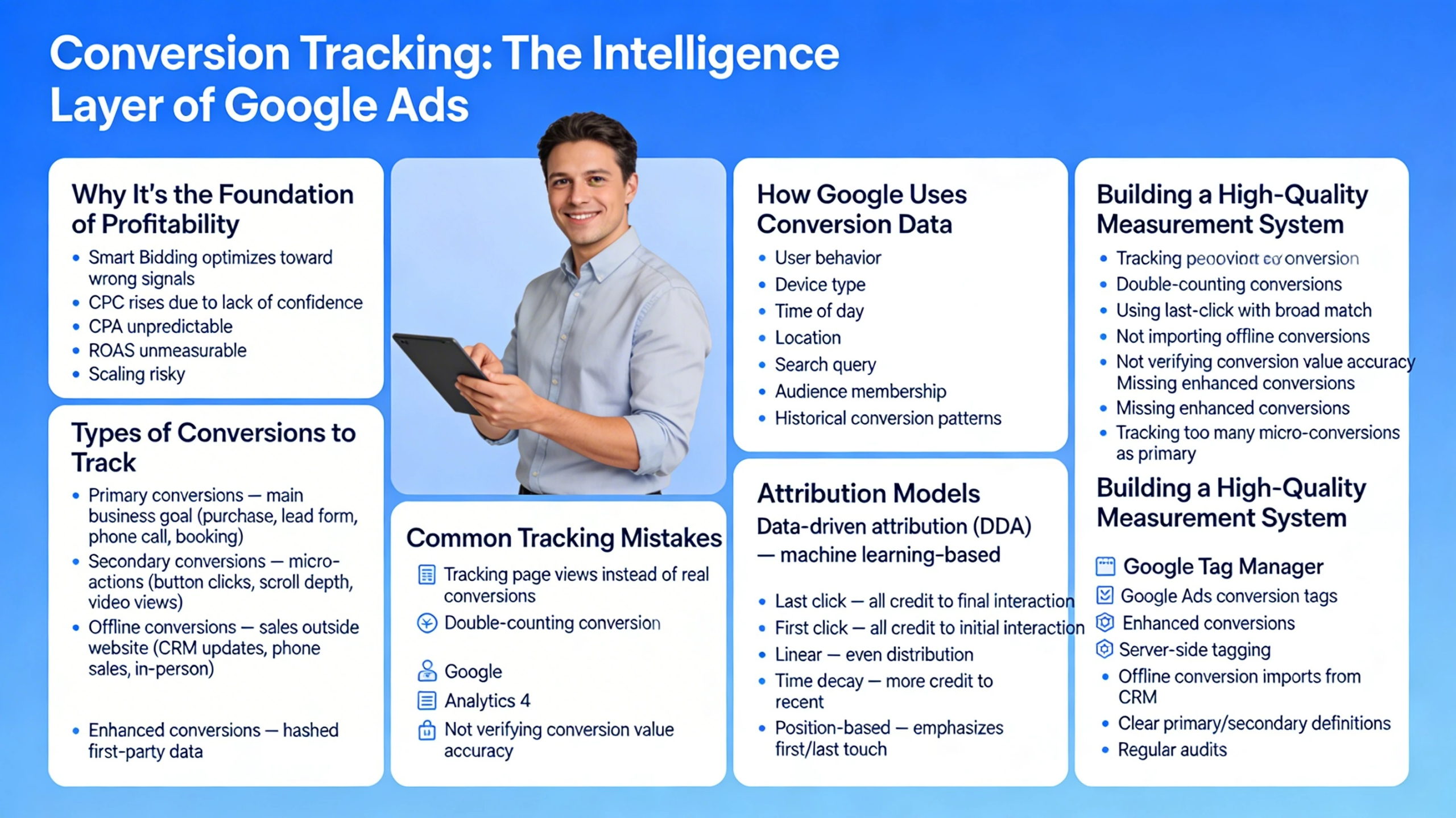
Conversion tracking is the intelligence layer of Google Ads. It tells Google which clicks matter, which users convert, and which signals predict profitable behavior. Without accurate tracking, Smart Bidding becomes blind, optimization stalls, and scaling becomes impossible. This pillar explains how conversion tracking works, why attribution matters, and how to build a measurement system that feeds Google the cleanest, most actionable data.
Why Conversion Tracking Is the Foundation of Profitability
Google Ads is an algorithm-driven system. Every bidding decision—who to show ads to, how much to bid, and which keywords to prioritize—depends on conversion data. When tracking is incomplete or inaccurate:
- Smart Bidding optimizes toward the wrong signals
- CPC rises because Google lacks confidence
- CPA becomes unpredictable
- ROAS becomes impossible to measure
- Scaling becomes risky
Strong tracking transforms Google Ads from guesswork into a predictable, data-driven engine.
Types of Conversions You Should Track
A complete measurement setup includes multiple conversion types, each representing a different stage of user intent.
- Primary conversions — the main business goal (purchase, lead form submission, phone call, booking).
- Secondary conversions — micro-actions that indicate interest (button clicks, scroll depth, video views).
- Offline conversions — sales or deals closed outside the website (CRM updates, phone sales, in-person transactions).
- Enhanced conversions — hashed first-party data sent to Google to improve match accuracy.
Tracking only one conversion type limits Google’s learning. Tracking too many without prioritization confuses the algorithm. The key is defining a clear primary conversion and supporting it with meaningful secondary signals.
How Google Uses Conversion Data
Google’s Smart Bidding models analyze:
- User behavior
- Device type
- Time of day
- Location
- Search query
- Audience membership
- Historical conversion patterns
The more accurate your conversion data, the more precisely Google can predict which clicks are likely to convert. This leads to lower CPA and higher ROAS.
Attribution Models and Why They Matter
Attribution determines how credit is assigned across touchpoints. Google offers several models:
- Data-driven attribution (DDA) — uses machine learning to assign credit based on actual performance patterns.
- Last click — gives all credit to the final interaction.
- First click — gives all credit to the initial interaction.
- Linear — distributes credit evenly.
- Time decay — gives more credit to recent interactions.
- Position-based — emphasizes first and last touch.
DDA is the recommended model because it reflects real user behavior and gives Smart Bidding the most accurate signals.
Common Tracking Mistakes That Kill Performance
Many advertisers unknowingly sabotage their campaigns with tracking errors:
- Tracking page views instead of real conversions
- Double-counting conversions
- Using last-click attribution with broad match
- Not importing offline conversions
- Not verifying conversion value accuracy
- Missing enhanced conversions
- Tracking too many micro-conversions as primary goals
These mistakes distort Google’s learning and lead to wasted spend.
Building a High-Quality Measurement System
A professional tracking setup includes:
- Google Tag Manager for centralized control
- Google Ads conversion tags
- Enhanced conversions for better match rates
- Google Analytics 4 for behavioral insights
- Server-side tagging for data accuracy
- Offline conversion imports from CRM
- Clear primary and secondary conversion definitions
- Regular audits to catch tracking drift
This system ensures Google receives clean, reliable data that improves bidding efficiency.
Strategic Takeaway
Conversion tracking is not a technical chore—it is the strategic core of Google Ads. When your tracking is accurate and your attribution model reflects real behavior, Smart Bidding becomes dramatically more effective, costs drop, and scaling becomes predictable.