
Landing page alignment is one of the strongest performance multipliers in Google Ads. Even with perfect keywords, flawless structure, and high‑CTR ads, a misaligned landing page can destroy conversion rates, inflate CPA, and drag down Quality Score. Google’s system evaluates not just your ad, but the entire user journey—from search intent to landing page experience. This pillar explains how to build landing pages that reinforce intent, improve Quality Score, and maximize conversions.
How Google Evaluates Landing Pages
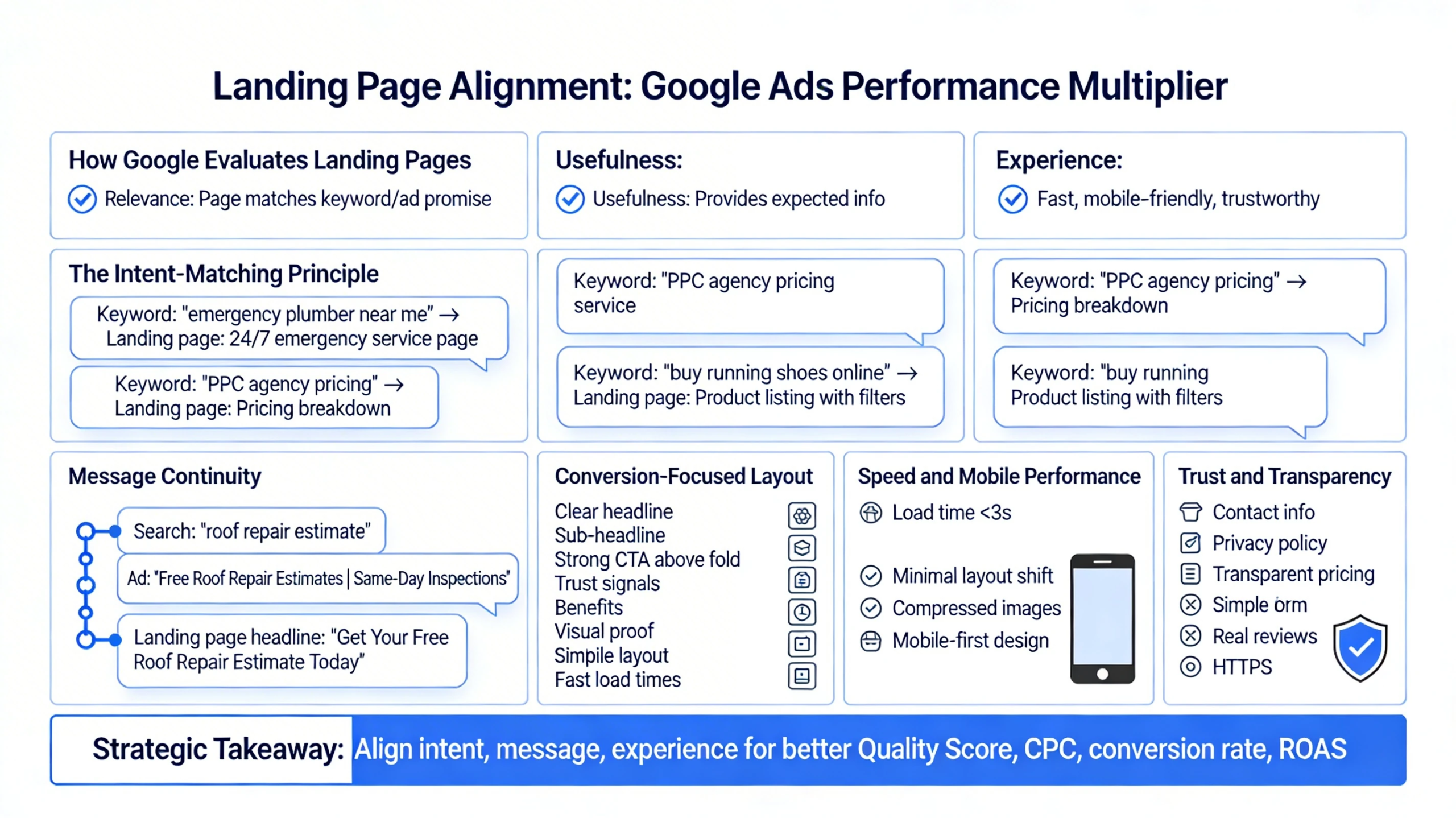
Google measures landing page experience using three core criteria:
- Relevance — Does the page match the keyword and ad promise?
- Usefulness — Does it provide the information the user expects?
- Experience — Is it fast, mobile‑friendly, and trustworthy?
These signals influence both Quality Score and Ad Rank, meaning landing pages directly affect your CPC and impression share.
The Intent‑Matching Principle
The most important rule in landing page alignment is simple:
The landing page must fulfill the exact intent of the keyword and ad.
Examples:
- Keyword: “emergency plumber near me”
- Landing page: 24/7 emergency plumbing service page, not a generic homepage.
- Keyword: “PPC agency pricing”
- Landing page: pricing breakdown or service packages, not a generic “About Us”.
- Keyword: “buy running shoes online”
- Landing page: product listing page with filters, not a blog post.
When the landing page mirrors the user’s intent, conversion rates rise and Quality Score improves.
Message Continuity
Message continuity means the headline, ad copy, and landing page all reinforce the same promise. This reduces friction and increases trust.
A strong continuity chain looks like this:
- Search: “roof repair estimate”
- Ad: “Free Roof Repair Estimates | Same‑Day Inspections”
- Landing page headline: “Get Your Free Roof Repair Estimate Today”
When users see the same message repeated, they feel confident they’re in the right place.
Conversion‑Focused Layout
High‑performing landing pages follow a predictable structure:
- Clear headline matching the ad
- Sub‑headline reinforcing the value
- Strong CTA above the fold
- Trust signals (reviews, ratings, certifications)
- Benefits and differentiators
- Visual proof (photos, videos, case studies)
- Simple form or booking flow
- Mobile‑optimized layout
- Fast load times
This structure reduces cognitive load and guides users toward action.
Speed and Mobile Performance
Google heavily weights mobile experience. Slow or poorly optimized pages hurt both Quality Score and conversions.
Key benchmarks:
- Load time under 3 seconds
- Minimal layout shift
- Compressed images
- Clean code and caching
- Mobile‑first design
A fast page improves both user experience and Smart Bidding efficiency.
Trust and Transparency
Google evaluates trust signals such as:
- Clear contact information
- Privacy policy
- Transparent pricing
- Real reviews
- Secure checkout (HTTPS)
Pages lacking trust indicators often receive lower Quality Scores and higher bounce rates.
Alignment With Smart Bidding
Smart Bidding performs best when landing pages:
- Convert consistently
- Provide clear conversion signals
- Have minimal friction
- Offer a single primary CTA
If the page has multiple competing CTAs, Smart Bidding receives mixed signals and optimization slows.
The Strategic Takeaway
Landing page alignment is not just about design—it’s about intent, message continuity, and user experience. When your landing page fulfills the promise made in your ad, every metric improves: Quality Score, CPC, conversion rate, and ROAS.