
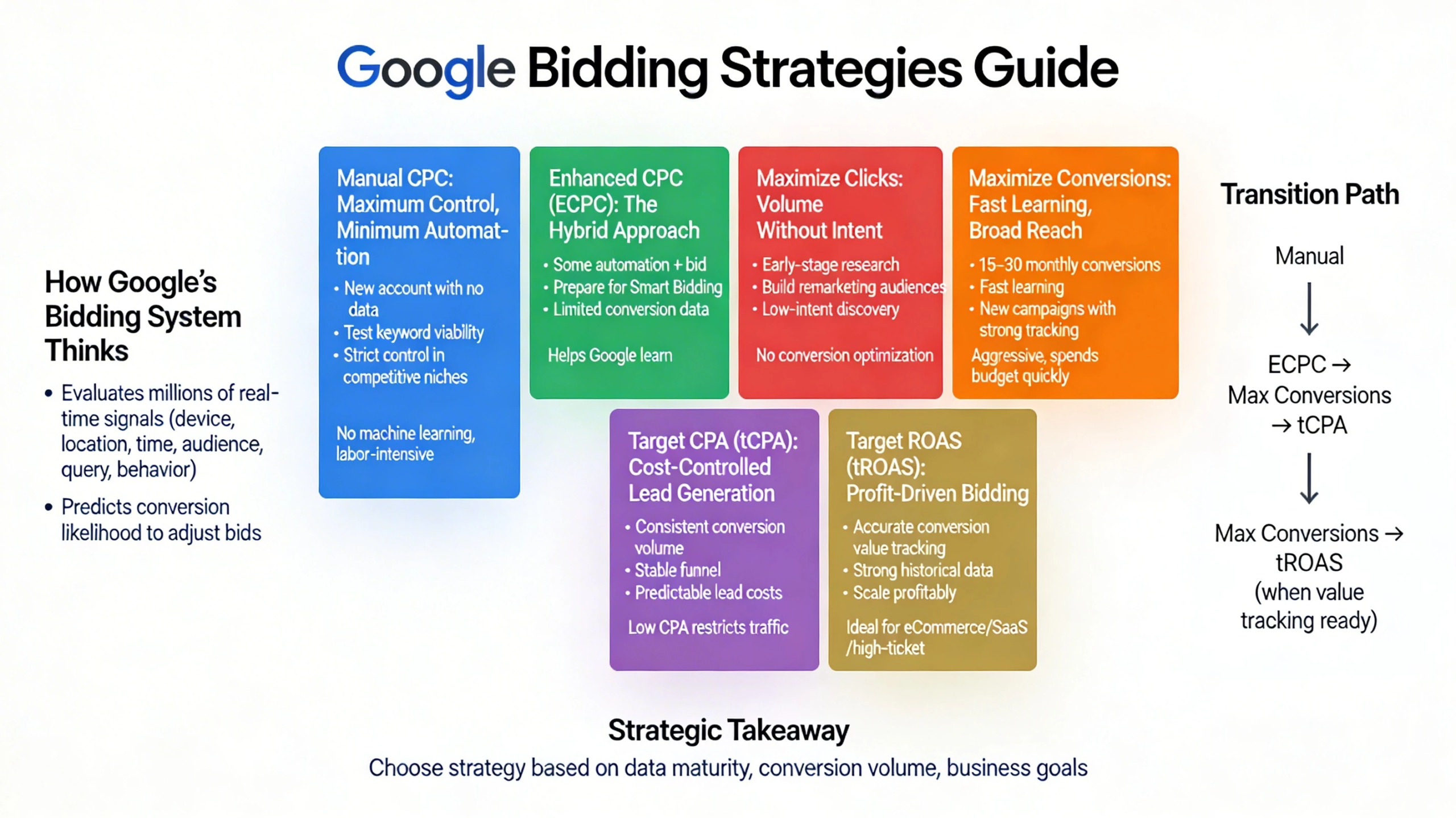
Bidding strategies determine how Google allocates your budget, how aggressively you compete in auctions, and how efficiently you acquire conversions. Even with perfect targeting and strong ad copy, the wrong bidding strategy can inflate CPA, limit impression share, or starve campaigns of momentum. This pillar breaks down how each bidding strategy works, when to use it, and how to transition between them without disrupting performance.
How Google’s Bidding System Thinks
Google’s bidding algorithms evaluate millions of signals in real time—device, location, time of day, audience membership, search query, historical behavior, and more. The goal is to predict the likelihood of a conversion and adjust bids accordingly. The more conversion data you feed the system, the more accurate and profitable the bidding becomes.
This is why bidding strategy is inseparable from conversion tracking. Without clean data, even the best strategy underperforms.
Manual CPC: Maximum Control, Minimum Automation
Manual CPC gives you full control over keyword-level bids. It’s useful when:
- You’re launching a new account with no data
- You want to test keyword viability before automation
- You need strict control in highly competitive niches
However, manual CPC does not use Google’s machine learning signals. It’s labor-intensive and scales poorly. Most mature accounts eventually transition to Smart Bidding.
Enhanced CPC (ECPC): The Hybrid Approach
Enhanced CPC is manual bidding with Google’s algorithm adjusting bids up or down based on conversion likelihood. It’s a transitional strategy between manual and full automation.
Use ECPC when:
- You want some automation but still want bid control
- You’re preparing a campaign for Smart Bidding
- You have limited conversion data
ECPC helps Google learn without fully committing to automated bidding.
Maximize Clicks: Volume Without Intent
Maximize Clicks is a simple strategy that aims to get as many clicks as possible within your budget. It’s useful for:
- Early-stage research
- Building remarketing audiences
- Low-intent discovery campaigns
However, it does not optimize for conversions. It should never be used for high-intent search campaigns.
Maximize Conversions: Fast Learning, Broad Reach
Maximize Conversions uses Google’s AI to find users most likely to convert. It’s ideal when:
- You have at least 15–30 conversions per month
- You want fast learning
- You’re launching new campaigns with strong tracking
It’s aggressive and can spend your full budget quickly, but it accelerates data collection.
Target CPA (tCPA): Cost-Controlled Lead Generation
Target CPA tells Google the maximum cost per conversion you’re willing to pay. It works best when:
- You have consistent conversion volume
- Your funnel is stable
- You want predictable lead costs
If your CPA target is too low, Google will restrict traffic and stall delivery.
Target ROAS (tROAS): Profit-Driven Bidding
Target ROAS is the most advanced bidding strategy. It optimizes for revenue, not just conversions. Use it when:
- You track conversion values accurately
- You have strong historical data
- You want to scale profitably
tROAS is ideal for eCommerce, SaaS, and high-ticket services.
When to Transition Between Strategies
A smooth transition prevents performance drops:
- Manual → ECPC → Max Conversions → tCPA
- Max Conversions → tROAS (when value tracking is ready)
Each step gives Google more data and stability before moving to the next level.
Strategic Takeaway
Bidding strategy is not about choosing the “best” option—it’s about choosing the right strategy for your data maturity, conversion volume, and business goals. When your bidding aligns with your tracking and structure, Google’s automation becomes a powerful profit engine.