
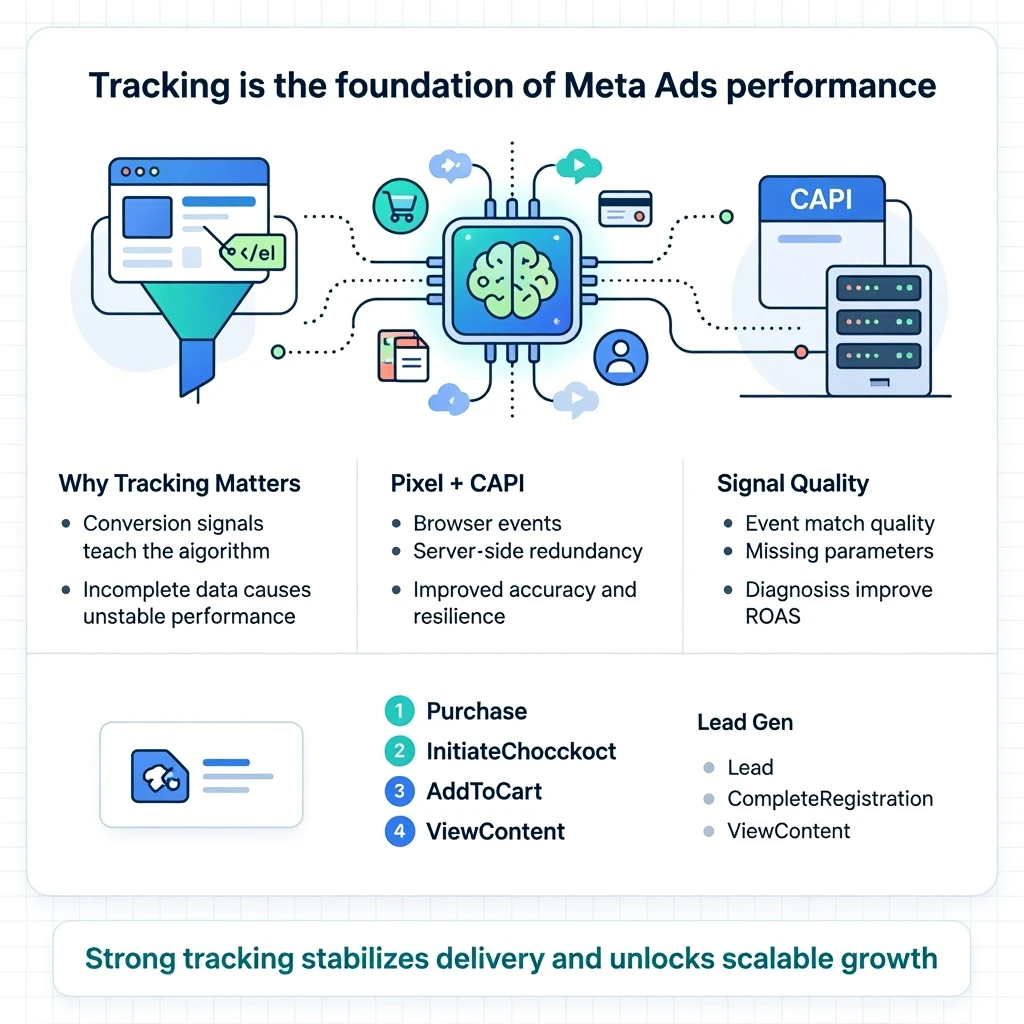
Tracking is the backbone of Meta Ads performance. Without accurate event data, the algorithm cannot learn, optimize, or scale. Strong tracking ensures Meta understands which users convert, which actions matter, and which signals should guide delivery. Weak tracking leads to unstable performance, poor optimization, and wasted budget. This pillar explains how Meta’s tracking ecosystem works, how events influence optimization, and how to structure a reliable conversion framework.
Why Tracking Matters in Meta Ads
Meta’s machine learning system relies on conversion signals to identify your best customers. Every purchase, lead, add-to-cart, or view-content event teaches the algorithm what type of user to find next. When tracking is incomplete or inaccurate, Meta receives the wrong signals—or no signals at all—and performance deteriorates.
Tracking is not just a technical setup; it is a performance multiplier.
Meta Pixel
The Pixel is a browser-based tracking script that captures user actions on your website. It records:
- Page views
- Add-to-cart events
- Initiate checkout events
- Purchases
- Custom events
Pixel data helps Meta understand user behavior and build retargeting audiences. However, browser tracking alone is no longer enough due to privacy changes, ad blockers, and iOS restrictions.
Conversions API (CAPI)
CAPI sends events directly from your server to Meta, bypassing browser limitations. It improves:
- Event accuracy
- Attribution
- Optimization stability
- Signal resilience
CAPI is essential for modern Meta Ads performance. When combined with the Pixel, it creates a “redundant signal system” that ensures events fire even when browser tracking fails.
Standard Events
Meta provides a set of predefined events that represent common business actions:
- ViewContent
- AddToCart
- InitiateCheckout
- Purchase
- Lead
- CompleteRegistration
- Subscribe
Using standard events ensures the algorithm understands your funnel and can optimize effectively. Custom events are useful, but standard events should be the foundation.
Event Prioritization & Aggregated Event Measurement
Due to privacy changes, Meta requires advertisers to prioritize up to eight events per domain. Prioritization determines which events are used for optimization and reporting when users opt out of tracking.
A typical e‑commerce prioritization might be:
- Purchase
- InitiateCheckout
- AddToCart
- ViewContent
A typical lead generation prioritization might be:
- Lead
- CompleteRegistration
- ViewContent
Correct prioritization ensures Meta optimizes for the most valuable actions.
Optimization Events
The optimization event you choose at the ad set level determines what Meta tries to maximize. Common options include:
- Purchases
- Leads
- Add-to-cart
- Landing page views
- Link clicks
Choosing the wrong event is one of the most common performance killers. For example, optimizing for link clicks attracts clickers—not buyers. Optimizing for purchases attracts people most likely to convert, even if CPM is higher.
Attribution Settings
Attribution determines how Meta credits conversions. The default is 7-day click and 1-day view, which balances accuracy and learning. Shorter windows reduce reported conversions and can destabilize optimization. Longer windows provide more data but may inflate attribution.
Attribution should match your sales cycle and business model.
Signal Quality & Diagnostics
Meta provides diagnostics to evaluate event quality:
- Event match quality
- Redundant event firing
- Missing parameters
- Low signal strength
Improving signal quality directly improves ROAS because the algorithm learns faster and more accurately.
Strategic Takeaway
Tracking is the foundation of Meta Ads performance. When Pixel and CAPI work together, events are correctly prioritized, and optimization signals are clean, making the algorithm dramatically more efficient. Strong tracking reduces costs, stabilizes delivery, and unlocks scalable growth.