
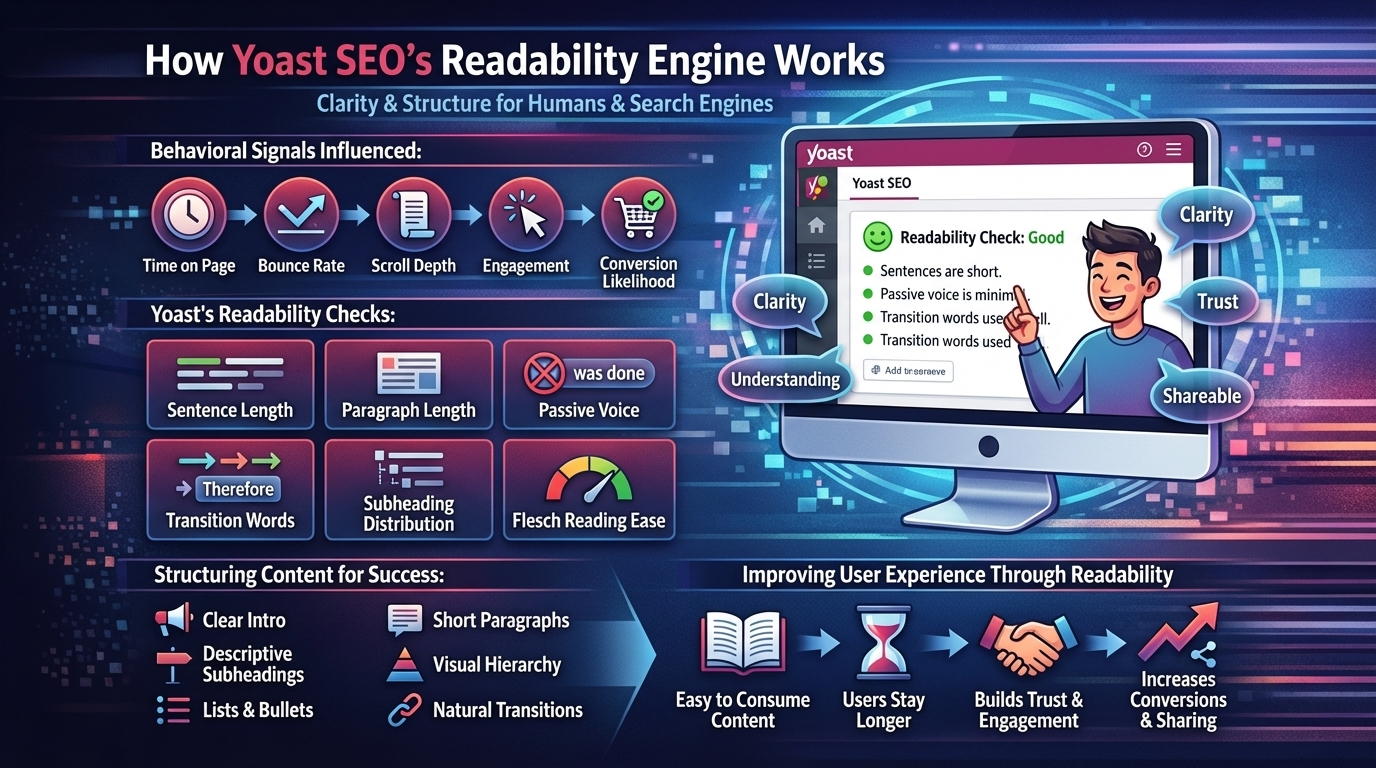
Yoast SEO’s readability engine is designed to help you create content that users can understand quickly and search engines can evaluate confidently. While the SEO analysis focuses on keyphrases and metadata, the readability analysis focuses on clarity, structure, and flow. These elements directly influence user engagement, dwell time, and conversion rates—signals that indirectly support stronger rankings. This pillar explains how Yoast evaluates readability, why it matters, and how to structure content for both humans and search engines.
How Readability Influences SEO Performance
Search engines increasingly reward content that demonstrates clarity, coherence, and user satisfaction. Readability affects several behavioral signals:
- Time on page
- Bounce rate
- Scroll depth
- Engagement with internal links
- Conversion likelihood
Readable content keeps users engaged longer, which helps search engines interpret the page as high‑quality and relevant. Yoast’s readability checks provide a framework for achieving this consistently across your site.
Yoast’s Readability Checks: What They Measure
Yoast evaluates readability using a set of linguistic and structural indicators. Each check is designed to improve clarity without sacrificing depth.
- Sentence length — Long sentences reduce comprehension. Yoast encourages shorter, more digestible phrasing.
- Paragraph length — Large blocks of text overwhelm readers. Short paragraphs improve scanning and retention.
- Passive voice — Excessive passive voice weakens clarity. Yoast promotes active voice for stronger communication.
- Transition words — Words like “however,” “therefore,” and “for example” improve flow and logical progression.
- Subheading distribution — Frequent headings break content into meaningful sections and improve navigation.
- Flesch Reading Ease score — Measures how easy the text is to read based on syllable and sentence length.
These checks guide you toward content that is accessible, structured, and user‑friendly.
Structuring Content for Readability and SEO
Strong readability is not just about short sentences—it’s about creating a logical, scannable structure. Effective content includes:
- A clear introduction that sets expectations
- Short paragraphs that focus on one idea
- Descriptive subheadings that guide readers
- Lists and bullets for complex information
- Visual hierarchy that supports scanning
- Natural transitions between sections
This structure helps both users and search engines understand the page’s purpose and flow.
Balancing Readability with SEO Requirements
Yoast’s readability and SEO analyses work together, but they serve different goals. Sometimes, SEO‑optimized content can become too dense or repetitive. The key is balance:
- Use keyphrases naturally
- Avoid keyword stuffing
- Maintain conversational tone
- Prioritize clarity over rigid optimization
- Use synonyms and semantic variations
Readable content that satisfies search intent will outperform keyword‑heavy content that feels forced.
Improving User Experience Through Readability
Readability is a core part of user experience. When content is easy to consume:
- Users stay longer
- They trust the brand more
- They are more likely to convert
- They explore additional pages
- They share the content more often
Yoast’s readability tools help ensure every page supports these outcomes.
Why This Pillar Matters
Readability is one of the most overlooked SEO factors, yet it directly influences user satisfaction and engagement. Yoast’s readability engine provides a practical, repeatable framework for producing clear, structured, and user‑friendly content across your entire site.