
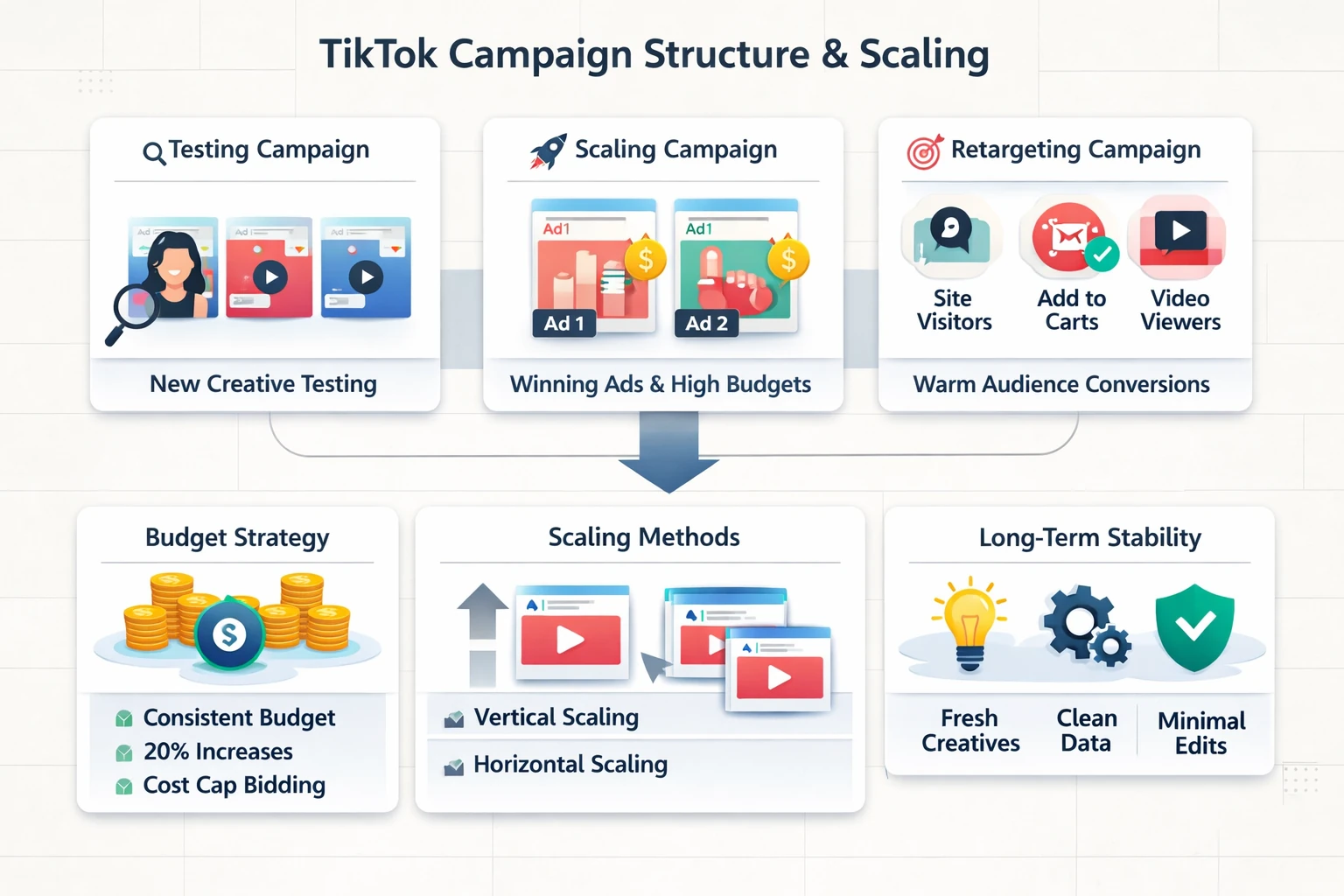
A strong TikTok campaign structure creates stability, reduces learning resets, and gives the algorithm enough room to optimize. Because TikTok is a creative‑first platform, the account architecture must support rapid testing, clean signal flow, and efficient scaling. This pillar explains how to structure campaigns, how to scale budgets without breaking performance, and how to maintain long‑term stability as you grow.
Why Campaign Structure Matters on TikTok
TikTok’s delivery system performs best when campaigns are simple, consolidated, and fed with consistent creative signals. Over‑segmentation—too many ad groups, too many audiences, too many edits—prevents the algorithm from gathering enough data to optimize. A clean structure ensures:
- Faster learning phase exit
- Lower CPMs
- More stable delivery
- Easier creative testing
- Clearer diagnostics
- Better scaling efficiency
The goal is to reduce noise and let the algorithm do its job.
The Three‑Layer TikTok Account Structure
A scalable TikTok Ads account typically includes three core campaign types:
- Testing Campaign — used to validate new creatives, hooks, and concepts.
- Scaling Campaign — used to push proven winners with higher budgets.
- Retargeting Campaign — used to convert warm audiences and high‑intent users.
This structure separates experimentation from scaling, preventing weak creatives from hurting your best performers.
Testing Campaign Structure
The testing campaign is where new ideas enter the system. A strong testing setup includes:
- Broad targeting to maximize learning
- Lowest cost bidding for flexibility
- 3–5 creatives per ad group
- Multiple creators and variations
- Daily budgets large enough to generate conversions
The goal is to identify which creatives have strong hook rates, hold rates, and conversion potential.
Scaling Campaign Structure
Once a creative proves itself in testing, it moves into the scaling campaign. Scaling campaigns rely on:
- Fewer ad groups
- Higher budgets
- Cost Cap or Lowest Cost bidding
- Broad or lookalike audiences
- Minimal edits to avoid learning resets
Scaling campaigns should be stable, predictable, and optimized for efficiency rather than experimentation.
Retargeting Campaign Structure
Retargeting captures users who have shown intent but haven’t converted. Strong retargeting includes:
- Website visitors
- Add‑to‑carts
- Initiate checkouts
- Video viewers
- Profile visitors
- TikTok Shop engagers
Retargeting creatives should be direct, trust‑building, and benefit‑focused.
Budget Architecture for Stability and Scale
TikTok’s algorithm responds best to consistent budgets. Effective budget architecture includes:
- Avoiding budget changes over 20%
- Using daily budgets for long‑term stability
- Ensuring enough budget to exit learning
- Scaling gradually (20–30% increases)
- Duplicating ad groups for aggressive scaling instead of editing budgets
- Using Cost Cap for predictable CPA at higher spend
Underfunded campaigns struggle to optimize; over‑edited campaigns never stabilize.
Horizontal vs. Vertical Scaling
TikTok supports two scaling methods:
- Vertical scaling — increasing budgets on winning ad groups.
- Horizontal scaling — duplicating winners into new ad groups or audiences.
Horizontal scaling is often more stable because it avoids learning resets and allows the algorithm to explore new pockets of users.
Maintaining Long‑Term Stability
Long‑term success requires:
- Continuous creative refresh
- Clean tracking signals
- Minimal structural changes
- Clear separation between testing and scaling
- Strong retargeting to capture warm traffic
When structure, creative, and optimization align, TikTok becomes one of the most scalable ad platforms available.