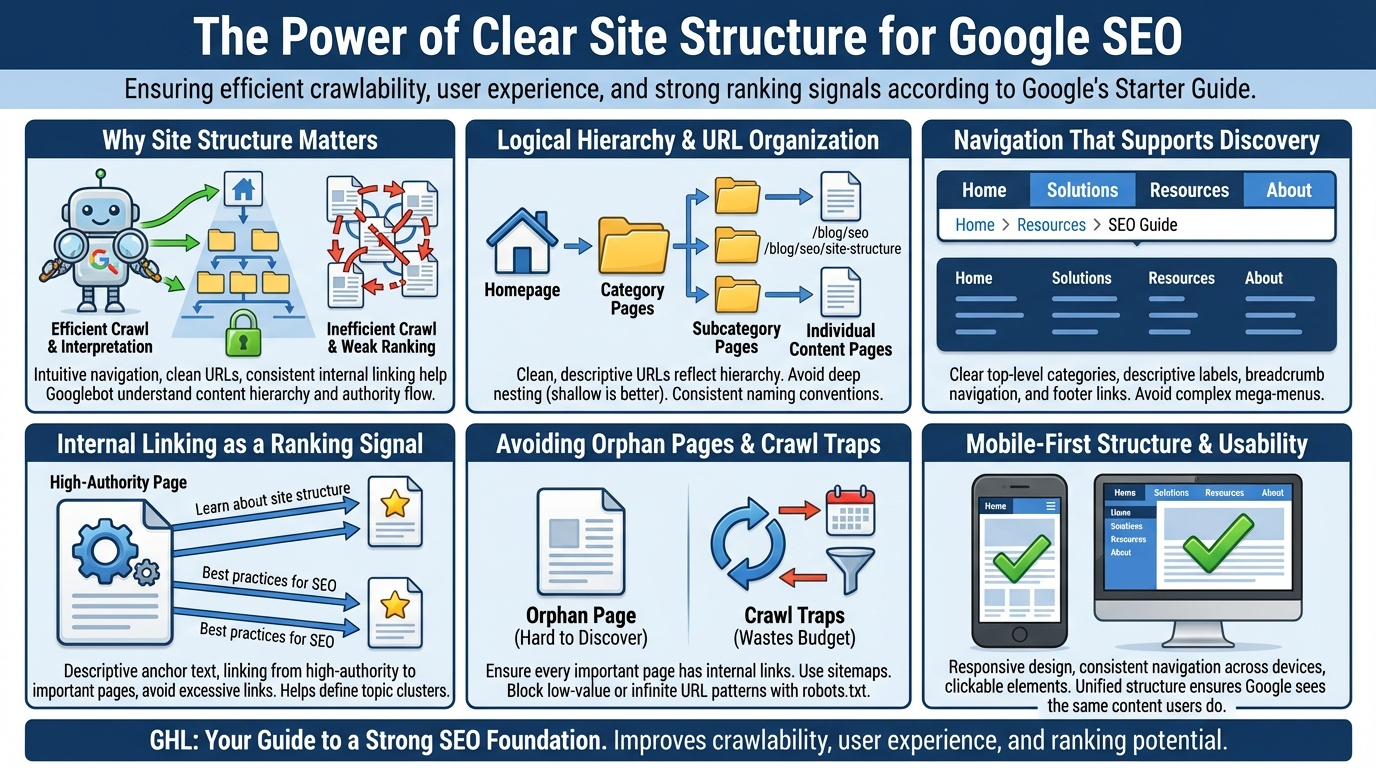
A clear, logical site structure is one of the strongest foundations of Google SEO. Google’s SEO Starter Guide emphasizes that both users and search engines rely on intuitive navigation, clean URL paths, and consistent internal linking to understand how your content fits together. When your structure is organized, Googlebot crawls more efficiently, users find information faster, and your most important pages gain stronger ranking signals.
Why Site Structure Matters for Google Search
Google discovers and interprets content through links. A well‑organized structure helps Googlebot understand which pages are most important, how topics relate to each other, and how authority should flow across the site. A poor structure—deep nesting, orphan pages, inconsistent navigation—creates crawl inefficiencies and weakens ranking potential. Google recommends designing your site for humans first, ensuring that navigation mirrors how users naturally explore information.
Logical Hierarchy & URL Organization
A strong structure begins with a clear hierarchy:
- Homepage → Category pages → Subcategory pages → Individual content pages
- Clean, descriptive URLs that reflect this hierarchy
- Avoiding deep nesting (Google prefers shallow structures)
- Consistent naming conventions
Google stresses that URLs should be simple, readable, and meaningful. Parameters, unnecessary folders, and cryptic strings make it harder for both users and search engines to understand page purpose.
Navigation That Supports Discovery
Navigation menus help users and Googlebot understand your site’s main sections. Google recommends:
- Clear top‑level categories
- Descriptive labels (not generic terms like “Products” or “Services”)
- Breadcrumb navigation for contextual awareness
- Footer links to important pages
- Avoiding overly complex mega‑menus
Breadcrumbs are especially valuable because they reinforce hierarchy and provide additional internal links that help Google interpret relationships between pages.
Internal Linking as a Ranking Signal
Internal links distribute authority and guide Googlebot through your site. Google highlights several best practices:
- Use descriptive anchor text that reflects the target page’s topic
- Link from high‑authority pages to important or new pages
- Avoid excessive links on a single page
- Ensure no important page is more than a few clicks from the homepage
Internal linking also helps Google detect topic clusters, which strengthens relevance and improves ranking for competitive queries.
Avoiding Orphan Pages & Crawl Traps
Orphan pages—pages with no internal links pointing to them—are difficult for Google to discover. Crawl traps, such as infinite calendars or faceted navigation loops, waste crawl budget. Google recommends:
- Ensuring every important page has at least one internal link
- Using sitemaps to support discovery
- Blocking low‑value or infinite URL patterns with robots.txt
- Keeping navigation consistent across templates
These practices help Googlebot crawl efficiently and focus on the pages that matter most.
Mobile‑First Structure & Usability
Because Google uses mobile‑first indexing, your mobile navigation must match your desktop structure. Hidden menus, inaccessible links, or inconsistent layouts can cause Google to miss important pages. Google encourages:
- Responsive design
- Consistent navigation across devices
- Clickable, easy‑to‑tap elements
- Avoiding mobile‑only or desktop‑only content
A unified structure ensures Google sees the same content users do.
Why This Pillar Matters
A strong site structure improves crawlability, user experience, and ranking potential. It helps Google understand your content, strengthens internal authority flow, and ensures your most valuable pages receive the visibility they deserve.