
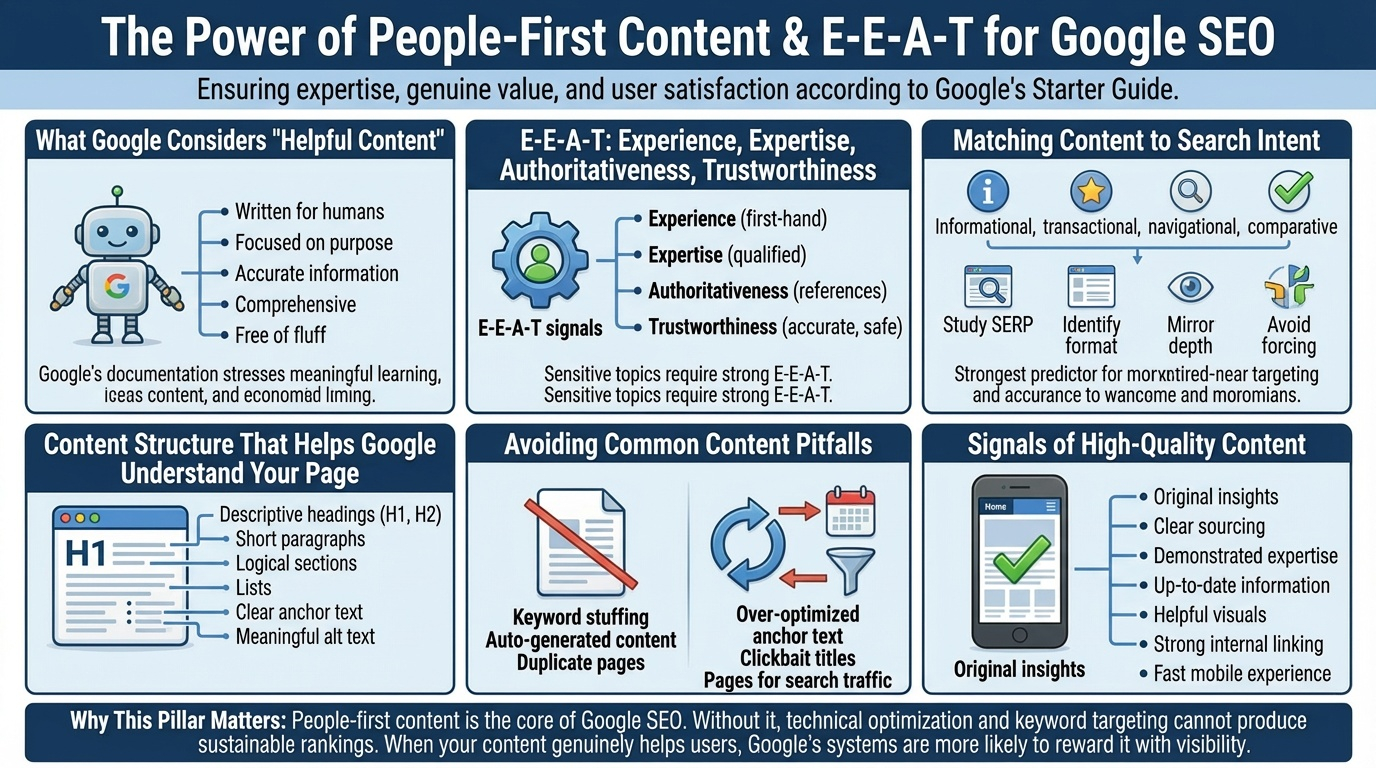
Google’s SEO Starter Guide places people‑first content at the center of modern SEO. Google’s ranking systems are designed to reward pages that demonstrate expertise, provide genuine value, and satisfy user intent. This pillar explains how Google evaluates content quality, what signals matter most, and how to create pages that consistently earn trust and visibility.
What Google Considers “Helpful Content”
Google prioritizes content that answers real questions, solves real problems, and reflects real expertise. Helpful content is:
- Written for humans, not algorithms
- Focused on a clear purpose
- Supported by accurate, trustworthy information
- Comprehensive enough to satisfy the user’s query
- Free of fluff, filler, or keyword manipulation
Google’s documentation stresses that content should leave users feeling they’ve learned something meaningful—not that they need to search again for a better answer.
E‑E‑A‑T: Experience, Expertise, Authoritativeness, Trustworthiness
Google evaluates content quality through E‑E‑A‑T signals. These are not single ranking factors but patterns Google uses to assess credibility.
- Experience — Does the author demonstrate first‑hand knowledge?
- Expertise — Is the content written by someone qualified on the topic?
- Authoritativeness — Do other reputable sites reference or link to this content?
- Trustworthiness — Is the information accurate, transparent, and safe?
Pages covering sensitive topics—health, finance, legal, safety—require especially strong E‑E‑A‑T because misinformation can harm users.
Matching Content to Search Intent
Google rewards content that aligns with what users expect to see. Intent can be informational, transactional, navigational, or comparative. To match intent effectively:
- Study the current SERP for your target keyword
- Identify the dominant content format (guide, product page, video, FAQ)
- Mirror the depth and structure users expect
- Avoid forcing a page to rank for an intent it cannot satisfy
Intent alignment is one of the strongest predictors of ranking success.
Content Structure That Helps Google Understand Your Page
Google relies on clear structure to interpret your content. Effective pages use:
- Descriptive headings (H1, H2, H3)
- Short paragraphs
- Logical sections
- Lists and tables for clarity
- Clear, descriptive anchor text
- Images with meaningful alt text
This structure improves readability and helps Google identify key topics and relationships.
Avoiding Common Content Pitfalls
Google warns against several practices that reduce content quality:
- Keyword stuffing
- Auto‑generated or thin content
- Duplicate or near‑duplicate pages
- Over‑optimized anchor text
- Clickbait titles that don’t match the content
- Pages created solely to attract search traffic
These patterns signal low value and can trigger ranking suppression.
Signals of High‑Quality Content
Google’s documentation highlights several positive signals:
- Original insights or analysis
- Clear sourcing and citations
- Demonstrated expertise
- Up‑to‑date information
- Helpful visuals or examples
- Strong internal linking
- Fast, mobile‑friendly experience
These signals help Google understand that your content is trustworthy and worth ranking.
Why This Pillar Matters
People‑first content is the core of Google SEO. Without it, technical optimization and keyword targeting cannot produce sustainable rankings. When your content genuinely helps users, Google’s systems are more likely to reward it with visibility.