
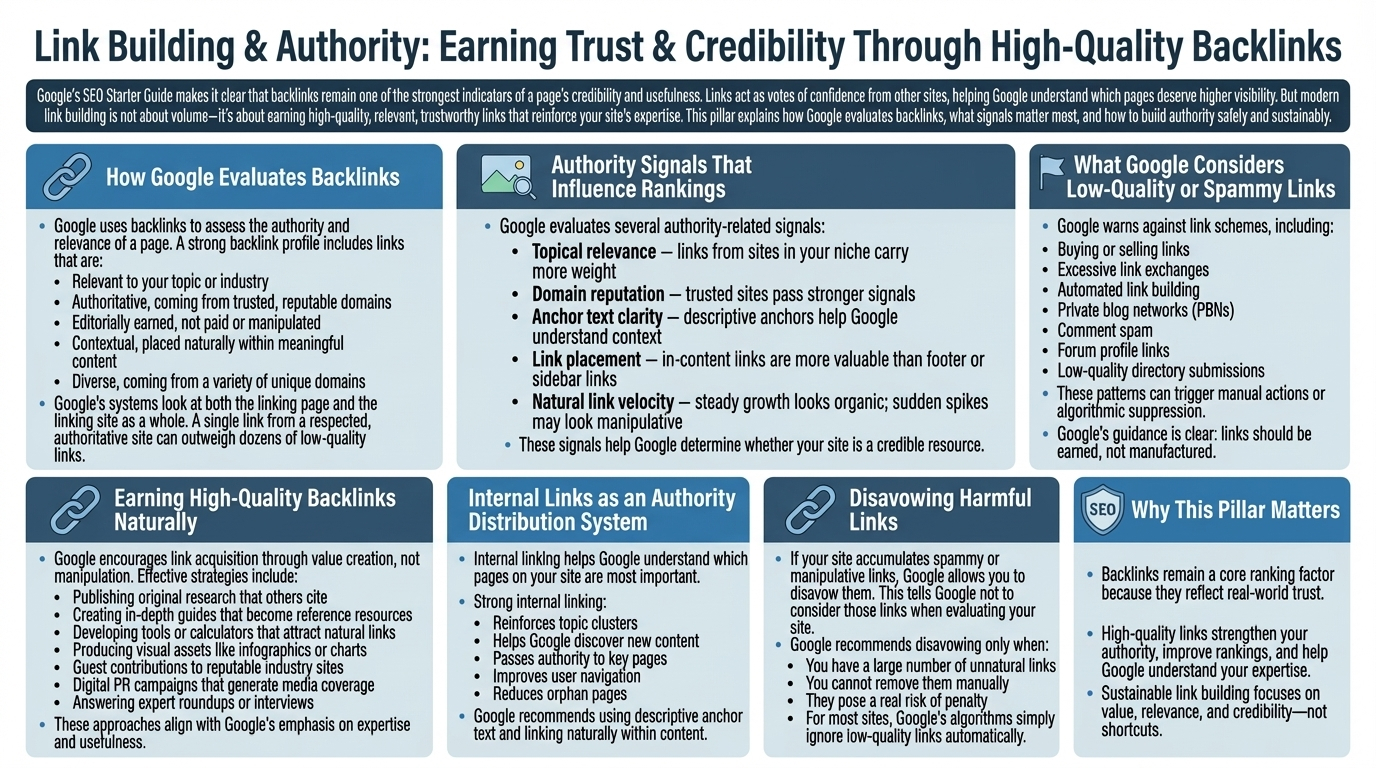
Google’s SEO Starter Guide makes it clear that backlinks remain one of the strongest indicators of a page’s credibility and usefulness. Links act as votes of confidence from other sites, helping Google understand which pages deserve higher visibility. But modern link building is not about volume—it’s about earning high‑quality, relevant, trustworthy links that reinforce your site’s expertise. This pillar explains how Google evaluates backlinks, what signals matter most, and how to build authority safely and sustainably.
How Google Evaluates Backlinks
Google uses backlinks to assess the authority and relevance of a page. A strong backlink profile includes links that are:
- Relevant to your topic or industry
- Authoritative, coming from trusted, reputable domains
- Editorially earned, not paid or manipulated
- Contextual, placed naturally within meaningful content
- Diverse, coming from a variety of unique domains
Google’s systems look at both the linking page and the linking site as a whole. A single link from a respected, authoritative site can outweigh dozens of low‑quality links.
Authority Signals That Influence Rankings
Google evaluates several authority‑related signals:
- Topical relevance — links from sites in your niche carry more weight
- Domain reputation — trusted sites pass stronger signals
- Anchor text clarity — descriptive anchors help Google understand context
- Link placement — in‑content links are more valuable than footer or sidebar links
- Natural link velocity — steady growth looks organic; sudden spikes may look manipulative
These signals help Google determine whether your site is a credible resource.
What Google Considers Low‑Quality or Spammy Links
Google warns against link schemes, including:
- Buying or selling links
- Excessive link exchanges
- Automated link building
- Private blog networks (PBNs)
- Comment spam
- Forum profile links
- Low‑quality directory submissions
These patterns can trigger manual actions or algorithmic suppression. Google’s guidance is clear: links should be earned, not manufactured.
Earning High‑Quality Backlinks Naturally
Google encourages link acquisition through value creation, not manipulation. Effective strategies include:
- Publishing original research that others cite
- Creating in‑depth guides that become reference resources
- Developing tools or calculators that attract natural links
- Producing visual assets like infographics or charts
- Guest contributions to reputable industry sites
- Digital PR campaigns that generate media coverage
- Answering expert roundups or interviews
These approaches align with Google’s emphasis on expertise and usefulness.
Internal Links as an Authority Distribution System
Internal linking helps Google understand which pages on your site are most important. Strong internal linking:
- Reinforces topic clusters
- Helps Google discover new content
- Passes authority to key pages
- Improves user navigation
- Reduces orphan pages
Google recommends using descriptive anchor text and linking naturally within content.
Disavowing Harmful Links
If your site accumulates spammy or manipulative links, Google allows you to disavow them. This tells Google not to consider those links when evaluating your site. Google recommends disavowing only when:
- You have a large number of unnatural links
- You cannot remove them manually
- They pose a real risk of penalty
For most sites, Google’s algorithms simply ignore low‑quality links automatically.
Why This Pillar Matters
Backlinks remain a core ranking factor because they reflect real‑world trust. High‑quality links strengthen your authority, improve rankings, and help Google understand your expertise. Sustainable link building focuses on value, relevance, and credibility—not shortcuts.