
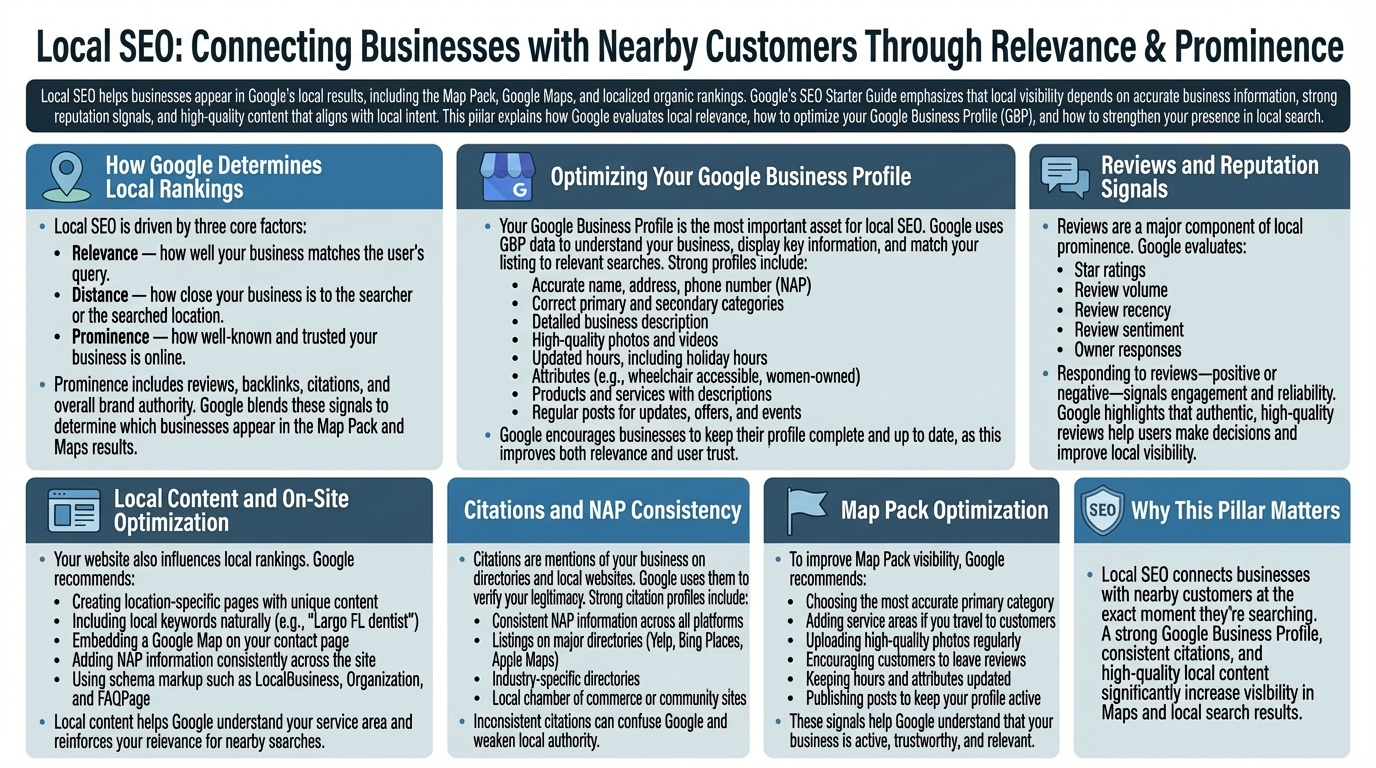
Local SEO helps businesses appear in Google’s local results, including the Map Pack, Google Maps, and localized organic rankings. Google’s SEO Starter Guide emphasizes that local visibility depends on accurate business information, strong reputation signals, and high‑quality content that aligns with local intent. This pillar explains how Google evaluates local relevance, how to optimize your Google Business Profile (GBP), and how to strengthen your presence in local search.
How Google Determines Local Rankings
Local SEO is driven by three core factors:
- Relevance — how well your business matches the user’s query.
- Distance — how close your business is to the searcher or the searched location.
- Prominence — how well‑known and trusted your business is online.
Prominence includes reviews, backlinks, citations, and overall brand authority. Google blends these signals to determine which businesses appear in the Map Pack and Maps results.
Optimizing Your Google Business Profile
Your Google Business Profile is the most important asset for local SEO. Google uses GBP data to understand your business, display key information, and match your listing to relevant searches. Strong profiles include:
- Accurate name, address, phone number (NAP)
- Correct primary and secondary categories
- Detailed business description
- High‑quality photos and videos
- Updated hours, including holiday hours
- Attributes (e.g., wheelchair accessible, women‑owned)
- Products and services with descriptions
- Regular posts for updates, offers, and events
Google encourages businesses to keep their profile complete and up to date, as this improves both relevance and user trust.
Reviews and Reputation Signals
Reviews are a major component of local prominence. Google evaluates:
- Star ratings
- Review volume
- Review recency
- Review sentiment
- Owner responses
Responding to reviews—positive or negative—signals engagement and reliability. Google highlights that authentic, high‑quality reviews help users make decisions and improve local visibility.
Local Content and On‑Site Optimization
Your website also influences local rankings. Google recommends:
- Creating location‑specific pages with unique content
- Including local keywords naturally (e.g., “Largo FL dentist”)
- Embedding a Google Map on your contact page
- Adding NAP information consistently across the site
- Using schema markup such as LocalBusiness, Organization, and FAQPage
Local content helps Google understand your service area and reinforces your relevance for nearby searches.
Citations and NAP Consistency
Citations are mentions of your business on directories and local websites. Google uses them to verify your legitimacy. Strong citation profiles include:
- Consistent NAP information across all platforms
- Listings on major directories (Yelp, Bing Places, Apple Maps)
- Industry‑specific directories
- Local chamber of commerce or community sites
Inconsistent citations can confuse Google and weaken local authority.
Map Pack Optimization
To improve Map Pack visibility, Google recommends:
- Choosing the most accurate primary category
- Adding service areas if you travel to customers
- Uploading high‑quality photos regularly
- Encouraging customers to leave reviews
- Keeping hours and attributes updated
- Publishing posts to keep your profile active
These signals help Google understand that your business is active, trustworthy, and relevant.
Why This Pillar Matters
Local SEO connects businesses with nearby customers at the exact moment they’re searching. A strong Google Business Profile, consistent citations, and high‑quality local content significantly increase visibility in Maps and local search results.