
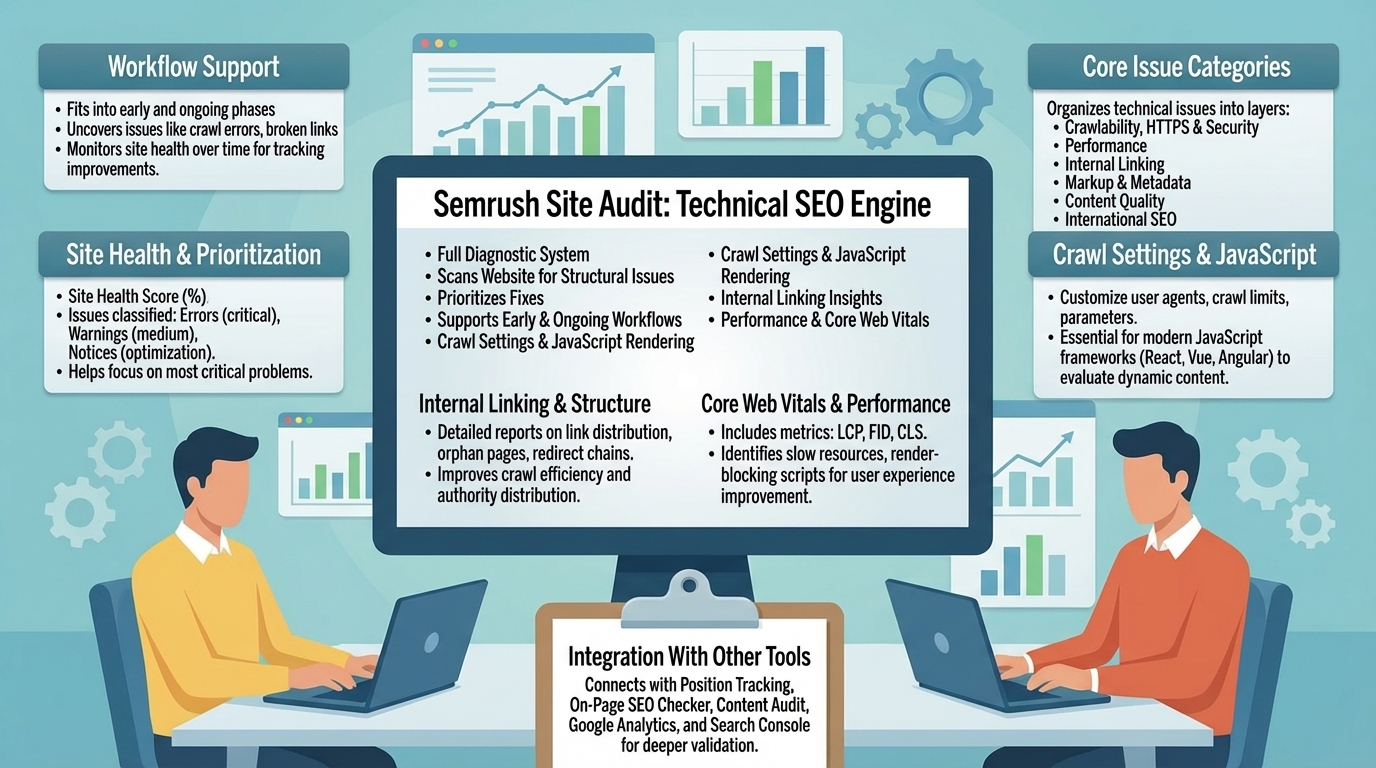
Semrush Site Audit is the platform’s technical SEO engine, designed to scan your website, identify structural issues, and prioritize fixes that improve crawlability, indexation, and overall search performance. It functions as a full diagnostic system, analyzing hundreds of technical factors across site architecture, performance, metadata, internal linking, and security. Because technical SEO directly affects how search engines access and interpret your content, Site Audit is one of the most important components of the Semrush SEO Toolkit.
How Site Audit Supports Technical SEO Workflows
Site Audit fits into the early and ongoing phases of SEO. It helps uncover issues that block ranking potential, such as crawl errors, broken links, duplicate content, and slow pages. It also monitors site health over time, allowing teams to track improvements and catch regressions quickly. The tool is built to support both small sites and large enterprise environments, offering flexible crawl settings, JavaScript rendering, and custom rules for advanced users.
Core Categories of Issues Detected by Site Audit
Semrush organizes technical issues into several key categories, each representing a different layer of site health:
- Crawlability — Robots.txt conflicts, blocked pages, crawl depth issues, and sitemap errors.
- HTTPS & Security — Mixed content, invalid certificates, insecure resources.
- Performance — Slow page load, large resources, Core Web Vitals indicators.
- Internal Linking — Broken links, orphan pages, redirect chains, excessive parameters.
- Markup & Metadata — Missing titles, duplicate meta descriptions, incorrect canonical tags.
- Content Quality — Thin content, duplicate pages, low word count, missing headers.
- International SEO — Incorrect hreflang tags, inconsistent language targeting.
These categories help teams prioritize fixes based on impact and severity.
Site Health Score & Issue Prioritization
Semrush assigns a Site Health Score, a percentage that reflects the overall technical condition of the website. Issues are classified as Errors, Warnings, or Notices, allowing teams to focus on the most critical problems first. Errors typically include broken pages, server issues, and major crawl blocks. Warnings highlight medium‑impact issues such as missing metadata or slow performance. Notices identify optimization opportunities that can improve long‑term SEO stability.
Crawl Settings & JavaScript Rendering
Site Audit allows users to customize crawl behavior, including user agents, crawl limits, URL parameters, and JavaScript rendering. This flexibility is essential for modern websites built on frameworks like React, Vue, or Angular. JavaScript rendering ensures that dynamic content is evaluated accurately, revealing issues that traditional crawlers might miss.
Internal Linking & Site Structure Insights
The tool provides detailed reports on internal linking, including link distribution, orphan pages, and redirect chains. Strong internal linking improves crawl efficiency and distributes authority across the site. Site Audit highlights opportunities to strengthen internal pathways and eliminate structural bottlenecks.
Core Web Vitals & Performance Diagnostics
Semrush includes performance metrics aligned with Google’s Core Web Vitals, such as Largest Contentful Paint (LCP), First Input Delay (FID), and Cumulative Layout Shift (CLS). It also identifies large images, render‑blocking scripts, and inefficient resource loading. These insights help teams improve user experience and meet modern ranking expectations.
Integration With Other Semrush Tools
Site Audit integrates with Position Tracking, On‑Page SEO Checker, and the Content Audit tool. This allows technical insights to flow directly into content optimization and ranking workflows. It also connects with Google Analytics and Search Console for deeper validation.