
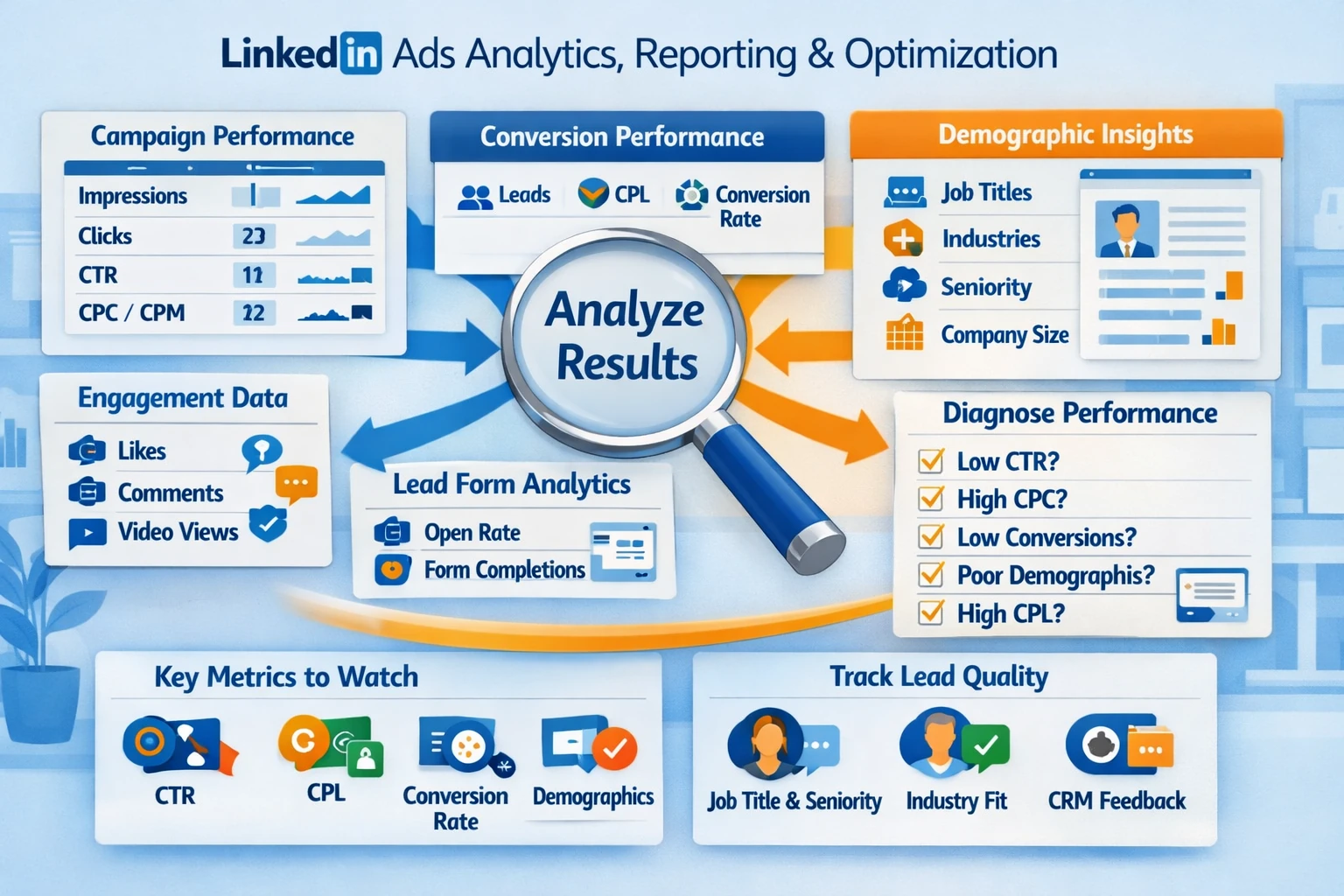
LinkedIn’s analytics system gives B2B advertisers deep visibility into audience quality, engagement behavior, and conversion performance. Because LinkedIn is built on professional identity data, its reporting provides insights unavailable on other platforms—such as job titles, industries, seniority levels, and company sizes of people interacting with your ads. This pillar explains how to read LinkedIn’s analytics, which metrics matter most, how to diagnose performance issues, and how to optimize campaigns for lower CPL and higher lead quality.
Understanding LinkedIn’s Reporting Structure
LinkedIn organizes analytics into several key areas:
- Campaign Performance — impressions, clicks, CTR, CPC, CPM
- Conversion Performance — leads, CPL, conversion rate, post‑click behavior
- Demographic Reporting — job titles, industries, seniority, company size
- Engagement Insights — likes, comments, shares, video views
- Lead Gen Form Analytics — open rate, completion rate, cost per form fill
These layers help you understand not just what happened, but who engaged and why.
Core Metrics That Matter Most
LinkedIn has higher CPCs than other platforms, so the focus is on quality and intent. Key metrics include:
- CTR — measures relevance; strong campaigns typically hit 0.5–1%+.
- CPC — varies by industry; lower CPC often indicates strong creative.
- Lead Form Completion Rate — 10–15% is average; 20–30% is strong.
- CPL — depends on offer and audience; benchmark internally, not globally.
- Conversion Rate — landing pages often convert 5–15%; Lead Gen Forms 15–40%.
- Demographic Fit — ensures the right people are engaging.
Demographic fit is one of LinkedIn’s biggest advantages—no other platform shows job titles and seniority of converters.
Using Demographic Reporting for Optimization
Demographic insights reveal which segments are driving results. You can analyze performance by:
- Job title
- Job function
- Seniority
- Industry
- Company size
- Location
If you see irrelevant roles (e.g., students, interns, unrelated industries), refine targeting or add exclusions. If certain segments outperform, create dedicated campaigns for them.
Diagnosing Performance Issues
LinkedIn performance issues typically fall into one of three categories:
- Low CTR — creative or messaging mismatch
- High CPC — overly narrow targeting or weak creative
- Low conversion rate — landing page friction or misaligned offer
- High CPL — combination of the above
- Poor demographic fit — targeting too broad or not layered correctly
Fixing the root cause requires matching the symptom to the correct lever.
Optimizing Creative Based on Analytics
Creative is the biggest driver of cost efficiency. Improve performance by:
- Testing new hooks (stats, questions, insights)
- Using Document Ads for value‑first content
- Switching from single image to video or carousel
- Refreshing creative every 4–6 weeks
- Aligning creative with funnel stage
LinkedIn rewards ads that generate early engagement, so strong hooks matter.
Optimizing Targeting Based on Analytics
Refine targeting by:
- Expanding from Job Title → Job Function → Skills
- Excluding irrelevant industries or seniorities
- Creating separate campaigns for high‑performing segments
- Using retargeting for BOF offers
- Using lookalikes for TOF scale
Targeting should evolve as you gather more demographic data.
Optimizing Offers & Landing Pages
If conversion rates are low:
- Simplify the landing page
- Shorten the form
- Strengthen the offer value
- Use Lead Gen Forms instead of landing pages
- Add social proof or case studies
Offer quality is often the biggest driver of CPL.
Scaling Based on Data
Scale only when:
- CTR is strong
- Demographic fit is high
- CPL is stable
- Lead quality is validated by sales
Scale by increasing budgets gradually, expanding audiences, or adding new creative formats.