
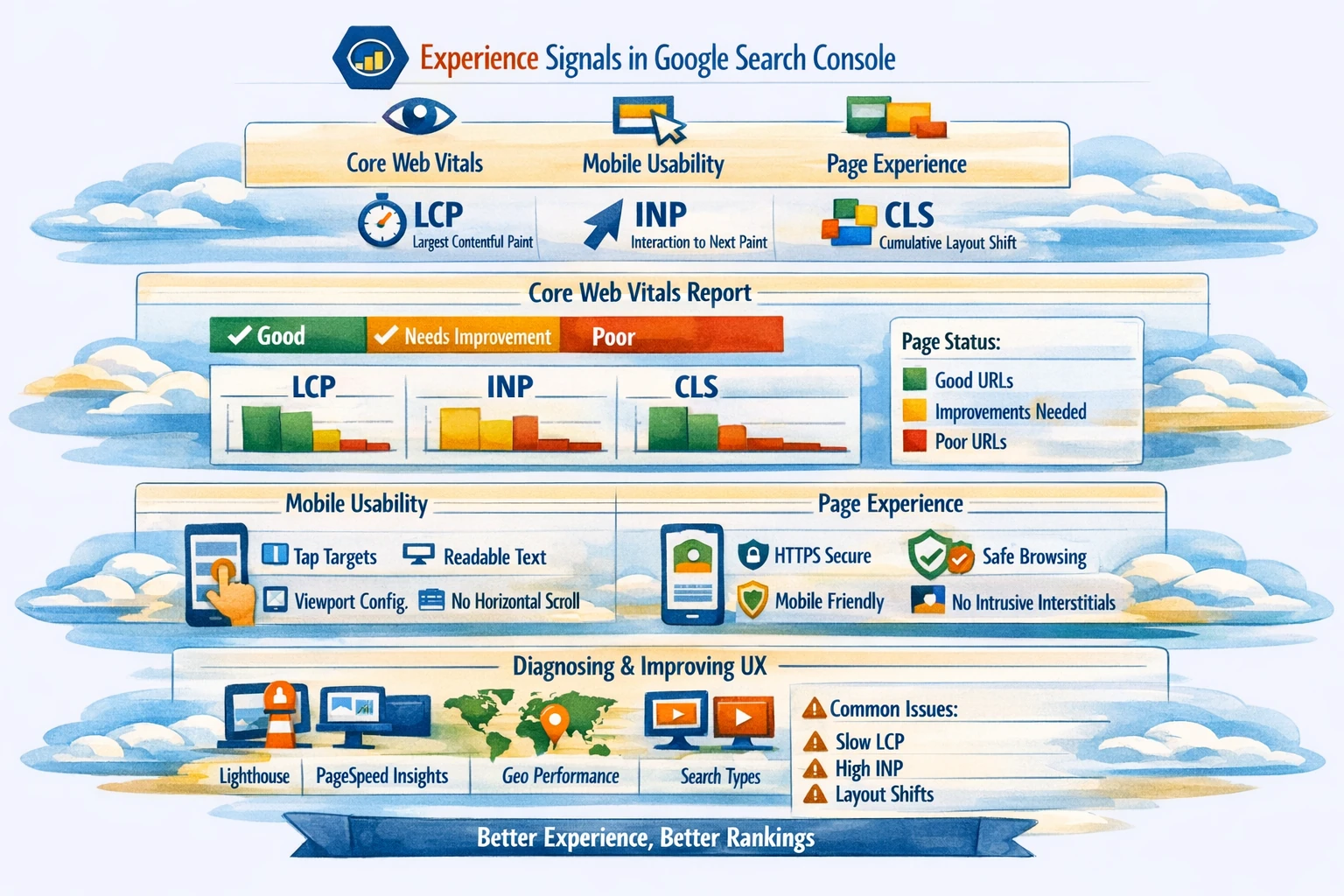
Experience signals in Google Search Console measure how real users experience your site. These signals—Core Web Vitals, mobile usability, and page experience—directly influence visibility, rankings, and user satisfaction. Google’s Core Web Vitals report groups URLs by performance status and evaluates them using real‑world field data, focusing on three metrics: Largest Contentful Paint (LCP), Interaction to Next Paint (INP), and Cumulative Layout Shift (CLS). A URL group’s status is determined by its worst-performing metric, and URLs without enough data are omitted from the report.
Core Web Vitals: The Foundation of Page Experience
Core Web Vitals measure how users actually experience your site. They reflect loading performance, interactivity, and visual stability—three pillars of modern UX. Google compares your site’s metrics against benchmarks and competing pages targeting similar queries.
The three Core Web Vitals are:
- Largest Contentful Paint (LCP) — Measures loading speed. Good LCP is under 2.5 seconds.
- Interaction to Next Paint (INP) — Measures responsiveness to user interactions.
- Cumulative Layout Shift (CLS) — Measures visual stability and unexpected layout movement.
These metrics are based on real user data, not lab simulations, making them highly reliable indicators of actual performance.
How GSC Reports Core Web Vitals
The Core Web Vitals report groups URLs by:
- Status: Good, Needs improvement, Poor
- Metric type: LCP, INP, CLS
- URL groups: clusters of similar pages
A URL group’s status is determined by its worst metric. If a group lacks enough field data for LCP and CLS, it is excluded from the report.
This grouping helps identify systemic issues across templates, CMS components, or page types.
Mobile Usability & Mobile Experience
Mobile usability remains a critical ranking and UX factor. GSC evaluates:
- Tap target spacing
- Text readability
- Viewport configuration
- Content wider than screen
- Mobile rendering issues
Although Google has shifted away from the standalone “Mobile Usability” report, mobile experience remains central to Core Web Vitals and overall page experience.
Page Experience Signals
Page experience is a holistic evaluation that includes:
- Core Web Vitals
- HTTPS usage
- Mobile friendliness
- Safe browsing
- Absence of intrusive interstitials
While Google no longer uses Page Experience as a direct ranking “score,” these signals still influence visibility through user behavior, engagement, and SERP competitiveness.
How Core Web Vitals Affect SEO
Core Web Vitals became part of Google’s ranking systems after the Page Experience Update. They influence:
- Competitive rankings
- User satisfaction
- Bounce and engagement metrics
- Conversion rates
- Crawl efficiency
Improving Web Vitals strengthens both SEO and business outcomes.
Diagnosing & Improving Experience Signals
Common issues include:
- Slow server response (affects LCP)
- Heavy JavaScript (affects INP)
- Unoptimized images (affects LCP)
- Ads or dynamic elements shifting layout (affects CLS)
- Poor mobile layout or typography
Tools like Lighthouse, PageSpeed Insights, and Chrome UX Report complement GSC’s field data.
Why This Pillar Matters
Experience signals determine:
- How users perceive your site
- How competitive your pages are in SERPs
- How well your site performs on mobile
- How efficiently Google crawls and indexes your content
- How likely users are to convert
Strong Core Web Vitals and mobile experience create a durable SEO advantage.