
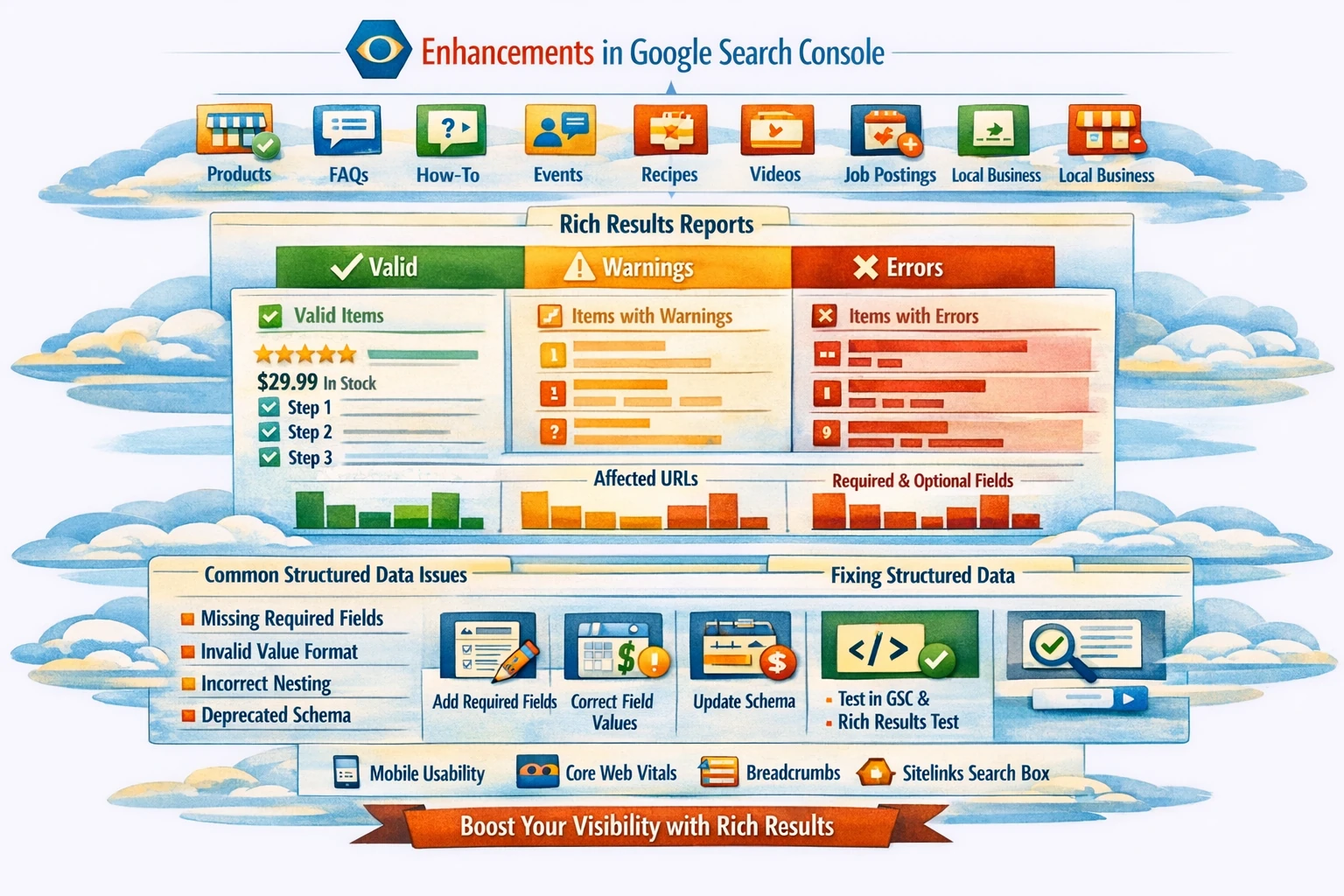
Enhancements in Google Search Console provide visibility into how structured data is detected, validated, and rendered as rich results in Google Search. These reports help you understand which schema types Google recognizes, whether they contain errors or warnings, and how eligible they are for enhanced SERP features. Structured data is a standardized way of marking up content so search engines can understand it more effectively, improving visibility and click‑through rates.
How GSC Detects Structured Data
Google Search Console scans your site for structured data types such as:
- Products
- FAQs
- How‑to
- Breadcrumbs
- Events
- Recipes
- Articles
- Videos
- Job postings
- Local business markup
When GSC detects a supported schema type, it generates a dedicated Enhancements report. These reports show:
- Valid items
- Items with warnings
- Items with errors
- Affected URLs
- Required vs. optional properties
Structured data must follow schema.org standards and Google’s implementation guidelines to qualify for rich results.
Rich Result Reports
Rich result reports show which structured data types are eligible for enhanced SERP features. Google provides a separate report for each type it detects on your site. These reports are not exhaustive; they show a sample of detected items to help you assess quality. If a URL is missing from the report, the URL Inspection tool can confirm whether structured data is present.
Rich results can include:
- Star ratings
- Price and availability
- FAQ dropdowns
- How‑to steps
- Recipe cards
- Event details
- Video enhancements
These features increase SERP visibility and improve CTR.
Common Structured Data Issues
GSC flags several types of problems:
- Missing required fields — prevents eligibility for rich results
- Invalid field values — incorrect formats or unsupported types
- Incorrect nesting — schema placed in the wrong hierarchy
- Inconsistent markup — mismatched data between schema and visible content
- Deprecated schema types — outdated or unsupported markup
Errors block rich results entirely, while warnings indicate optional improvements.
Fixing Structured Data Errors
Fixing structured data issues typically involves:
- Adding missing required properties
- Correcting field formats (e.g., dates, URLs, price formats)
- Ensuring schema matches visible content
- Updating outdated schema types
- Validating with Google’s Rich Results Test
Structured data errors can prevent pages from showing rich snippets, reducing visibility and CTR.
Enhancements Beyond Schema
Some enhancements are not strictly tied to structured data, including:
- Mobile usability
- Core Web Vitals
- Page experience
- Breadcrumbs (auto‑detected)
- Sitelinks search box (auto‑detected)
These signals influence how your site appears in search and how users interact with it.
Why Enhancements Matter
Enhancements determine:
- Eligibility for rich results
- Visibility in competitive SERPs
- CTR improvements
- Content discoverability
- Structured data health
- How Google interprets your content
A strong structured data implementation increases your search footprint and improves user engagement.