
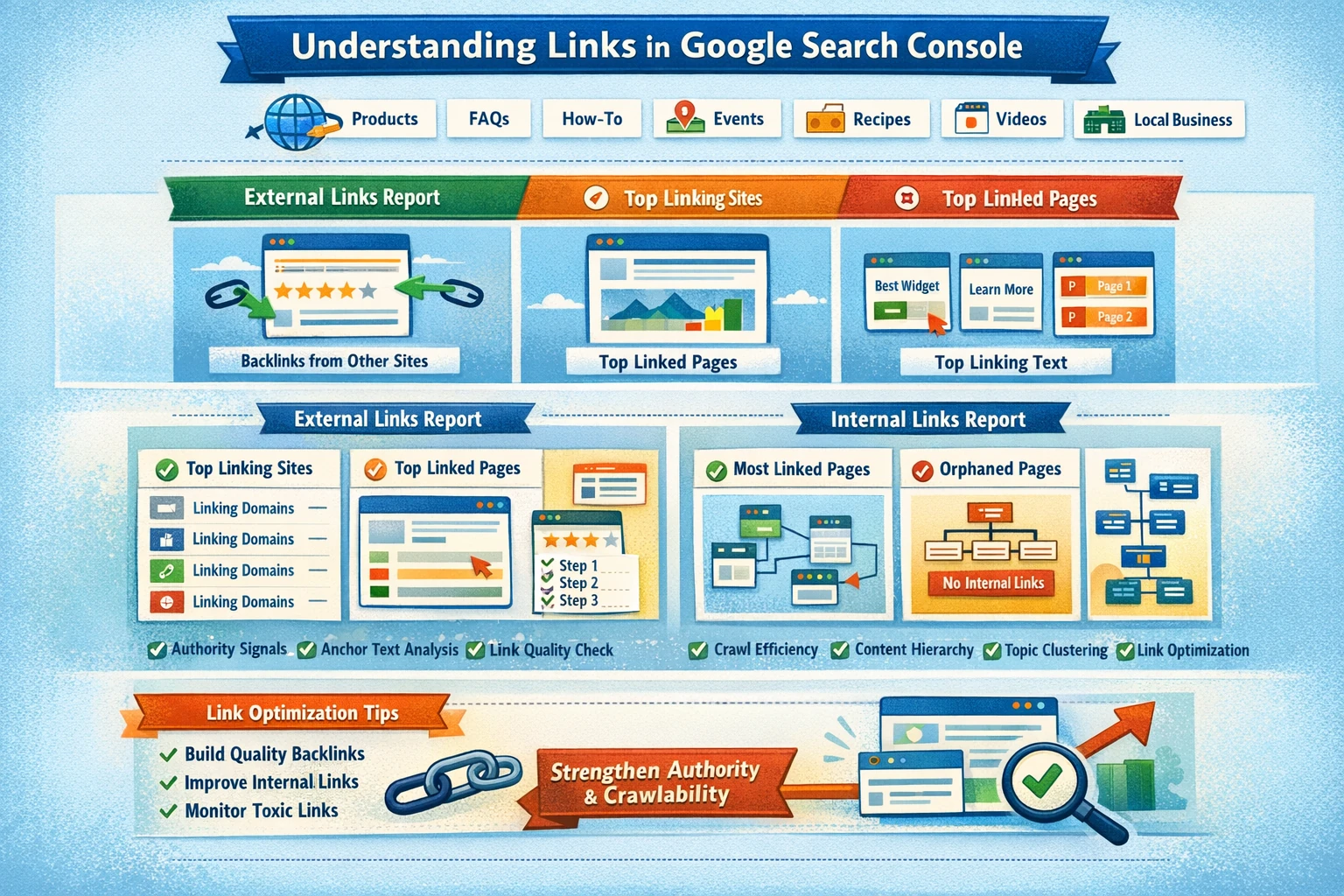
Google Search Console’s Links report is the central place where Google reveals how it understands your site’s backlink profile and internal linking structure. Backlinks remain one of the strongest signals of authority, while internal links shape how Google crawls, distributes PageRank, and interprets content hierarchy. This pillar explains how GSC reports link data, how to interpret it, and how to use it to strengthen both authority and crawlability.
How GSC Measures Links
The Links report shows two major categories:
- External links (backlinks) — links from other websites pointing to your pages.
- Internal links — links within your own site pointing to other pages.
Backlinks are treated as “votes of confidence,” helping Google evaluate authority and relevance. Internal links help Google understand site structure and discover content.
GSC groups pages by canonical URL, meaning parameters and duplicates are normalized before counting. Duplicate links from the same source URL to the same target URL are combined. Tables are limited to 1,000 rows, so the report is not a complete backlink index.
External Links: Authority & Trust Signals
The external links section includes:
- Top linking sites — domains linking to you most frequently.
- Top linked pages — your pages receiving the most backlinks.
- Top linking text — anchor text used by external sites.
These signals help identify:
- Which pages attract natural links
- Which domains trust your content
- Whether anchor text aligns with your topical relevance
- Potential spam or low‑quality links
Backlinks from reputable, relevant sites may help your content rank higher in search results.
Internal Links: Structure, Hierarchy & Crawl Flow
Internal links show how your own site distributes authority. GSC reveals:
- Pages with the most internal links
- Pages with few or no internal links
- Navigation patterns Googlebot follows
- Structural gaps in your content hierarchy
Internal linking helps:
- Google discover new pages
- Reinforce topical clusters
- Pass authority to important URLs
- Improve crawl efficiency
A strong internal linking system is essential for large sites, ecommerce catalogs, and content hubs.
How to Interpret Link Data for SEO
The Links report helps diagnose several strategic issues:
- High‑value pages with few backlinks → outreach or content promotion opportunity.
- Pages with many backlinks but low rankings → content quality or technical issues.
- Pages with few internal links → weak crawlability or orphaned content.
- Anchor text mismatches → unclear topical relevance.
- Sudden backlink spikes → possible spam or negative SEO.
Because GSC’s link index is not exhaustive, it should be used alongside other link intelligence tools—but it remains the most authoritative source for what Google itself sees.
Strengthening Backlink Signals
Use GSC to identify:
- Pages naturally attracting links → replicate their content patterns.
- Linking domains → build deeper relationships or partnerships.
- Missing anchor text relevance → adjust content titles and internal anchors.
- Toxic or irrelevant links → monitor for spam patterns.
Backlinks remain a long‑term authority signal, and GSC provides the clearest view of how Google interprets them.
Strengthening Internal Linking Signals
Internal linking improvements often produce immediate SEO gains:
- Add contextual links to important pages.
- Ensure every page has at least one internal link.
- Use descriptive anchor text.
- Strengthen category → subcategory → article hierarchy.
- Link new content from high‑authority pages.
Internal links are one of the most controllable ranking levers.
Why This Pillar Matters
Links determine:
- How Google discovers your content
- How authority flows through your site
- Which pages rank competitively
- How Google interprets your topical structure
- How resilient your site is to algorithm changes
A strong link architecture—both external and internal—creates a durable SEO foundation.