
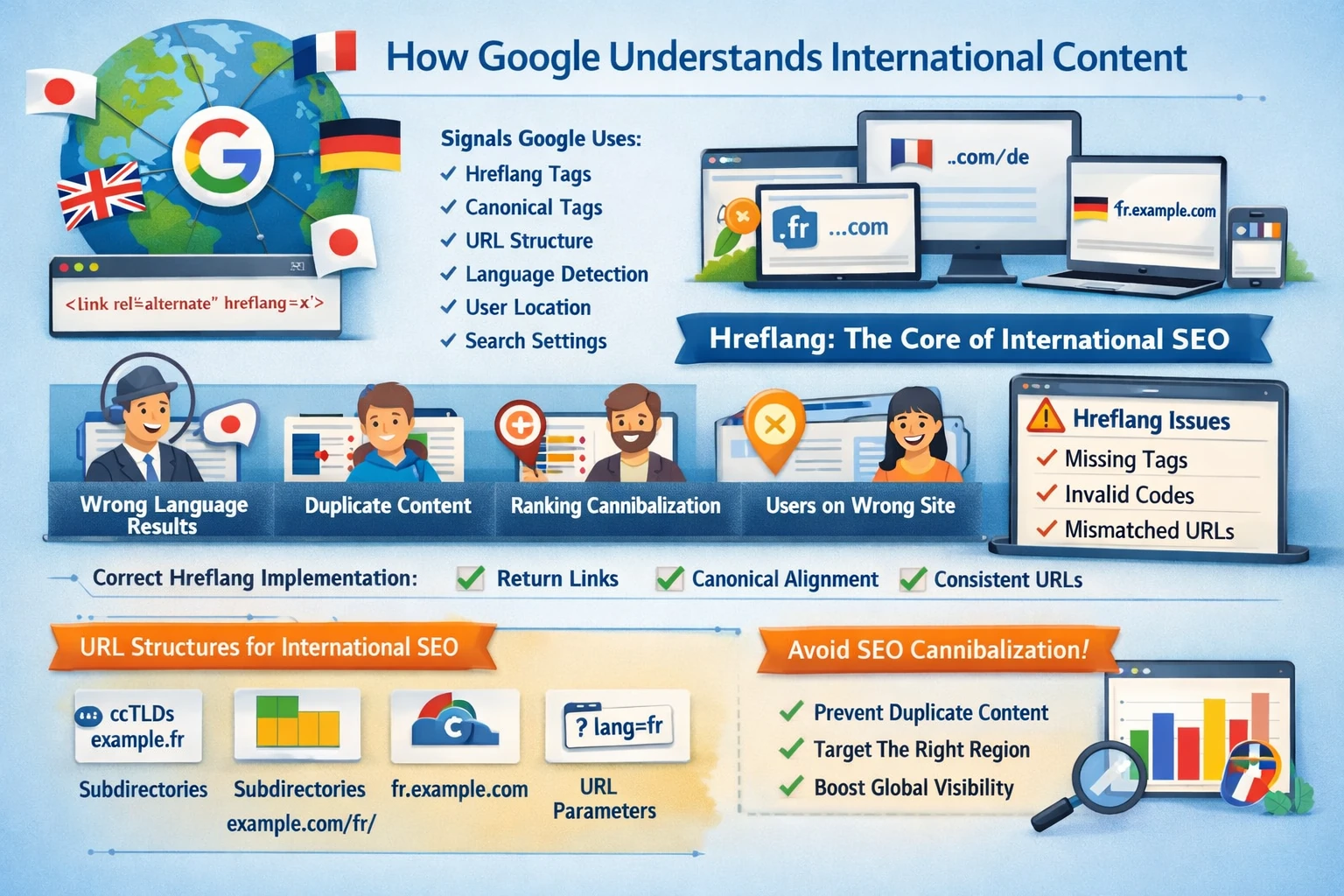
International SEO ensures that Google serves the correct language and regional version of your content to the right users. Google Search Console plays a central role in diagnosing hreflang issues, validating international configurations, and understanding how Google interprets your multilingual or multi‑regional architecture. This pillar explains how hreflang works, how GSC reports errors, how to structure international sites, and how to avoid the most common pitfalls that cause ranking cannibalization across languages and regions.
How Google Understands International Content
Google uses several signals to determine which version of a page to show:
- hreflang annotations
- Canonical tags
- URL structure
- Server location (less important today)
- Language detection from visible content
- User location and search settings
Among these, hreflang is the strongest explicit signal for language and regional targeting.
Hreflang: The Core of International SEO
Hreflang tells Google which language or region a page is intended for. It prevents:
- Wrong‑language pages appearing in search
- Duplicate content issues across translations
- Ranking cannibalization between regional variants
- Users landing on the wrong version of your site
A correct hreflang implementation includes:
- A self‑referencing hreflang tag
- Reciprocal (return) tags
- Canonical alignment
- Consistent URL mapping across all languages
Formats include:
- HTML <link rel=”alternate” hreflang=”x”>
- HTTP headers
- XML sitemaps (recommended for large sites)
URL Structures for International SEO
Google supports multiple international architectures:
- ccTLDs — example.fr, example.de
- Subdirectories — example.com/fr/, example.com/de/
- Subdomains — fr.example.com, de.example.com
- URL parameters — ?lang=fr (not recommended)
Each structure has tradeoffs:
- ccTLDs → strongest geo‑targeting, highest maintenance
- Subdirectories → easiest to manage, strongest consolidated authority
- Subdomains → flexible but weaker authority consolidation
- Parameters → discouraged due to indexing and duplication issues
GSC helps validate these structures through indexing and hreflang diagnostics.
🛠️ International Targeting Report (Legacy but Still Useful)
Although Google deprecated the “International Targeting” report for some properties, many sites still see:
- Language errors — missing return tags, invalid codes
- Country targeting — for sites using Search Console’s geo‑targeting (subdirectories/subdomains only)
Even when the report is unavailable, hreflang issues still appear in:
- URL Inspection
- Page Indexing
- Sitemaps
- Rich Results Test
- Third‑party crawlers
Diagnosing Hreflang Issues in GSC
Common problems include:
- Missing return tags
- Incorrect language codes (e.g., “en-UK” instead of “en-GB”)
- Canonical pointing to a different language
- Hreflang pointing to non‑indexable URLs
- Mixed HTTP/HTTPS versions
- Inconsistent mapping across languages
These issues cause Google to ignore hreflang entirely.
Preventing International SEO Cannibalization
Without proper hreflang, Google may:
- Rank the wrong language version
- Swap regional pages (e.g., UK vs. US)
- Treat translations as duplicates
- Split link equity across versions
A clean hreflang system ensures each version ranks only where intended.
Measuring International Performance in GSC
The Performance report allows segmentation by:
- Country
- Language (via query patterns)
- Device
- Page
- Search type
This helps identify:
- Markets with rising demand
- Regions where visibility is weak
- Pages ranking in the wrong country
- Opportunities for localized content expansion
International SEO is as much about analytics as it is about markup.
Why This Pillar Matters
International targeting determines:
- Whether users see the correct language version
- Whether regional pages compete with each other
- How efficiently Google indexes multilingual content
- How well your site performs globally
- Whether your international architecture scales cleanly
A strong hreflang and international strategy prevents duplication, improves relevance, and maximizes global search visibility.