
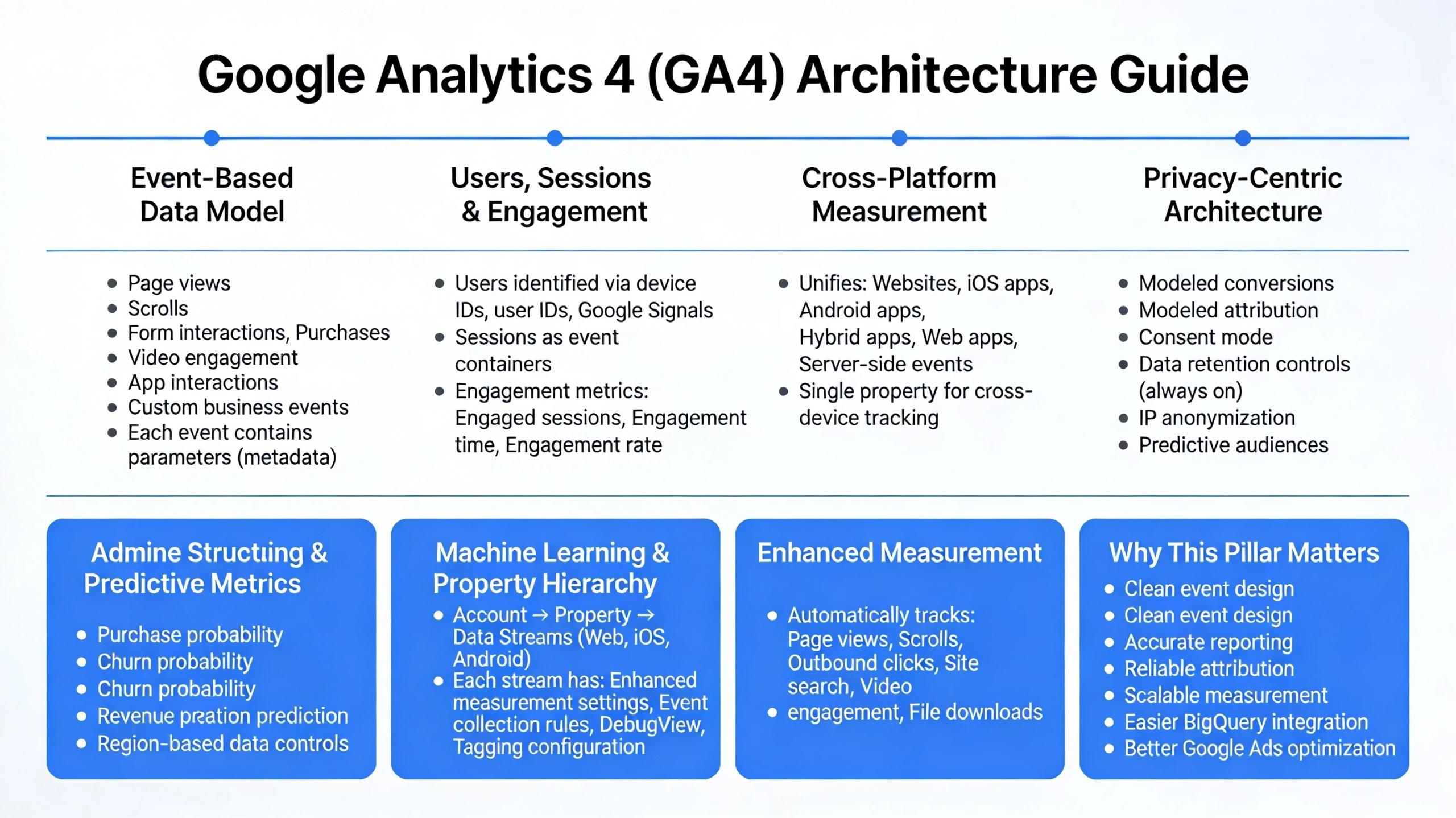
Google Analytics 4 (GA4) is built on a fundamentally different architecture than Universal Analytics (UA). Instead of sessions and pageviews as the core measurement units, GA4 uses an event‑based data model designed for cross‑platform tracking, privacy‑centric measurement, and machine‑learning‑driven insights. This pillar establishes the foundation you need before diving into events, conversions, audiences, attribution, or BigQuery.
The Event‑Based Data Model
GA4 treats everything as an event:
- Page views
- Scrolls
- Clicks
- Form interactions
- Purchases
- Video engagement
- App interactions
- Custom business events
Each event can contain parameters, which act like metadata describing the event. This structure is more flexible, scalable, and future‑proof than UA’s rigid categories, actions, and labels.
Why this matters: You can model any business process—lead generation, SaaS onboarding, ecommerce, multi‑step funnels—without being constrained by predefined schemas.
Users, Sessions & Engagement
GA4 still tracks users and sessions, but with new definitions:
- Users are identified through device IDs, user IDs, and Google Signals.
- Sessions are event containers, not the primary measurement unit.
- Engagement replaces bounce rate as a more meaningful metric.
GA4 introduces:
- Engaged sessions
- Engagement time
- Engagement rate
These metrics reflect modern user behavior across apps, mobile, and multi‑device journeys.
Cross‑Platform Measurement
GA4 is designed to unify:
- Websites
- iOS apps
- Android apps
- Hybrid apps
- Web apps
- Server‑side events
Data streams feed into a single property, allowing you to track a user across devices and platforms.
This is critical for: SaaS products, mobile apps, ecommerce, and multi‑touch customer journeys.
Privacy‑Centric Architecture
GA4 was built for a world without third‑party cookies. Key features include:
- Modeled conversions
- Modeled attribution
- Consent mode
- Data retention controls
- IP anonymization (always on)
- Region‑based data controls
GA4 fills gaps using machine learning when user‑level data is unavailable.
Machine Learning & Predictive Metrics
GA4 includes predictive capabilities such as:
- Purchase probability
- Churn probability
- Revenue prediction
- Predictive audiences
These unlock advanced remarketing and lifecycle automation when connected to Google Ads.
Admin Structure & Property Hierarchy
GA4 uses a simplified hierarchy:
- Account
- Property
- Data Streams (Web, iOS, Android)
Each stream has its own:
- Enhanced measurement settings
- Event collection rules
- DebugView
- Tagging configuration
This structure is cleaner and more scalable than UA’s views and filters.
Enhanced Measurement
GA4 automatically tracks:
- Page views
- Scrolls
- Outbound clicks
- Site search
- Video engagement
- File downloads
This reduces the need for manual tagging and speeds up implementation.
Why This Pillar Matters
Understanding GA4’s architecture ensures:
- Clean event design
- Accurate reporting
- Reliable attribution
- Scalable measurement
- Easier BigQuery integration
- Better Google Ads optimization
Everything else—events, conversions, audiences, funnels, attribution—depends on this foundation.