
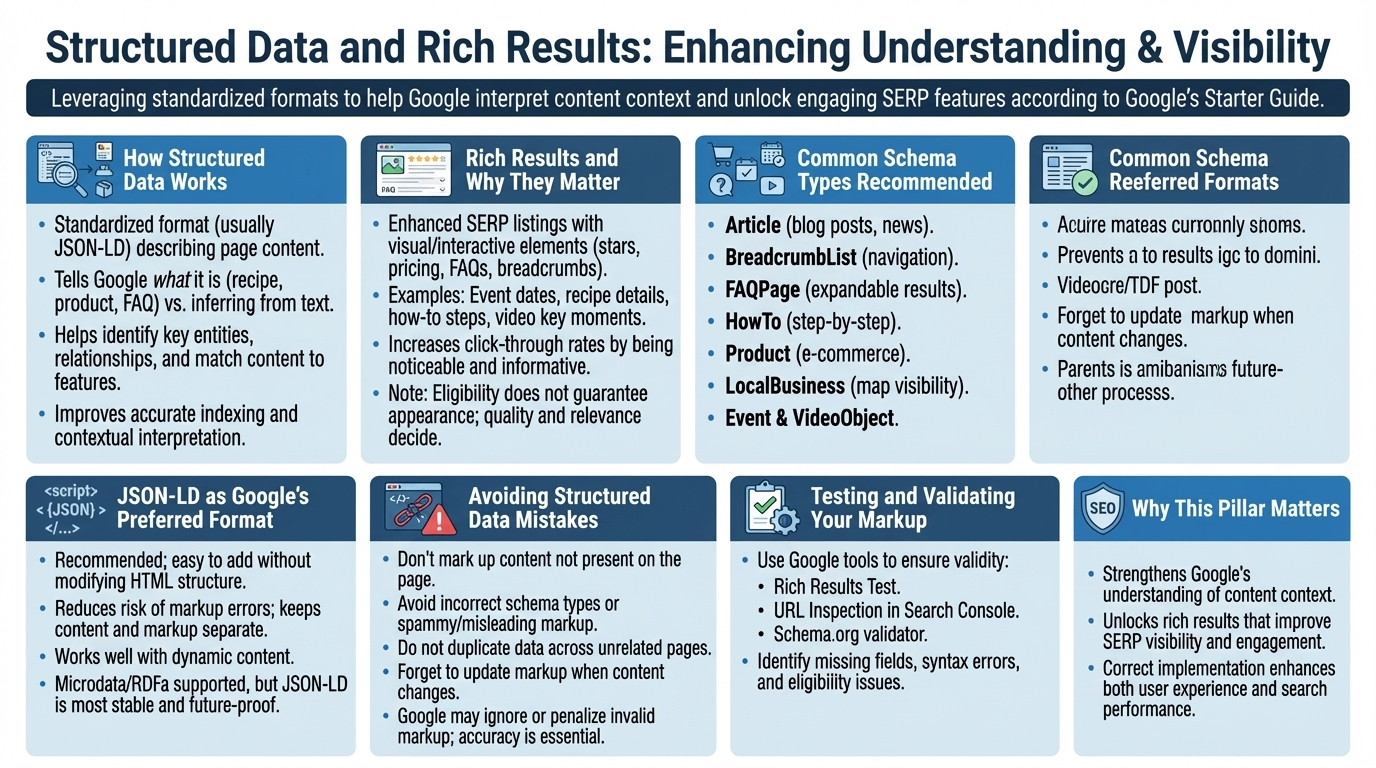
Structured data helps Google understand your content more precisely and unlocks enhanced search features known as rich results. Google’s SEO Starter Guide emphasizes that structured data does not guarantee higher rankings, but it does help Google interpret meaning, relationships, and context—making your pages eligible for richer, more engaging SERP displays. This pillar explains how structured data works, why it matters, and how to implement it correctly.
How Structured Data Helps Google Understand Your Content
Structured data is a standardized format (usually JSON‑LD) that describes the content on your page. It tells Google what your page is—a recipe, product, FAQ, event, article, or review—rather than leaving Google to infer meaning from text alone. Google uses this information to:
- Identify key entities
- Understand relationships between elements
- Match content to relevant search features
- Provide more accurate indexing
- Improve contextual interpretation
This clarity helps Google deliver better results to users and improves your content’s visibility in SERPs.
Rich Results and Why They Matter
Rich results are enhanced search listings that include additional visual or interactive elements. Examples include:
- Review stars
- Product pricing and availability
- FAQ dropdowns
- Breadcrumbs
- Event dates
- Recipe images and cooking times
- How‑to steps
- Video key moments
These enhancements increase click‑through rates by making your listing more noticeable and informative. Google stresses that structured data only makes you eligible for rich results—quality, relevance, and compliance still determine whether they appear.
Common Schema Types Recommended by Google
Google supports many schema types, but several are especially impactful:
- Article — for blog posts, news, and guides
- BreadcrumbList — improves navigation clarity
- FAQPage — enables expandable FAQ rich results
- HowTo — shows step‑by‑step instructions
- Product — for e‑commerce listings
- LocalBusiness — for local SEO and map visibility
- Event — for concerts, classes, and activities
- VideoObject — for video indexing and key moments
Using the correct schema type ensures Google interprets your content accurately.
JSON‑LD as Google’s Preferred Format
Google recommends JSON‑LD because it:
- Is easy to add without modifying HTML structure
- Reduces risk of markup errors
- Keeps content and markup separate
- Works well with dynamic content
Microdata and RDFa are still supported, but JSON‑LD is the most stable and future‑proof approach.
Avoiding Structured Data Mistakes
Google warns against several common errors:
- Marking up content that does not exist on the page
- Using schema types incorrectly
- Adding spammy or misleading markup
- Duplicating structured data across unrelated pages
- Forgetting to update markup when content changes
Google may ignore or penalize invalid markup, so accuracy is essential.
Testing and Validating Your Markup
Google provides tools to ensure your structured data is valid:
- Rich Results Test
- URL Inspection in Search Console
- Schema.org validator
These tools help identify missing fields, syntax errors, and eligibility issues.
Why This Pillar Matters
Structured data strengthens Google’s understanding of your content and unlocks rich results that improve visibility and engagement. When implemented correctly, it enhances both user experience and search performance.